



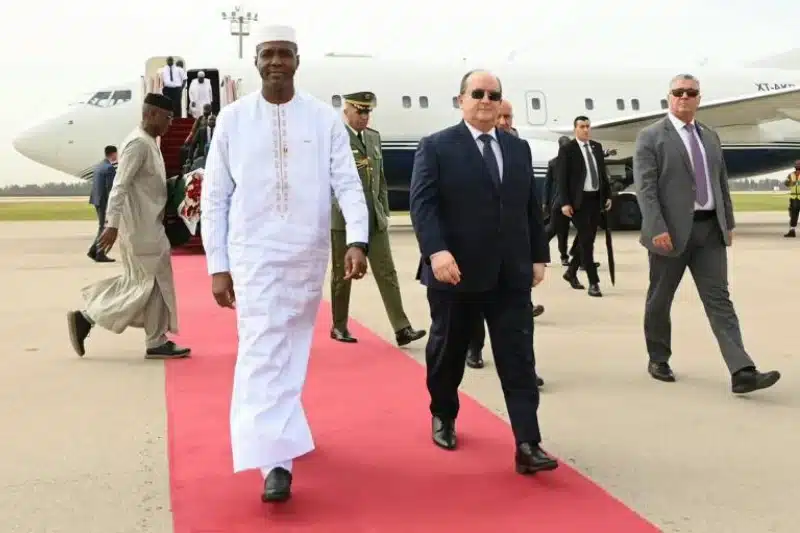

Sifi Ghrieb touched down in Bamako on Monday carrying a handwritten message from Algiers, arriving in a capital where fuel queues stretch for blocks and generators hum through the night.
The Algerian prime minister’s visit is meant to project a diplomatic thaw. The city around him tells a different story.
That freeze only began to thaw this year. Ambassadors returned to their posts on 10 July, and both nations reopened their skies the following day.
A phone call between Ghrieb and his Malian counterpart, General Abdoulaye Maïga, on 9 August set the tone for what followed. Maïga then travelled to Algiers on 24 August, where he met President Abdelmadjid Tebboune and spoke of rebuilding a shared regional space.
The restoration of ambassadors marked the clearest sign yet that Algeria-Mali relations were moving away from confrontation and back toward diplomatic engagement.
Monday’s trip is the reciprocal gesture, and it carries more weight than a routine diplomatic call. Ghrieb is delivering a message from Tebboune to Mali’s military ruler, General Assimi Goïta, according to Middle East Online, giving the visit a level of political heft that photo-opportunity diplomacy rarely has.
Here is where Algeria-Mali relations meet a harder reality. Mali has been under a fuel blockade since September 2025, imposed by the al-Qaeda-linked group JNIM, which has burned more than 300 tankers on the roads that carry roughly 95 percent of the country’s imported fuel. Western embassies have urged their citizens to leave. The blockade eased briefly in early 2026 before JNIM reinstated it in April, the same month the drone incident soured relations with Algiers even further.
So the question worth asking is not whether Algeria and Mali can shake hands again. It is what Algeria actually gains from mending Algeria-Mali relations while Bamako’s own approach roads remain a battlefield.
The answer lies south of the Sahara. Algeria’s rapprochement with Mali comes as Algiers reassesses its broader approach to the Sahel, where its influence has faced growing challenges from emerging regional powers and shifting alliances, according to Middle East Online’s reporting. Put simply, Algeria’s influence in the Sahel has weakened as military governments across the region have forged new alliances and challenged older regional power structures.
That calculation cuts both ways. Mali is landlocked. It cannot afford to lose Algeria as a northern outlet indefinitely, no matter how loudly the junta talks about sovereignty and Russian partnership. Algeria, in turn, cannot secure its southern border without some working relationship with whoever controls Bamako, blockade or no blockade.
Monday’s talks are expected to cover regional security and economic cooperation, though no agreement had been announced as this article went to press. That is not unusual. Diplomatic resets rarely produce signed documents on day one. They produce photographs, statements about shared history, and a slow accumulation of smaller agreements that only add up months later.
Yet the future of Algeria-Mali relations will depend as much on security conditions in northern Mali as on the goodwill expressed during official visits.
What makes this particular reset worth watching is the contrast sitting underneath it. A prime minister lands with a message about peace and cooperation, in a capital that cannot reliably keep its streetlights on. Algeria-Mali relations may be warming on paper, but lasting progress will depend on whether diplomatic engagement can translate into greater stability.


