



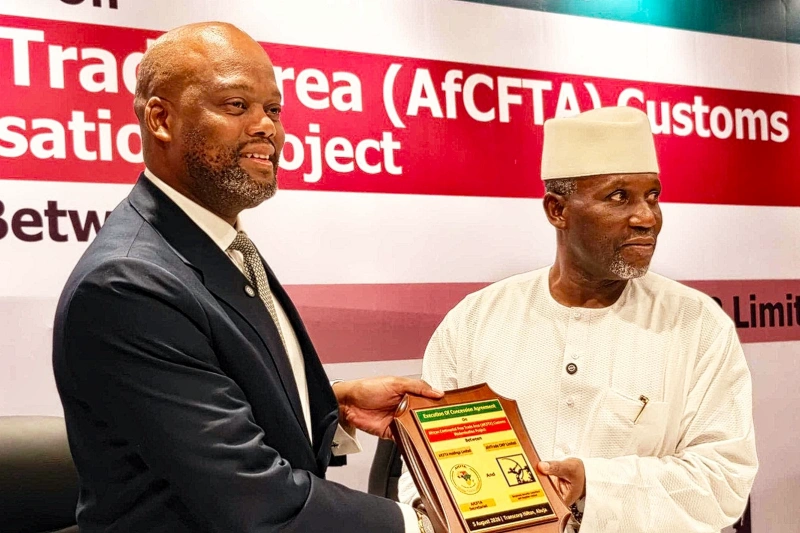

The African Continental Free Trade Area Secretariat has signed a 20-year, $3.1 billion concession agreement with Bergmans Security Consultants and Supplies Limited to launch the AfCFTA customs modernisation project across the continent.
The agreement was formally executed in Abuja this week, at a ceremony held at the Transcorp Hilton Hotel, as reported by Vanguard. AfCFTA Secretary-General Wamkele Mene signed on behalf of the continental trade bloc. Alhaji Saleh Ahmadu, Chairman of Bergmans, signed for the company, according to Punch.
The deal was executed between AfCFTA Holdings Limited, the AfCFTA Secretariat, and AfriTrade CMP Limited, a subsidiary of Bergmans, Leadership newspaper reported. It formally kicks off the AfCFTA customs modernisation project, weeks after both parties signed a Memorandum of Understanding in Lagos on 1 July, on the sidelines of the Digital Trade Forum 2026, as confirmed by allAfrica.
Under the concession, Bergmans will finance the entire $3.1 billion project and deploy digital and physical infrastructure at border posts across participating African countries, Punch reported. This includes non-intrusive inspection technology, integrated data centres and multilingual customs portals built to support the continent’s official languages, according to Vanguard.
Mene said the AfCFTA customs modernisation project was inspired by results already achieved in Nigeria, where Bergmans’ subsidiary, Trade Modernisation Project Limited, holds the concession for the Nigeria Customs Service Modernisation Project. He said the Nigerian rollout lifted customs revenue by 90.4 per cent, as reported by CNBC Africa. Vanguard separately quoted the company as saying revenue inflow had more than tripled since the platform went live.
Manual customs systems remain widespread across the continent, and Mene said this contributes to corruption, revenue leakages and both under-invoicing and over-invoicing of goods, according to Reuters. The AfCFTA customs modernisation project is designed to replace these paper-based processes with real-time digital tracking of cargo moving between borders.
Fifty African Union member states have now ratified the AfCFTA agreement, Mene said, as reported by Reuters. Intra-African trade reached $220 billion in 2024, up 12.5 per cent on the previous year, yet it still accounts for only around 15 per cent of the continent’s total commerce. That compares with roughly 60 per cent in Europe and 50 per cent in Asia, according to The High Street Journal.
The AfCFTA groups 55 African Union member states and eight Regional Economic Communities, forming a market of about 1.3 billion people with a combined gross domestic product of roughly $3.4 trillion, Leadership reported. The secretariat is headquartered in Accra, Ghana.
Ahmadu said the concession marked the start of a long-term investment that would reshape customs operations across participating states, Punch reported. He added that Bergmans was ready to begin deploying capital immediately. The continental platform will initially go live in at least six African countries before wider expansion, Brand Communicator reported, citing Ahmadu.
Officials have framed the AfCFTA customs modernisation project as central to the bloc’s target of doubling intra-African trade by 2035. Different countries currently run different customs systems entirely. Nigeria has moved through several platforms, from the Automated System for Customs Data to NICIS and now its home-grown B’Odogwu system, while Ghana, Cameroon, Uganda and Morocco operate their own separate systems, Comptroller-General of the Nigeria Customs Service Bashir Adewale Adeniyi said when the MoU was signed in July, as reported by BusinessDay.
Mene said the initiative would be financed entirely through private capital under the long-term concession, meaning it would not add to the budgets of national governments, The Nation reported. He described the model as one already tested successfully in Nigeria and now being extended across the wider bloc.
Bergmans describes itself as a security consulting and technology solutions firm that has worked with government and intelligence-linked clients, Leadership reported. Its group managing director, Dr Jummai Umar-Ajijola, said at the earlier MoU signing that the firm’s approach rests on private-sector financing structured through public-private partnerships.
For businesses trading across African borders, the practical test of the AfCFTA customs modernisation project will come once the first phase of countries begin using the new digital infrastructure. Officials have pointed to faster cargo clearance and better data capture as the immediate goals, with the wider ambition of a single, interoperable customs system tying the continent’s trade corridors together over the next two decades.


