




Mahama says ECOWAS integration still belongs to presidents. The bloc promised a citizen-owned community by 2020. Here is what the record shows.
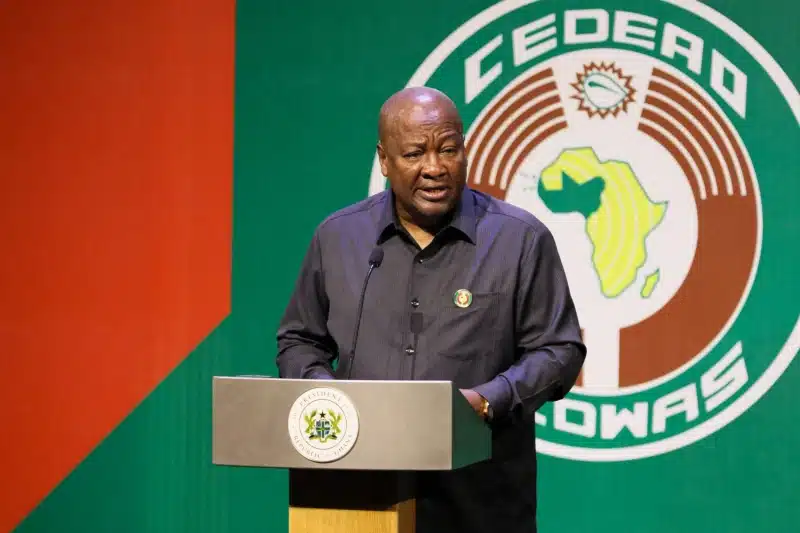
Move goods from Freetown to Accra, President John Mahama told regional leaders and investors this week, and “you will regret it and never try again.”
He was not describing one bad trip. He was describing ECOWAS integration at 51 years old, and he pointed to a cause close to home.
The setting was the West Africa Integration and Investment Summit in Sierra Leone. In remarks carried in full by 3News, Mahama said ECOWAS integration had spent decades as a club of presidents. “It was not an ECOWAS of the people, especially the young people,” he said.
He said that whenever people heard about the bloc, it was because “there was a summit and our leaders were meeting.”
The diagnosis is not new. It is written into the bloc’s own paperwork.
In June 2007, ECOWAS leaders meeting in Abuja adopted Vision 2020. The aim was to make ECOWAS integration a project citizens owned, turning an “ECOWAS of States” into an “ECOWAS of Peoples” by 2020.
That deadline passed in December 2020. A successor plan, Vision 2050, took over, and the same phrase went with it.
It was still in use in September 2025. Mohammed Lawan Gana, the ECOWAS resident representative in Ghana, spoke at a journalists’ workshop in Accra. He said the bloc’s focus was “transitioning” to “an ECOWAS of the people.”
A little over a year later, a sitting president told leaders and investors that the time had come to take ownership of the bloc.
Mahama is no outsider to that gap. He chaired the Authority of Heads of State in 2014 and 2015. The communiqué from the May 2015 summit in Accra records him in the chair. At the Accra summit in July 2014, he spoke up for a biometric identity card meant to ease movement across the region.
That record makes his criticism harder to wave away as an outsider’s complaint. It also sharpens the question he put to the room: where did ECOWAS integration go wrong, and why did it stall?
His main example was the ECOWAS Trade Liberalisation Scheme, introduced in 1979 and extended to industrial products in 1990. Under the scheme, qualifying industrial goods can cross regional borders without customs duties if they satisfy ECOWAS rules of origin and carry the appropriate certificate. Mahama cited the requirement that manufactured goods meet a 60 per cent local-content threshold.
He cited Ghanaian business people being asked at the Nigerian border for NAFDAC certificates despite holding ETLS papers. Trade among West African countries, he estimated, sits between 12 and 15 per cent. That is a stubborn figure for a bloc that has pursued ECOWAS integration since 1975, and he said it had been stuck there for years.
In the speech, ownership looked mostly economic. The Ghana Broadcasting Corporation summarised his call as an agenda that works for businesses, traders and citizens. He said governments should be enablers, not operators. Reports of the speech carry no proposal for a citizens’ forum, an assembly or a vote.
In his telling, ECOWAS integration runs through the border post and the balance sheet.
The July communiqué reaffirms free movement and says engagement with Mali, Burkina Faso and Niger should help preserve regional mobility, economic exchanges and people-to-people relations. But it does not establish a new formal mechanism for citizens to participate in ECOWAS decision-making.
It also voices concern at persistent arrears on the Community Levy, which is meant to finance the bloc’s institutions and programmes. It is hard to expect ECOWAS integration to quicken while the bloc’s own funding runs late.
On the ECO, the planned single currency and a flagship of ECOWAS integration, Mahama repeated that ready countries should start and others join later. The communiqué resolved in July that the 2027 launch will begin with countries that meet the convergence criteria. He added that the ECO could run alongside national currencies and settle trade without going through the dollar.
ECOWAS leaders are due to meet again in December, and the communiqué asks for the ECO task force to convene before then. Those meetings will show whether the speech moves ECOWAS integration at all.
Traders on the road from Accra to Lagos will not wait for them. Ownership is not declared from a podium. It is tested at a checkpoint, two kilometres at a time.


