



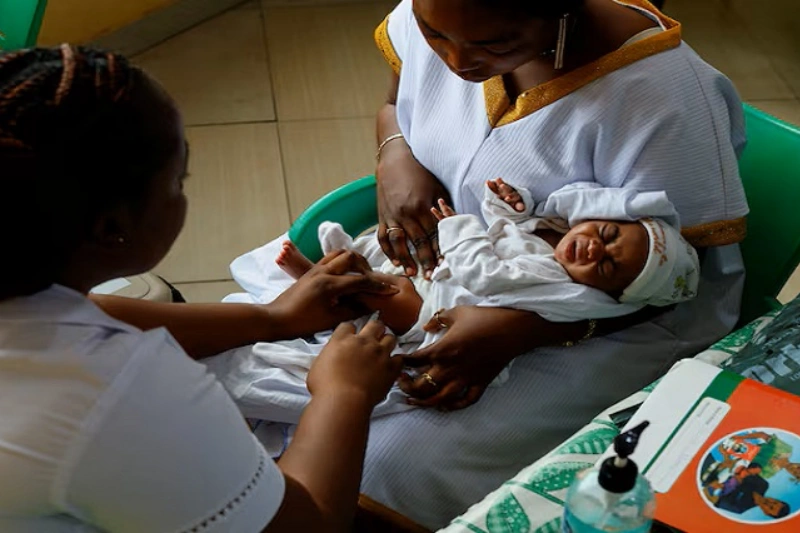

The hepatitis B vaccine trial planned for 14,000 newborns in Guinea-Bissau is over.
The man who designed it has said so himself.
“We were not given the necessary governmental approval,” Frederik Schaltz-Buchholzer, a Danish researcher with the Bandim Health Project, wrote on LinkedIn on Wednesday.
It is a short sentence that closes a long fight. Nobody argued about whether the vaccine works. It does. The argument was about who gets to decide what happens to a newborn in Guinea-Bissau.
Eight days before that post, Health Minister Quinhin Nantote told a press conference in Bissau that the government had not authorised the hepatitis B vaccine trial. He said any research involving children must follow national law and international ethical rules.
The US Department of Health and Human Services also said the study had not been approved. That was a change of tone. In January, its spokesman had said the work was proceeding as planned.
So how did a project reach this point? Start with the paperwork. Bandim’s own protocol says the national ethics committee approved the study on 5 November 2025. Three weeks later, soldiers seized power in Bissau.
In December, the US Centers for Disease Control and Prevention awarded the Danish team $1.6 million without a competitive bidding process. Private foundations were expected to provide another $1.6 million. The study’s funding and design soon came under scrutiny.
Half of the 14,000 babies would get the jab at birth. The other half would wait six weeks, which is the country’s current schedule. The aim was not to test protection against hepatitis B. It was to look for wider effects, including on survival, infections, skin conditions and brain development.
The researchers said the second group in the hepatitis B vaccine trial would simply receive what Guinea-Bissau offers today.
The World Health Organization saw it differently. In a statement on 13 February, it said holding back the birth dose in a hepatitis B vaccine trial would be unethical and could cause serious harm that may not be reversible.
The numbers explain the worry. WHO estimates that more than 12 per cent of adults in Guinea-Bissau live with chronic hepatitis B. Among children under five, infection runs near 2 per cent, against a global target of 0.1 per cent or lower. The country decided in 2024 to add a birth dose by 2028.
Africa CDC backed a fresh ethical review in January. “We are led by the interests of our people in Africa,” its director general, Jean Kaseya, told journalists.
Then the story got murky. Nantote said the trial was suspended and that a six-member ethics committee had never met to approve it. Bandim answered with an approval letter and said the committee had cleared a revised protocol on 14 July.
Early in October, a Danish ethics committee signed off too. Around 11 October, reports said Bissau had approved the hepatitis B vaccine trial as well.
Two days later the minister said no. “This is not even remotely true,” he told The Guardian.
On Monday, judicial police raided Bandim’s offices and seized doses of hepatitis B vaccine. In a statement, police said the move was meant to establish the circumstances of the batch. They did not suggest any fault with the vaccines.
Two days after that, Schaltz-Buchholzer conceded that the hepatitis B vaccine trial was dead.
Washington is now asking questions. On Thursday, top Democrats on the House Energy and Commerce Committee demanded answers from the CDC over its funding of the hepatitis B vaccine trial.
US Health Secretary Robert F Kennedy Jr has praised the Danish team’s work. One of its leaders, Christine Stabell Benn, has advised a US vaccine committee.
Paul Offit, a vaccine specialist at the Children’s Hospital of Philadelphia, told The Guardian the team’s central idea made no biological sense. He urged funders to spend the money vaccinating as many children as possible.
The WHO has offered to help Guinea-Bissau bring in the birth dose.
Guinea-Bissau did not need a trial to learn that the vaccine works. It needs the vaccine, and it has now made clear who decides when it arrives.


