



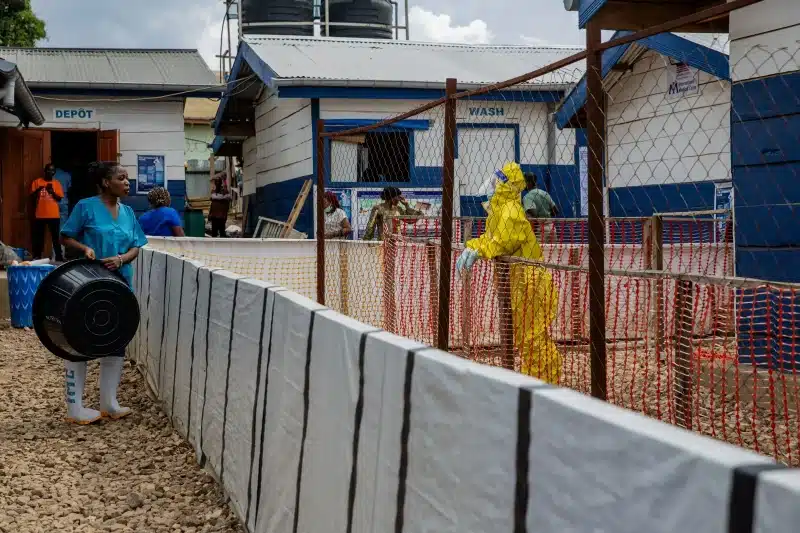

Twelve years ago to the day, the World Health Organization told a news conference in Abuja that Nigeria was free of Ebola. On Tuesday, the government confirmed an Ebola case in Abuja.
The patient is a woman who recently arrived from Uganda, Health Minister Muhammad Ali Pate told reporters. Her symptoms began on 7 October, the Associated Press reported, and she was admitted to a private hospital on 11 October.
Laboratory confirmation came on 20 October, nine days after admission. The ministry says only that she was treated for several days before the diagnosis was made. It has not said when a sample was first taken or explained the delay between admission and confirmation.
That gap matters because of who was in the building. Pate said 44 close contacts linked to the Ebola case in Abuja are now being monitored. They include health workers, other patients, caregivers and people who travelled with her.
The hospital is getting support to tighten infection prevention and control. The woman is isolated and, by the minister’s account, stable.
Nigeria has been here before. In July 2014, a traveller from Liberia, Patrick Sawyer, collapsed at Lagos airport. The final count, the AP reported when the all-clear came, was 20 cases and eight deaths, including two doctors and a nurse.
On 20 October 2014, the WHO’s Nigeria director, Rui Gama Vaz, called the response a “spectacular success story”. He also warned that the country’s size and long borders left it open to further imported cases.
Tuesday tested the second half of that message.
The regional threat has been growing since May, when the WHO declared the Bundibugyo outbreak in the Democratic Republic of Congo and Uganda a public health emergency of international concern. According to the Associated Press, the outbreak has infected more than 9,000 people and killed more than 4,300. Kenya has also reported nine cases, following its first case earlier this month. Nigeria’s newly confirmed infection adds another layer of concern, although officials have yet to establish where the woman contracted the virus.
Nigeria had notice. Pate said a Presidential Task Force on Ebola was set up in May. The Nigeria Centre for Disease Control said two weeks ago it was stepping up surveillance after Kenya’s first case. On paper, the country was ready. The Ebola case in Abuja is the first real test of that preparation.
The tools are limited. WHO says there is no licensed vaccine or specific treatment for Bundibugyo virus. Nigeria had no Ebola vaccine in 2014 either, and still won through early isolation and tracing. Detection and tracing carry the weight again.
The origin of the Ebola case in Abuja is still unknown. Uganda, the AP noted, had been declared free of the virus after its own cases, and officials have not said where the infection began. A single imported case does not mean the virus is spreading in Nigeria.
The ministry insists the country has “the experience and public health systems to respond to this case”. Pate said, in remarks the AP carried, that authorities were “doing everything possible to contain this case”.
He also urged calm. Voice of Nigeria quoted him saying there was “no need for panic”, and he asked Nigerians not to share unverified claims on social media.
The NCDC toll-free line is 6232, for anyone seeking information on the Ebola case in Abuja or wanting to report a suspected case.
In 2014, Nigeria won by finding every contact before the virus did. The test has not changed. There are 44 names on the list now, and a diagnosis that arrived nine days after admission.


