



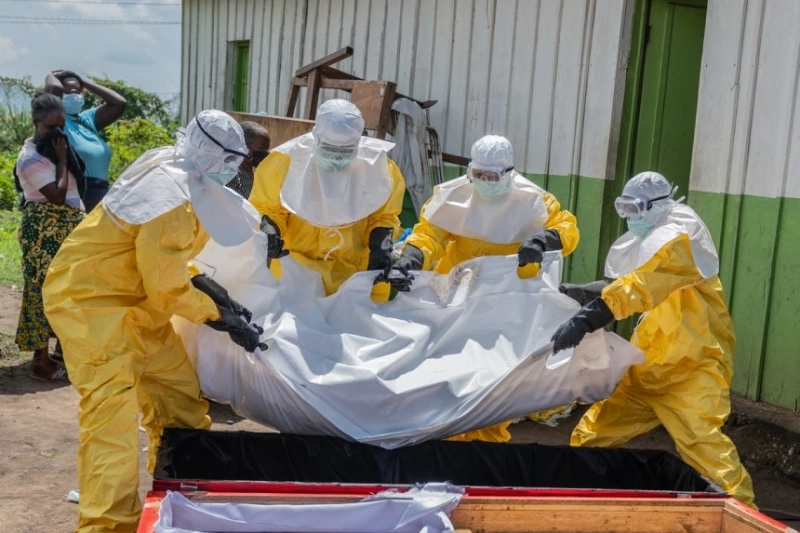

Doctors Without Borders has issued a stark warning from Geneva that the DRC Ebola outbreak is spreading faster than the response effort can contain it, two months after the crisis was formally declared in Ituri province.
The medical charity, widely known by its French acronym MSF, said on Wednesday that confirmed infections had tripled in under five weeks, while deaths had risen more than fivefold over the same period. That pace has turned the DRC Ebola outbreak into the third largest, and the fastest growing, on record.
MSF emergency programme manager Trish Newport did not soften the message. She said teams were still chasing the epidemic rather than staying ahead of it, and warned that every delay in scaling up care was costing lives.
The numbers behind the warning are grim. Confirmed cases have now passed 2,000, with at least 754 deaths officially recorded, according to figures MSF released alongside its appeal. The organisation noted that the outbreak has already overtaken half the total caseload recorded during the DRC’s 2018 to 2020 Ebola epidemic, a crisis that dragged on for nearly two years before it was brought under control.
Ituri province, where the DRC Ebola outbreak began, remains the epicentre. It accounts for roughly nine in every ten confirmed cases across the country. Beyond Ituri, infections have also been confirmed in North Kivu, South Kivu and Tshopo provinces, while neighbouring Uganda has reported cases crossing its border since the early days of the crisis.
What makes this particular DRC Ebola outbreak so difficult to control is the strain responsible. Unlike the Zaire strain that devastated West Africa between 2014 and 2016, this epidemic is being driven by the Bundibugyo virus, for which no vaccine or treatment has ever been approved. The two existing Ebola vaccines, including the widely used Ervebo jab, work against the Zaire strain only and offer no protection here.
Health workers are therefore left relying on supportive care alone, managing fever, vomiting and fluid loss while hoping patients’ own immune systems can fight off the virus. During the two previous Bundibugyo outbreaks, in Uganda in 2007 and DRC in 2012, fatality rates ranged between 25 and 40 per cent, a figure that underlines why MSF is pushing so hard for faster international support.
There is, however, a cautious sign of movement on the treatment front. The World Health Organisation confirmed this week that the first clinical trial of a potential intervention against Bundibugyo has begun. The clinical trial represents one of the first major scientific efforts aimed at slowing the DRC Ebola outbreak driven by the Bundibugyo strain.
Known as EBO-PEP, the trial is evaluating whether obeldesivir, an oral antiviral drug developed by the American pharmaceutical firm Gilead Sciences, can prevent infection in people who have already been exposed.
The trial, led by DRC’s National Institute for Biomedical Research alongside the humanitarian group ALIMA and MSF, opened its first enrolment centres in Bunia one of the epicentres of the DRC Ebola outbreak and Rwampara on 14 July. It aims to recruit close to 1,000 participants aged 12 and above who have had direct contact with a confirmed case within the preceding five days but show no symptoms themselves. Each volunteer will be monitored daily for three weeks, with a final check-up at day 42.
WHO director-general Tedros Adhanom Ghebreyesus described the trial as a potentially major step forward if the drug proves effective among high-risk contacts, since obeldesivir has already shown promise against related filoviruses in laboratory studies, even though its efficacy against Bundibugyo specifically has yet to be proven in humans.
Complicating matters further, WHO emergencies chief Chikwe Ihekweazu told reporters in Geneva that the true scale of the DRC Ebola outbreak could be two to four times larger than official figures suggest. He pointed to surveillance gaps as the core problem, noting that roughly 80 per cent of newly detected cases fall outside the known chains of contact tracing, meaning health workers are frequently discovering infections only after they have already spread through a community.
Ihekweazu also raised concern over patients who are dying at home without ever reaching a treatment centre, a pattern that suggests the outbreak’s real death toll may be underreported.
MSF says it now runs seven Ebola treatment centres and more than fifteen isolation units across the affected provinces, offering a combined capacity of over 430 beds. Since the outbreak began, its teams have admitted more than 960 patients and supported the recovery of over 116 survivors.
More than 1,400 MSF staff are currently deployed across Ituri, North Kivu and South Kivu, alongside colleagues working across the border in Uganda. MSF says its expanded network of treatment centres is critical to containing the DRC Ebola outbreak before transmission accelerates further.
The response is unfolding against a backdrop of entrenched insecurity. Armed conflict and mass displacement have plagued north eastern DRC for decades, and MSF says fighting, roadblocks and shifting front lines continue to slow the movement of test samples, supplies and specialist staff into affected areas. Movement restrictions imposed by DRC and neighbouring countries, including border closures and self monitoring requirements for humanitarian workers, have added further friction to an already stretched response.
MSF’s Ituri medical programme manager, Ayokunnu Raji, described the toll the outbreak is taking on frontline teams. At the Ebola treatment centre in Mongbwalu, he said, patients frequently arrive in critical condition with little chance of survival, and more than 110 people have died there even as 57 others have pulled through.
With the rainy season approaching, MSF has also warned that a parallel rise in malaria cases could place additional strain on a health system already stretched thin by the DRC Ebola outbreak, cholera and years of underinvestment.
For now, the charity’s message to international donors and health authorities is blunt: without faster funding and coordination, the DRC Ebola outbreak will keep outrunning every effort built to stop it.


