




Nobody at NAWEC could claim the Gambia power cuts came out of the blue. The utility’s own board put the risk in writing on 12 June.
Documents reported by Gambian outlet Kerr Fatou show that NAWEC’s board warned that sustained load shedding “could escalate into civil unrest and broader national security concerns” if electricity supply was not stabilised quickly.
The same papers put numbers on the shortfall. Peak demand stood at about 110 megawatts, while available supply had fallen to approximately 67 megawatts.
Eight days later, President Adama Barrow told a National People’s Party rally in Brikama that the outages were caused by technical faults. Those faults had been fixed, he said, and supply would remain stable for two to three years.
The electricity available under his tenure, he claimed, had “never happened before” in The Gambia since independence. He also accused opposition leader Ousainou Darboe of using a staged video to make the country look dark.
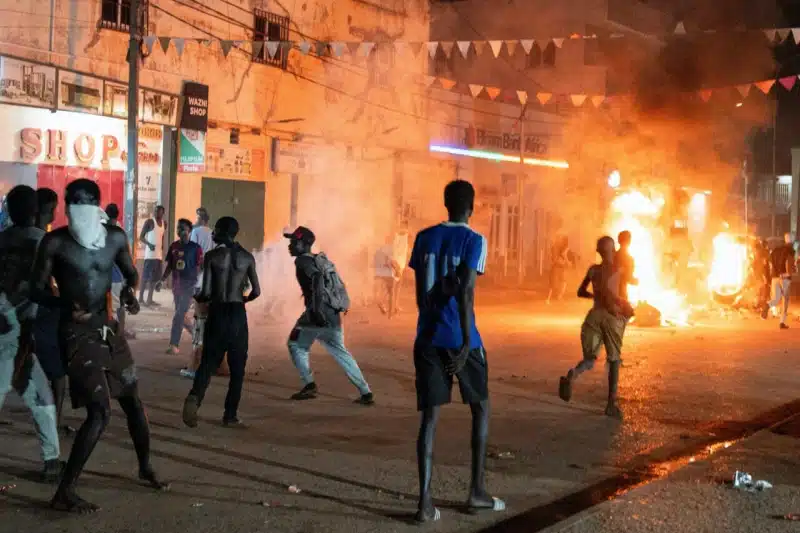
Less than three months later, the Gambia power cuts brought crowds onto the streets. On the night of 7 September, protesters in Banjul and nearby towns burned tyres, blocked roads and demanded Barrow’s departure. Police fired tear gas.
By Thursday, Reuters reported, police chief Seedy Mukhtar Touray had banned protests without a permit, and 11 people had been arrested over vandalism.
On 8 September, Barrow described the crisis in terms strikingly close to NAWEC’s June warning. In a televised address, he called the power cuts “a national security issue” and acknowledged failures absent from his earlier assurances.
“I must admit, however, the shortcomings in our planning, power generation, and maintenance systems,” Barrow said.
The causes of the Gambia power cuts were already emerging in June. Barrow acknowledged that NAWEC’s debt to Senegal’s Senelec was affecting its ability to deliver consistent power, while the utility blamed low rainfall at a dam in Guinea for disrupting electricity imports.
NAWEC’s stopgap, announced on 24 June, was an emergency deal for up to 70 megawatts from Senegal, capped at 50 days. The leaked papers projected a net loss of about 355 million dalasi on the deal alone.
On 15 August, NAWEC announced fresh load shedding between 8pm and 4am, citing demand of about 140 megawatts amid high temperatures.
Barrow’s fix now has a deadline. He promised supply would improve by the end of October, telling Gambians he would not promise “what the Government cannot deliver”.
Improvement is not a measurable target. Nor is it a guarantee that the power cuts will end.
The first equipment arrived on 5 October. NAWEC said two 10.5-megawatt generators had reached the Port of Banjul and were expected to add 21 megawatts of installed capacity at the Brikama power station once commissioned by the end of October. A third unit was expected later. Barrow had previously spoken of a single 24-megawatt machine.
The extra capacity could ease the shortfall, but its impact will depend on commissioning, reliable operation and whether the network can deliver the electricity to consumers.
The utility insists the Gambia power cuts are already easing. Pierre Silva, its public relations officer, reported “massive improvement” on 30 September, with imports from Senegal and Guinea largely restored.
NAWEC’s system operations manager, Sanna Darboe, said imports from Senegal and Guinea could reach 110 megawatts at peak, while local generation contributed roughly 40 megawatts when solar power was available. Several generators remained out of service for maintenance.
That matters because the Gambia power cuts bite hardest after dark, when solar provides no electricity. A 50-megawatt solar plant at Soma has been awarded, but no completion date has been announced. Barrow has acknowledged that solar alone cannot solve the night-time shortfall.
Silva also warned that even with 1,000 megawatts of generation, overloaded transformers and feeders could still prevent electricity from reaching homes. One transformer, he said, can cost more than $500,000 to replace.
Energy Minister Nani Juwara says electricity access has risen from under 40 per cent of the population before 2017 to over 90 per cent. But a wire to the house is not the same as power in it. More connections also mean greater demand on an already strained system.
The timing gives the electricity crisis added political weight. With presidential voting scheduled for 5 December, the end-of-October deadline falls just 35 days before the election. That leaves little time for the government to demonstrate whether its promise will translate into more reliable electricity for households and businesses.
Barrow is seeking another term, while Ousainou Darboe and Talib Bensouda are also seeking the presidency, according to the campaign information available to the newsroom. Bensouda, the Kanifing mayor associated with the Coalition 2026 ticket, has made reliable power a campaign issue. People without generators to run their businesses, he argues, are “forced to take the matter to the streets”.
Gambians will test Barrow’s promise at the light switch every evening. They will judge the Gambia power cuts at the ballot box five weeks later.


