



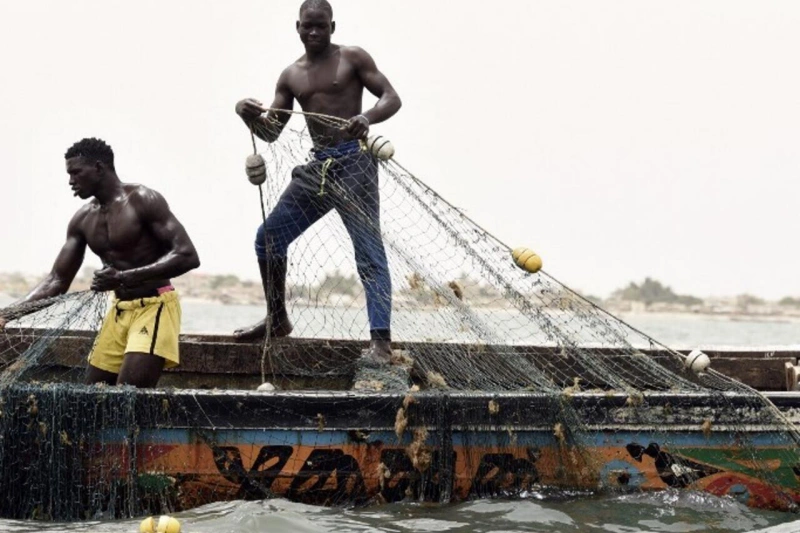

Senegalese fishermen say the big boats come in the dark. Lights off. Markings covered. Nets dragged close to the beach.
A trawler crewman told the Environmental Justice Foundation (EJF) as much. Captains, he said, ‘turn off the lights every time they enter the forbidden areas’. He meant the coastal strip kept for canoes.
In the dark, a pirogue is easy to hit. Fishermen near Saint-Louis told the investigative outlet Follow the Money that trawlers and canoes collide often. ‘There have even been fatalities,’ said one of them, Boly Fall.
A full public record of clashes involving Senegalese fishermen and industrial trawlers is hard to find. The evidence is scattered, but the available records point in the same direction.
The clearest numbers come from an EJF survey of 17 fishers in Kayar and Fass Boye, carried out between September 2022 and May 2023. Some 94 per cent said encounters with bottom trawlers had become more frequent over five years. And 59 per cent had been in an altercation with trawler crew.
That is a small sample, and official data is thin too. EJF noted that the government recorded 23 cases of trawlers destroying artisanal gear in 2021. The true number, it said, is probably higher.
One case in the report stands out. On 10 December 2019, villagers at Fass Boye told EJF, three trawlers were working close to the beach. One hauled a pirogue into its net, dropped it back and kept the motor.
When villagers went out to confront the crews, the crew of one trawler threw boiling water at them. One man was hurt. Eight pirogues were damaged or lost. A tarp hid the vessel’s name, and it was never identified.
So who is at the wheel? Amadou Diague, a retired fisherman in Guet Ndar, told Follow the Money that Spanish owners use the Senegalese flag as cover. For Senegalese fishermen, the word foreign is rarely simple.
The paper trail backs him up in part. EJF found that at least 52 per cent of the bottom trawlers licensed in 2019, almost all flying the Senegalese flag, were controlled by foreign owners. Spanish interests were the largest foreign group, ahead of Chinese.
Senegalese fishermen who lose a net rarely see the money back. EJF found that 85 per cent of those who suffered damage said they had not been properly compensated.
Things began to shift in April 2024, when President Bassirou Diomaye Faye’s government took office. Within a month it published a list of 132 authorised vessels. Follow the Money later found that at least a fifth belong to joint ventures with parent companies in the EU.
Mbor Mbengue, who chairs the fisheries council in Kayar, said many foreign trawlers simply stopped going to sea once the list appeared.
Senegalese fishermen near Saint-Louis told the same outlet in December 2024 that a navy ship now protects their canoes from aggressive foreign trawlers. In May 2024 the European Commission had given Senegal a yellow card over illegal fishing. The EU fisheries agreement expired that November and was not renewed.
Then came January 2026. A fishing boat struck a pirogue at night off Guet Ndar, a fishing district of Saint-Louis, and did not stop, according to local sources. Four people on the canoe were reported missing. Reports did not say who owned the boat.
The pattern is the one Senegalese fishermen keep describing. A collision in the dark. A boat that does not slow down.
Senegalese fishermen further south tell a similar story. AFP visited Rufisque, near Dakar, in March. A local wharf official said a pirogue now needs six or seven months to land what it once caught in two.
Trawlers are not the only pressure on Senegalese fishermen. AFP also reported that climate change is pushing small fish northwards and that more people have taken up fishing. EJF itself says trawling does not explain every ill.
Protecting Senegalese fishermen at sea is hard. Cheikh Salla Ndiaye, of the fisheries protection directorate, told AFP the job is very difficult, even with the navy and air force.
Rear Admiral Abdou Sène, the navy’s chief of staff, said in January that crews boarded more than 11 offending fishing vessels in 2025. Estimates put the number of pirogues at 12,000 to 19,000.
On 17 June 2026, Fisheries Minister Amy Mara outlined new measures aimed at protecting Senegalese fishermen while speaking at the Our Ocean Conference in Mombasa. Senegal, she said, would widen the coastal zone closed to industrial vessels from six to 12 nautical miles. That covers the whole territorial sea.
Artisanal fishing groups welcomed the pledge. But the minister herself said ‘discussions and studies are currently underway.
It is not the first time. Senegal announced a 12-nautical-mile zone at the UN Ocean Conference in Nice in June 2025. The Coalition for Fair Fisheries Arrangements noted that no concrete measure had been taken.
A wider line only helps Senegalese fishermen if someone can see who crosses the old one. EJF’s analysis of tracking data showed foreign trawlers logging almost 1,000 apparent fishing hours inside the existing zone in 2017. Some crews, EJF heard, also switch off their transponders.
Some Senegalese fishermen are learning to watch the water themselves. Ibrahima Mar, 55, from Rufisque, spent time on a Greenpeace ship learning to spot and report illegal fishing. He plans to take those tools home.
Mar says the fish were taken from his path, and ‘there’s no hope left’. One son reached Spain by pirogue. Another called from a boat carrying 140 people. The family never heard from him again.
His third son is in a training centre, learning to weld.
For many Senegalese fishermen, the sea remains both a livelihood and a source of uncertainty. Whether tighter controls on industrial vessels change that reality may determine whether the next generation stays on the coast or looks elsewhere for a future.


