



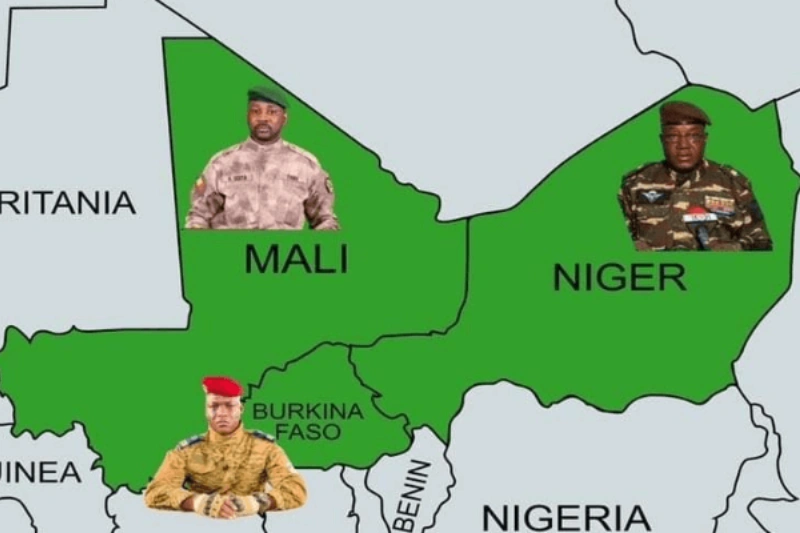

The soldiers came first.
Now the regulators, telecom officials and trade ministers are following. The latest moves suggest AES integration is evolving into something much bigger than a security alliance.
Two years after Burkina Faso, Mali and Niger formed the Alliance of Sahel States (AES) to confront growing security threats and redefine their regional alliances, the three countries are quietly building something much bigger: a shared system of governance that stretches from mobile phone networks to cross-border trade.
The latest sign came in Ouagadougou on 25 September, where telecommunications and postal regulators from the three countries signed a cooperation agreement aimed at coordinating rules across the AES space. The deal creates the Council of Sahel Regulators, a permanent body designed to harmonise regulation and oversee joint initiatives.
On the surface, it is a technical agreement.
In reality, it offers one of the clearest examples yet of how AES integration is expanding beyond military cooperation and moving into the institutions that shape everyday economic life.
When Burkina Faso, Mali and Niger launched the AES, security dominated the agenda.
The three military-led governments faced escalating jihadist violence and sought greater cooperation after distancing themselves from ECOWAS.
Since then, the confederation has steadily broadened its ambitions.
Officials have worked on a unified military force, cross-border cooperation mechanisms, trade coordination and industrial policies. Recent meetings have focused on investment, the movement of goods and people, and measures to strengthen economic links within the bloc.
The telecommunications agreement suggests AES integration is now entering a new phase.
Instead of concentrating only on defence, the three governments are beginning to align the rules that govern communication networks, digital infrastructure and economic activity.
Telecommunications may appear less dramatic than military operations, but they are often the foundation of regional integration.
The new cooperation framework covers mobile roaming, cybersecurity, consumer protection, frequency management and recognition of approved telecommunications equipment across the three countries. It also includes coordination on postal services and emerging technologies.
For businesses operating across borders, differing regulations can create delays and additional costs.
For consumers, incompatible systems can mean higher charges and weaker service coverage.
Officials involved in the agreement say closer coordination could reduce those barriers while encouraging investment in shared infrastructure.
The latest agreement did not emerge from nowhere.
In November 2024, the three countries signed a free-roaming protocol intended to make mobile communications work more seamlessly across the confederation. The new regulatory framework builds on that earlier effort.
Seen together, these steps suggest AES integration is becoming increasingly institutional rather than purely political.
The telecommunications initiative is not an isolated development. AES integration is also becoming visible in media regulation and public communication policies across the confederation.
Earlier this month, media regulators from Burkina Faso, Mali and Niger established a joint platform intended to coordinate approaches to media regulation and communication governance across the confederation. Officials described the initiative as part of a strategy to strengthen what they called information sovereignty.
The confederation has also approved plans for common public media institutions, including TV-AES and Radio Daandè Liptako, intended to serve audiences across the three countries.
Taken together, these developments reveal a pattern.
The goal is no longer simply cooperation between neighbouring governments.
The objective increasingly appears to be the creation of common institutions capable of operating across national borders.
That shift could prove one of the most significant aspects of AES integration.
While security concerns helped create the AES, economic issues may ultimately determine whether the project succeeds.
Trade ministers and economic planners have spent much of 2026 discussing ways to increase intra-AES commerce and industrial cooperation.
Officials meeting in Bamako this week are examining progress on freer movement of goods, investment promotion, anti-fraud measures and plans for a common purchasing centre and business climate observatory.
Earlier meetings in Ouagadougou stressed the need to move from political declarations to visible economic results.
For landlocked economies facing infrastructure constraints and security pressures, stronger regional markets could help offset some of those challenges.
That is one reason AES integration increasingly appears focused on practical economic governance rather than symbolic political statements alone.
Creating shared institutions is easier than making them work.
Differences in national laws, administrative capacity and economic priorities could complicate implementation.
The three countries also face continuing security pressures that consume resources and political attention.
Yet the pace of recent announcements suggests the confederation’s leaders are determined to deepen cooperation despite those obstacles. For supporters, AES integration represents an effort to create lasting institutions that can survive political transitions and security shocks.
The creation of regulatory councils, media platforms, economic coordination mechanisms and cross-border governance structures points to a longer-term ambition.
The real story is no longer whether the AES can coordinate military operations.
It is whether Burkina Faso, Mali and Niger can build enough common institutions to transform a security alliance into a functioning regional bloc.
That question, more than any battlefield development, may determine the future of AES integration.


