



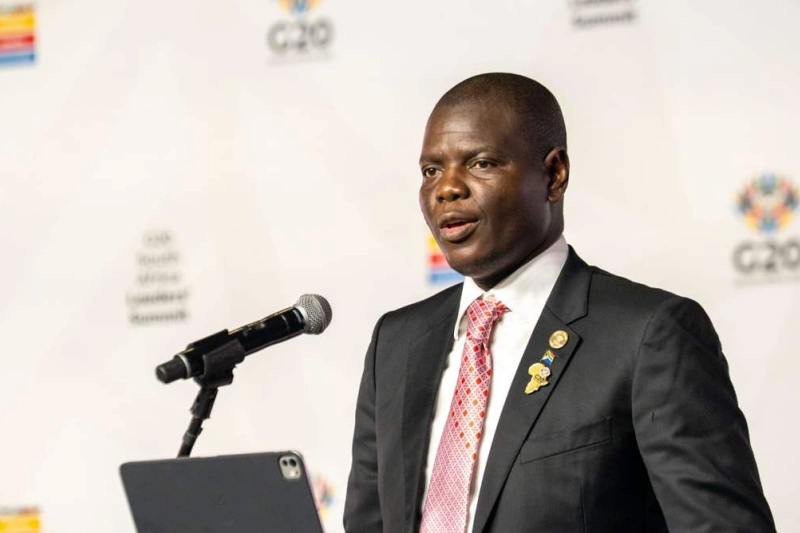

South Africa’s International Relations and Cooperation Minister, Ronald Lamola, told journalists in Pretoria on Wednesday that the African Union should adopt a continent-wide framework to handle migration, rather than treating xenophobic attacks in South Africa as a matter for one country alone.
Briefing reporters at the OR Tambo Building, Lamola said the African Union Executive Council had declined to place South Africa’s migration record on the agenda of the bloc’s mid-term review meeting. He described the outcome as vindication of Pretoria’s long-standing position that migration is a shared African problem and not a domestic failing that belongs to South Africa alone.
The minister’s comments follow months of pressure from Ghana, whose government wrote to the African Union Commission in May demanding continental scrutiny of xenophobic attacks in South Africa. Ghana’s Foreign Minister, Samuel Okudzeto Ablakwa, said in a letter dated 6 May that recurring assaults on African nationals had led to deaths, destroyed businesses and mounting fear among migrant communities, and he asked the Commission to place the matter formally before member states.
Ghana’s former president and current head of state, John Mahama, went further in July, describing xenophobic attacks in South Africa as escalating and calling on the African Union to deploy peacekeepers to high-risk areas, coordinate evacuations with regional blocs, and hold South Africa accountable through sanctions if attacks continued.
His government has already evacuated hundreds of Ghanaian nationals from South Africa since June, following similar voluntary repatriation programmes carried out by Nigeria, which flew home nearly 1,490 citizens in a process that concluded last month.
Independent monitors paint a picture of xenophobic attacks in South Africa that is harder to reconcile with the government’s preferred language of isolated criminality. Human Rights Watch reported in May that vigilante groups, including Operation Dudula and a movement calling itself March and March, had organised demonstrations against undocumented migrants in Pretoria, Johannesburg and Durban that turned violent and, in some cases, fatal.
In one case documented by the rights group, a Cameroonian shopkeeper in Durban who had lived in the country for nearly two decades was attacked in his own premises during a protest targeting foreign-owned shops.
Further incidents have continued into the middle of the year. In Jeffreys Bay, soldiers were deployed after shots were fired and twenty-three foreign-owned convenience stores were looted following door-to-door demands that undocumented migrants leave the township. In Estcourt, shops belonging to Kenyan and Pakistani traders were ransacked, their windows smashed and their stock either stolen or destroyed, according to footage verified by regional broadcasters.
South African officials have at times described such episodes as pure criminal activity rather than xenophobia, a framing that Ghana and other African governments say understates the scale and pattern of xenophobic attacks in South Africa.
Lamola insisted that the African Union’s response to xenophobic attacks in South Africa and similar tensions elsewhere should rest on what he called the push and pull factors driving migration across the continent, including unemployment, weak governance, insecurity and climate change. He cited the AU’s 2018 Protocol on the Free Movement of Persons, Rights of Residence and Rights of Establishment, adopted under Agenda 2063, as the appropriate framework for coordinating migration policy rather than singling out any one state.
He noted that close to 45 per cent of Africans living outside their country of birth do so out of necessity rather than choice, arguing that this makes migration a continental responsibility rather than a South African one alone.
Even as diplomats debate a continental response, Pretoria’s Inter-Ministerial Committee has intensified its own enforcement drive alongside the fallout from xenophobic attacks in South Africa. Officials say more than 72,900 foreign nationals have been repatriated, 354 criminal cases opened and nearly 29,000 immigration-related court matters finalised since the campaign began.
Lamola travelled to Accra as President Cyril Ramaphosa’s special envoy last month to meet Mahama and Ablakwa directly, and both governments have since agreed to work toward de-escalating tensions between Africa’s two largest economies.
Wednesday’s briefing also served as a curtain-raiser for the 46th SADC Summit of Heads of State and Government, which South Africa is hosting in Durban from 3 to 17 August, with Ramaphosa set to formally assume the SADC chairpersonship. Lamola said the timing underscored South Africa’s broader diplomatic priorities on the continent, even as questions over the safety of migrants living within its own borders remain unresolved.
For migrant communities living through xenophobic attacks in South Africa, from Johannesburg and Durban to smaller towns like Jeffreys Bay, the debate in Addis Ababa and Pretoria offers little immediate reassurance. Ghana’s letter to the African Union Commission had invoked the memory of continental solidarity shown during the struggle against apartheid, arguing that no African should be dehumanised on African soil.
Whether the African Union’s broader framework translates into protection on the ground, rather than another round of diplomatic statements, will determine whether the violence recedes or simply continues under a different name.


