



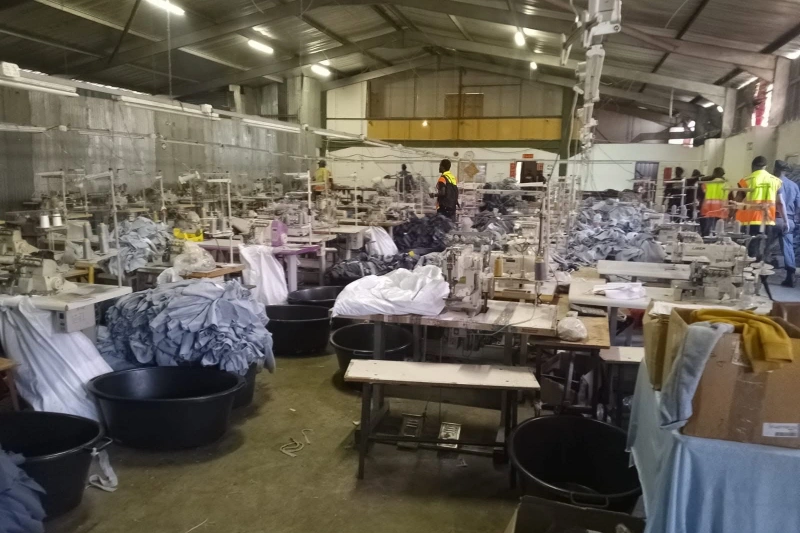

South African clothing factories in Newcastle, KwaZulu-Natal, are shutting down as immigrant workers flee the country to escape rising xenophobic violence.
Iqbal Ismail, chairperson of the eThekwini Clothing and Leather Association, told GroundUp that the sector will not survive without foreign labour. He runs a factory employing 150 people, only 30 of whom are South African. “Our sector will one hundred percent collapse if migrants suddenly disappear from our factories,” he said.
Newcastle sits at the centre of South Africa’s Cut, Make and Trim industry, commonly known as CMT. Almost every factory in the town is owned by Taiwanese or Chinese nationals who hold permanent residence in the country. Depending on who is asked, the town hosts between 140 and 300 CMT operations.
Ismail’s association represents 102 of these businesses. It was formed in response to growing calls for foreign nationals to be barred from factory work altogether. In May, the group threatened a full shutdown of eThekwini’s CMT operations for the second half of June, hoping to demonstrate how reliant South African clothing factories are on migrant staff. The planned shutdown never went ahead. Factories are closing regardless, as workers leave of their own accord.
Alex Liu, a longtime figure in Newcastle’s factory community and a local councillor, backed Ismail’s warning. He said South African clothing factories cannot function without foreign machinists because local workers rarely have the specialised skill needed to insert zippers, a task typically handled by migrant staff. Training could close that gap over time, he said, but the sector needs stability and investment it is not currently getting.
The industry is already under severe strain. Government raids in September 2025 and again in February 2026 exposed poor wages, unsafe factory floors and cramped worker dormitories. Since the February raids, most factories in the town have operated on reduced hours.
Ronghua Yan, who trades as David Old Tailor from a factory in nearby Madadeni, said the past decade has brought one crisis after another for South African clothing factories, from load shedding and looting to low prices set by retailers. “It’s the darkest time of my life,” he said, pointing to rising costs and the reputational damage caused by the raids. He believes owners in his position now face a stark choice: leave the country or pivot toward building their own clothing brands rather than relying on retailer contracts.
Major retailers, including Pepkor, Pick n Pay and Mr Price, confirmed to GroundUp that they had withdrawn orders from Newcastle suppliers following the February raids. Some have since redirected work to factories in Lesotho, eSwatini, Madagascar and China, though eSwatini’s government has also launched its own compliance drive under Labour Minister Phila Buthelezi. Retail analysts say South African clothing factories face growing competition from lower-cost regional producers.
Not every factory owner blames retailers alone. Joe Tau, managing director of Allwear, the town’s largest clothing manufacturer and a producer of school uniforms, said compliance is achievable but requires investment. He committed over 15 million rand to new machinery after a retailer asked him to cost a shirt, on condition of a three-year supply agreement. Tau employs more than 1,000 South African workers, 98% of them women, and pays bargaining council wage rates.
Wages remain a central pressure point across South African clothing factories. Workers are frequently paid per piece rather than by the hour, receiving as little as 20 cents for cutting a small piece of fabric. To match the sector’s minimum wage of 32 rand an hour, a worker would need to cut around 167 pieces hourly, a pace only the fastest machinists can sustain. Slower workers can earn as little as 20 rand a day.
The economic weight of the industry on Newcastle is significant. Liu estimated the town’s factories employ between 15,000 and 20,000 workers and produce roughly ten million garments a month, generating around 50 million rand in monthly revenue, half of which goes directly to wages. Ward 34, the municipal area covering most of the industrial zone, contributed over 761 million rand in rates in the last financial year, close to half the municipality’s total revenue.
Newcastle’s municipality has begun reaching out to CMT owners to gather information on the sector, though local business figures say support has been minimal for years despite the town actively courting Taiwanese and Chinese investment in the 1980s and 1990s. Business leaders argue that South African clothing factories need targeted support if Newcastle is to retain jobs and investment.
For now, owners of South African clothing factories in Newcastle say they are caught between retailers unwilling to raise prices, a workforce leaving out of fear, and a compliance burden they cannot meet without the very migrant labour now disappearing.


