



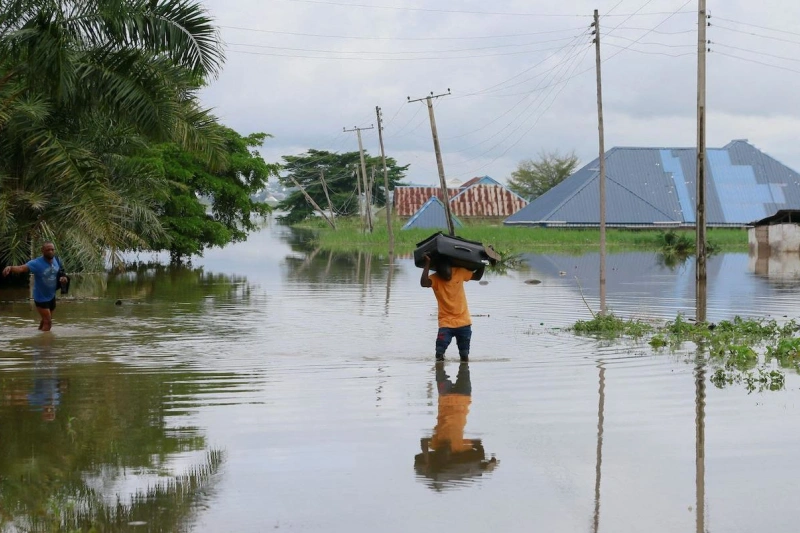

Climate change has made extreme rainfall in West Africa five times more likely than it was before industrialisation, a new scientific study has found, arriving weeks after floods along the Gulf of Guinea coast killed nearly 100 people.
The finding comes from World Weather Attribution, a research collaboration involving scientists from Côte d’Ivoire, Ghana, Kenya, the Netherlands, Sweden, the United States and the United Kingdom. The group published its analysis on Thursday, focusing on the spell of extreme rainfall in West Africa that struck the coast between 20 and 22 June.
During those three days, torrential rain hit Côte d’Ivoire, Ghana, Togo and Nigeria in quick succession. Some cities recorded more than 140 millimetres of rain within less than 24 hours, a volume that overwhelmed drainage systems built for far gentler conditions and sent flash floods tearing through informal settlements.
The human cost was severe. At least 59 people died in Côte d’Ivoire, where flooding has persisted since May, while 34 lives were lost in Ghana and five in Togo, according to the study. Ghana’s June rainfall was its heaviest since 1995, and the deluge submerged vehicles, swept away market stalls and cut electricity to parts of Lagos after floodwater disrupted a transmission substation.
Researchers concluded that this pattern of extreme rainfall in West Africa is no longer an anomaly. A three day event of this scale is now expected roughly once every two to four years across the study region, a sharp shift from the rarity such downpours once carried. Observed data showed that three day rainfall intensity over the affected coastline has climbed by around 23 percent since records began, which translates into extreme rainfall in West Africa being about five times more likely in today’s climate than it would have been in a world 1.4 degrees Celsius cooler.
Climate models examined separately by the team told a more cautious story, pointing to only a small rise in likelihood and roughly a 4 percent increase in intensity. The scientists noted that existing models struggle to capture rainfall behaviour specific to the African continent, so they treated the observation based findings as the more reliable signal of how extreme rainfall in West Africa has shifted.
Beyond the rainfall itself, the researchers pointed to rapid and often unplanned urban growth as a force multiplying the danger. Formal and informal settlements have spread into floodplains across the Gulf of Guinea coast, while natural vegetation that once absorbed excess water has given way to cropland and concrete. Population growth along this stretch of coastline is projected to continue for decades, meaning more people will be living in the path of future flooding.
Sea levels along the Gulf of Guinea have also risen faster than the global average, according to research cited in the study, compounding the threat that intensifying rainfall already poses to densely populated cities and critical infrastructure.
The scientists warned that if global temperatures reach 2.8 degrees Celsius above pre-industrial levels, a scenario current policies are not ruling out, extreme rainfall in West Africa would become wetter still. Since such extremes are already common rather than rare, the region would need to brace for downpours heavier than anything recorded in 2026.
Flooding of this kind carries consequences well past the initial inundation. Damaged sanitation systems and contaminated water sources raise the risk of waterborne disease in the weeks and months that follow, a danger the study said falls hardest on children and people with existing health conditions. Disrupted farmland and livelihoods also threaten to deepen food insecurity in a region already stretched thin.
The researchers called for urgent adaptation across Gulf of Guinea states, including stronger drainage and sanitation infrastructure, enforced rules on safer construction, improved early warning systems and greater involvement of affected communities in flood planning. They argued that physical infrastructure alone will not be enough, and that a broader mix of solutions is needed to reduce how exposed coastal populations remain to extreme rainfall in West Africa.
With the region’s rainy season still weeks from ending, authorities in Abidjan, Accra, Lomé and Lagos face a narrowing window to strengthen defences before the next intense spell of rain arrives.


