



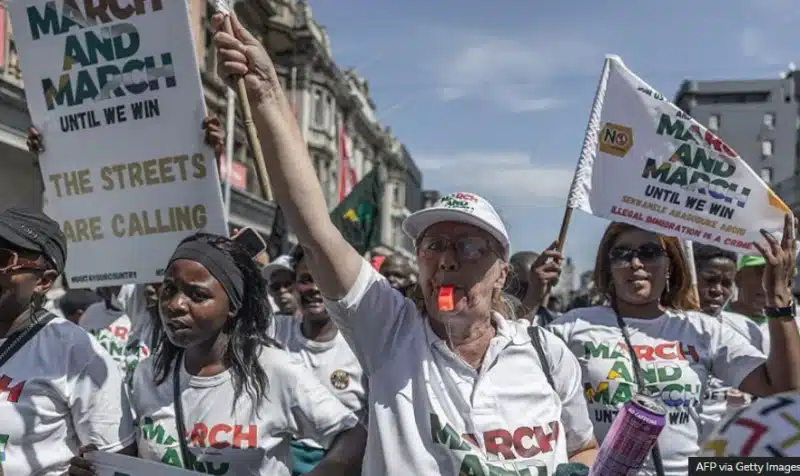

Anti-immigrant violence is gripping South Africa’s biggest urban centres, with a wave of protests, assaults and forced business closures drawing sharp condemnation from human rights bodies, foreign governments and political critics alike.
A Movement That Grew Fast
March and March is a shadowy anti-foreigner movement led by Jacinta Ngobese-Zuma, a former Vuma FM presenter whose contract was not renewed in 2025. She then started a movement that sprouted in KwaZulu-Natal before spreading rapidly across the country.
The organisation formally launched on 24 March 2025 in Durban as a once-off protest against undocumented migration, but it has since become the hotbed of the growing xenophobic attacks in South Africa. Overwhelming public response transformed it into a continuous movement, marching into streets, boardrooms, police stations and government offices.
The xenophobic attacks in South Africa linked to this movement now form part of a pattern that rights watchdogs say is accelerating towards a constitutional crisis.
What Happened on the Ground
On 29 April 2026, March and March marched in Tshwane and Johannesburg using anti-migrant rhetoric. The group is in alliance with Operation Dudula, the movement fronted by Zandile Dabula that was stopped by a high court order halting a violent campaign in November 2025.
Crowd numbers in Tshwane and Johannesburg were between 300 and 500 people, according to reports. Despite the relatively small turnout on the streets, the movement’s social media footprint is considerably larger.
A separate march was billed as a community clean-up campaign in Durban’s CBD but quickly got out of hand when participants started targeting foreign nationals, handing some over to police while foreign-owned shops were forced to close.
The BBC reported that the Ghanaian diplomatic mission and Nigerian associations had warned their members to shut their businesses ahead of the demonstrations. In late April 2026, five Ethiopian nationals were killed in Johannesburg over a span of just a few days. Three of them were shot while having breakfast inside a McDonald’s restaurant in the Central Business District.
These xenophobic attacks in South Africa have now reached international diplomatic levels.
Africa’s Response
African countries including Kenya, Malawi, Lesotho and Zimbabwe urged their citizens in South Africa to stay cautious and remain indoors amid attacks targeting foreigners, while Ghana called on the African Union to intervene.
Nigeria’s Foreign Minister Bianca Odumegwu-Ojukwu announced that her government had launched a voluntary operation to return 150 of their citizens, adding that two Nigerians had been killed in incidents connected to South African security personnel a month earlier.
The African Commission on Human and Peoples’ Rights, through Country Rapporteur Commissioner Solomon Ayele Dersso, expressed grave concern over reports of xenophobic violence and acts of intimidation against nationals of other African countries, noting that the latest incidents form part of a longstanding pattern of violence stretching back to the May 2008 nationwide attacks that resulted in over 60 deaths, 1,700 injuries and 100,000 displacements.
UN Secretary-General António Guterres also condemned the escalation, with Daily Maverick reporting that South Africa faces mounting international pressure to act before what observers describe as combustible rhetoric turns into a full-blown crisis.
The Political Fallout
Political analyst Goodenough Mashego, writing in IOL, warned that some parties may be using anti-immigration sentiment for political advantage, with certain political actors aligning themselves with the movement’s messaging in a way that could convert public frustration into electoral support.
University of KwaZulu-Natal academic Dr Lubna Nadvi cautioned that migration is increasingly being used as political fodder to secure votes, arguing that the issue is being shaped more by election politics than careful policy discussion and risks oversimplifying a much more complex mix of legal, economic and social challenges.
The xenophobic attacks in South Africa have put the Patriotic Alliance (PA) and its leader Gayton McKenzie under particular scrutiny. While on the campaign trail, McKenzie emphasised the PA’s stance on immigration and promised mass deportations of what he called illegal foreigners, accusing them of selling drugs, poisonous foods and working as cheap labour without paying tax.
Playwright and cultural activist Mike van Graan responded angrily, saying that if McKenzie remained in Cabinet, Nelson Mandela’s promise that South Africa would never again experience the oppression of one group by another means absolutely nothing. Van Graan demanded McKenzie’s immediate removal from government.
Mike Ndlovu from Kopanang Africa Against Xenophobia described what is happening as a qualitative drift towards right-wing populism and elements of fascism developing in South African politics.
Scapegoating a Structural Crisis
Advocate Simba Chitando, who represents the Zimbabwe Exemption Permit Holders Association, said there is absolutely no doubt that the cause of this violence is South African politicians who have instigated organised, state-sponsored hate crimes to deflect attention from their own shortcomings, economic decline and the general breakdown of the rule of law.
Professor Loren Landau, co-director of the Wits-Oxford Mobility Governance Lab, warned that the widespread appropriation of state authority by vigilante groups effectively privatises one of the core functions of the state, shifting the logic of impartial law to that of politics and markets. He warned that anyone deemed undesirable, based on race, ethnicity, religion, or nationality, can be censured, excluded or punished at the whim of local grandees and gangsters.
According to the Inclusive Society Institute’s GovDem Survey, distrust of African immigrants climbed from 62.6 per cent in 2021 to 73.1 per cent in 2025. Researchers at the University of Johannesburg have linked much of this sentiment to perceived economic threats, with foreigners blamed for shrinking jobs in a country where unemployment stands at 31.4 per cent, further fuelling xenophobic attacks in South Africa.
The xenophobic attacks in South Africa are not, experts argue, simply a product of public frustration. They are, as the Addis Standard observed, socially produced, politically amplified, and institutionally enabled.
A Cabinet That Speaks in Two Directions
South Africa’s Cabinet issued a statement saying South Africans are within their rights to protest against the spiralling illegal immigration challenge, but that violence linked to those protests is not acceptable and that law enforcement must deal with the instigators of such violence.
The statement did little to quiet critics who note that several parties sitting inside that same Cabinet have spent months amplifying the very rhetoric driving xenophobic attacks in South Africa’s streets.
March and March is demanding tighter immigration controls, including stricter visa regulations, a review of asylum policies and action against businesses employing undocumented foreign nationals. Whether South Africa’s government of national unity has the political will to separate those demands from the violence carried out in their name remains the question that neither the marches, nor the memoranda, have yet answered.


