



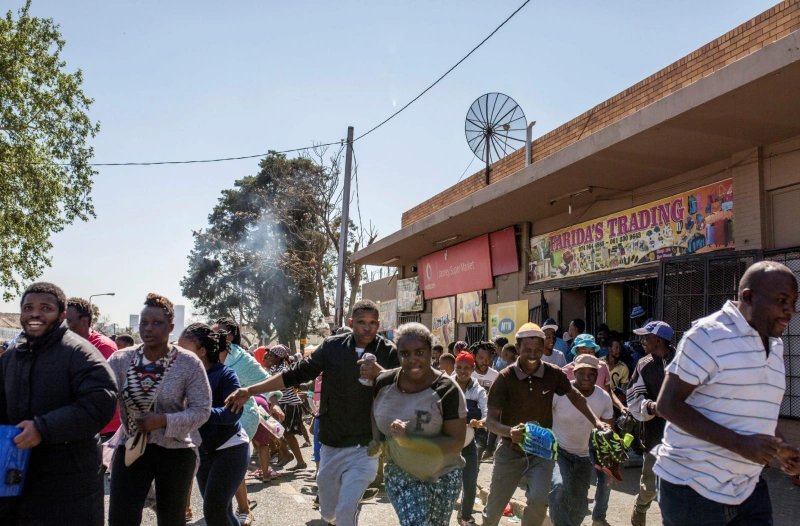

Nigerians are fleeing South Africa Xenophobia Attacks. Two of their countrymen are dead. And the continent’s human rights body is pointing fingers directly at Pretoria.
AfricanQuarters.co | 4 May 2026
The South Africa xenophobia attacks have crossed a threshold that can no longer be described as civil unrest. What is unfolding in Johannesburg, Pretoria and Port Elizabeth is, by any honest measure, a crisis of continental proportions, one that is straining Nigeria-South Africa relations to their limits and exposing the African Union’s persistent failure to hold one of its most powerful members to account.
Two Nigerians Dead. One Beaten by Soldiers.
The human cost is no longer abstract.
Nigeria’s Foreign Affairs Minister, Bianca Odumegwu-Ojukwu, confirmed in a situation report posted on her X handle on Sunday that two Nigerian nationals have died in separate incidents involving South African security personnel.
Amamiro Emmanuel died on 25 April after sustaining injuries from what the minister described as “brutal beatings by military personnel of the South African National Defence Force” in Port Elizabeth on 20 April.
A second Nigerian, Nnaemeka Matthew Andrew, died following an alleged interaction with members of the Tshwane Metro Police. His body was discovered at the Pretoria Central Mortuary on 20 April.
Odumegwu-Ojukwu described both deaths as unacceptable, stating plainly that “Nigeria demands justice be done in these cases.
130 Nigerians Register to Leave
At least 130 Nigerians have already registered for voluntary evacuation flights from South Africa as Nigeria moves to safeguard its citizens amid rising tensions linked to anti-foreigner protests.
The evacuation scheme follows a direct order from President Bola Tinubu, who directed that flights be arranged and that Nigerian diplomatic missions compile the data needed for processing.
Minister Odumegwu-Ojukwu disclosed that the number of applicants is expected to rise significantly, noting that Nigerian community organisations in South Africa are actively supporting the ongoing registration process.
Registration is free, but applicants must provide proof of their circumstances and personal identification to qualify. The Nigerian Consulate in Johannesburg and the High Commission in Pretoria are coordinating the exercise.
“A Repetitive Wave”
This is not the first time South Africa has descended into this cycle of violence against fellow Africans. It will not be the last, unless something fundamental changes.
Odumegwu-Ojukwu described the pattern bluntly: “It has become a repetitive wave, most especially before elections in South Africa, and anti-foreigner opposition parties leverage this situation to garner votes.”
She went further, reminding South Africa of a debt many of its younger citizens appear to have forgotten: “Nigeria is a frontline state which made great sacrifices towards the liberation struggles of South Africa, a fact which needs to be distilled down to the younger generation in South Africa.”
The irony is searing. A nation that fought apartheid with African solidarity is now watching vigilante groups chase other Africans out of hospitals and schools to demand their identity papers.
The Vigilante Groups Driving South Africa Xenophobia Attacks
The South Africa xenophobia attacks are not spontaneous mob actions. They are organised, evolving into structured campaigns rather than spontaneous outbreaks
Groups such as Operation Dudula and “March and March” have evolved from fringe movements into structured political forces. They conduct systematic “identity paper checks” outside public institutions, targeting anyone who appears foreign.
Meanwhile, political parties including ActionSA and the Patriotic Alliance have built platforms around nativist slogans, deploying language about migrants that stops just short of incitement but creates the climate for the South Africa xenophobia attacks.
South Africa’s youth unemployment rate, which stands at 60.9 per cent, provides the powder. The politicians and vigilante leaders supply the match.
As the Resource Centre for Human Rights and Civic Education (CHRICED) noted in a statement this week, economic desperation does not justify targeting fellow Africans. CHRICED’s Programme Communication Officer, Furera Isiaka, warned that “driving migrants out of South Africa will not solve the problem. Such attacks erode the unity and solidarity that defined Africa’s anti-apartheid struggle.”
Abuja Summons Pretoria’s Envoy
Nigeria’s diplomatic response has moved beyond statements.
Nigeria’s Ministry of Foreign Affairs summoned South Africa’s Acting High Commissioner to Abuja, with the Ministry’s spokesperson, Kimiebi Imomotimi Ebienfa, saying discussions would “primarily focus on the ongoing demonstrations by various groups within South Africa and the documented instances of mistreatment of Nigerian citizens and attacks on their businesses.
The meeting was held on Monday, 4 May, at the Ministry’s headquarters in Abuja.
Both countries had earlier signed a Memorandum of Understanding on early warning mechanisms designed to prevent exactly this kind of flare-up. That agreement has clearly not worked.
More Protests Expected This Week
The danger is not yet past.
The minister confirmed that another wave of demonstrations is expected between 4 and 8 May 2026, prompting further security and diplomatic coordination between both countries.
Nigerians in South Africa have been advised by their government to avoid high-risk areas and maintain a low profile during this period.
The AU’s Human Rights Body Steps In
The African Commission on Human and Peoples’ Rights (ACHPR), an organ of the African Union, issued a formal statement on 27 April deploring what it called the “vigilante conduct” and “documented mistreatment” of African nationals in South Africa.
The ACHPR called on Pretoria to conduct prompt, thorough and impartial investigations into all reported incidents, prosecute perpetrators, and take decisive measures to dismantle vigilante groups engaging in unlawful enforcement activities.
The Commission was unambiguous on one central point: immigration enforcement is the exclusive responsibility of the state, not of armed mobs.
Yet critics argue the Commission’s words, however correct, carry no teeth. The Human Rights and Legal Research Centre noted this week that the African Union has “clear legal frameworks” including the African Charter on Human and Peoples’ Rights, but that in the face of escalating violence, there has been “no decisive intervention, no sanctions, and no sustained pressure on South Africa to fulfil its obligations.
The Centre added that the AU’s inaction risks “undermining the AU’s credibility on human rights” and “abandoning vulnerable African migrants to violence.”
The AfCFTA Contradiction
There is a deeper, more damaging irony at play in the South Africa xenophobia attacks.
The same African Union that is championing the African Continental Free Trade Area, a framework designed to integrate African economies and allow goods and people to move more freely across borders, is watching one of its founding economies become a killing ground for African traders and workers.
The Centre for Global Affairs and Responsible Governance, in a statement issued in Accra on 27 April, put it plainly. Its Executive Director, Mathias Bonzo-Ewereko Boateng, said: “You cannot champion AfCFTA by day and allow mobs to lynch traders by night. Violence against Africans anywhere is violence against Africa.”
The Centre called on the AU to convene an emergency session and establish a monitoring and sanctions framework to address xenophobic violence across the continent.
Victor Oluwafemi, President of the African Development Studies Centre, made a related argument on 4 May, warning that AU silence in moments like this “is not neutrality” and that inaction emboldens vigilante groups while directly undermining the AfCFTA’s founding premise.
A Country Already in Diplomatic Trouble
The South Africa xenophobia attacks are landing at a moment when Pretoria is already navigating a bruising set of international relationships.
South Africa has been without a formal ambassador in Washington since March 2025, when the Trump administration expelled its envoy, Ebrahim Rasool. US Secretary of State Marco Rubio accused Rasool of being a “race-baiting politician” who hates the United States and President Trump, after Rasool spoke in academic terms about the MAGA movement and demographic change in America during a webinar organised by a South African think tank.
Rasool had characterised Trump as pursuing policies that amounted to “a white supremacist response to growing demographic diversity in the United States,” a characterisation that drew an immediate and furious response from Rubio, who declared him persona non grata and gave him 72 hours to leave.
The episode is worth recalling now, not because Rasool was necessarily wrong in his analysis, but because it illustrates a South Africa that has found itself simultaneously alienating Western allies over foreign policy whilst brutalising fellow Africans at home. That is not the diplomatic position of a country that sees itself as a continental leader.
What Comes After South Africa xenophobia attacks?
Analysts watching the South Africa xenophobia attacks are raising the possibility of economic consequences that could far outlast the protests themselves.
South African corporate giants, MTN, Multichoice and others, operate across dozens of African countries. If the continent’s governments conclude that Pretoria is neither willing nor able to protect their citizens, retaliatory pressure on those businesses becomes a genuine political option.
The Centre for Global Affairs and Responsible Governance has already called on the AU to consider “targeted, coordinated measures” against South Africa if the violence continues without accountability.
Ali Sabo of the Centre for Information Technology and Development argued that Africa’s progress depends on cooperation, not division, in line with the African Union’s vision of integration and open borders, and called for high-level diplomatic intervention before the situation deteriorates further.
For now, 130 Nigerians are queuing at a consulate to go home. More will follow. And the question that hangs over the continent is a simple one: how many more must flee before the African Union acts decisively on the South Africa xenophobia attacks?
Reporting draws on statements by Nigeria’s Ministry of Foreign Affairs, the African Commission on Human and Peoples’ Rights, the Resource Centre for Human Rights and Civic Education (CHRICED), the Centre for Global Affairs and Responsible Governance, and the African Development Studies Centre.


