




AfricanQuarters | 28 April 2026
Two coordinated attacks within hours of each other at the weekend have pushed Nigeria security crisis to a new and alarming threshold, with insurgents massacring civilians at a community football pitch in Adamawa State while kidnappers simultaneously raided an orphanage school in Kogi State.
A Football Pitch Turned Into Killing Field
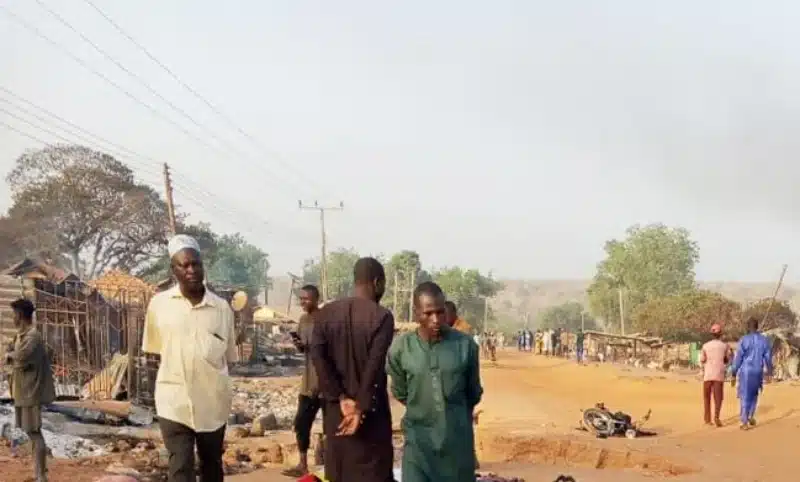
It was supposed to be an ordinary Sunday evening match. Young men and women had gathered at a football pitch in Guyaku village, Gombi Local Government Area of Adamawa State, when gunmen believed to be affiliated with the Islamic State West Africa Province, widely known as ISWAP, opened fire on the crowd late on 26 April 2026.
At least 29 people were killed.
Survivors describe an attack that did not end with the shooting. The gunmen stayed. They burned homes, destroyed motorcycles and set places of worship on fire in what local residents and security analysts describe as a sustained terror operation, not a raid.
The Nigerian military, which has been stretched across multiple fronts in the north-east, did not arrive in time to stop the killing. The delayed response has renewed sharp questions about the persistent security gap in rural communities across Adamawa.
Children Taken from an Orphanage
Hundreds of kilometres away in Lokoja, the Kogi State capital, gunmen struck the Dahallukitab Group of Schools, an orphanage facility described by sources familiar with the site as operating without full regulatory oversight in a poorly secured part of the city.
Twenty-three children were abducted, highlighting another dimension of Nigeria security crisis in the North-Central region.
Security forces launched follow-up operations and rescued 15 of them. As of the time of this report, eight children remain missing.
Unlike the massacre in Adamawa, the Lokoja raid was not designed to kill. It was designed to profit. Security analysts monitoring kidnapping networks in Nigeria’s North-Central region say the targeting of children in low-resistance, poorly protected facilities reflects a growing professionalism among criminal gangs who treat abduction as an industry, not an impulse.
One Weekend, Two Different Threats in Nigeria Security Crisis
What makes this weekend significant to those tracking Nigeria security crisis is not simply the scale of the violence, but the fact that two entirely different threat networks struck almost simultaneously.
In Adamawa, the perpetrators were ideologically driven. ISWAP-linked fighters have been linked to a string of attacks in the north-east, and the Guyaku massacre fits a pattern that security researchers say has grown measurably deadlier in 2026. The number of attacks in Adamawa has risen modestly, by roughly 13 per cent in recent months, but fatalities have surged by approximately 246 per cent, according to assessments reviewed by this publication. Fewer attacks, far more deaths, pointing to better weapons, tighter planning and a deliberate intent to kill in large numbers.
In Kogi, the perpetrators were financially driven. Their methods, swift entry, rapid extraction, no mass casualties, mirror tactics that kidnapping networks across Nigeria’s Middle Belt have refined over years of operation.
Different actors. Different motives. Same result: civilians targeted, the state outpaced.
A Pattern That Predates the Weekend
The Guyaku massacre did not happen in isolation.
On 21 April 2026, five days before the football pitch attack, ISWAP militants killed 12 civilians in Kubako, burning a church and, in a statement that drew condemnation from civil society groups, labelling the victims “combatants.” On the same day, a church minister was killed in northern Adamawa, in what analysts say indicates the group is now spreading operations across multiple locations simultaneously, marking a deadlier phase of Nigeria security crisis in the northeast.
The Guyaku attack represents the peak lethality event of this surge.
The Lakurawa Factor
Beyond ISWAP, security researchers tracking Nigeria security crisis have raised concerns about a lesser-known faction called Lakurawa, which is expanding from the north-west into central Nigeria. Unlike ISWAP, which maintains a recognisably ideological identity. Lakurawa is described by analysts as blurring the line between insurgency and banditry, adopting criminal tactics when useful and terror-level violence when useful, sometimes in the same operation.
The concern, as articulated by researchers who monitor the Sahel and Lake Chad Basin, is that Nigeria is no longer dealing with distinct, mappable threats. It is dealing with a hybrid ecosystem in which insurgent groups absorb criminal methods and criminal networks borrow insurgent levels of violence, further complicating Nigeria security crisis.
The American Advisory Presence
In early 2026, United States military advisory personnel were deployed to Nigeria to support the country’s counter-insurgency operations. The deployment was framed as a capacity-building measure.
Some analysts argue that the recent escalation, including the deliberate choice of a football pitch as a target, is partly a propaganda response by IS-linked networks seeking to demonstrate that neither the Nigerian military nor its foreign partners can protect ordinary civilians.
The Nigerian government has not commented publicly on whether the deployment of American advisers has altered operational planning on the ground.
What Guyaku Actually Signals
Security analysts say the choice of a football gathering as a target is not incidental.
ISWAP and affiliated networks have historically targeted military checkpoints, government buildings and Christian institutions. Attacking a community football match, where young people gather with no political or religious purpose, represents a deliberate widening of what constitutes a legitimate target in the group’s operational logic.
It is a message. Communities cannot simply avoid government buildings or military patrols to stay safe. Safety itself is being revoked.
The State’s Stretched Capacity
Nigeria’s security forces are fighting on too many fronts at once. In the north-east, ISWAP remains active across Borno, Adamawa and Yobe states. In the north-west, bandit networks have displaced hundreds of thousands and continue to conduct mass kidnappings of schoolchildren. In the Middle Belt, farmer-herder violence flares repeatedly. In the south-east, armed separatist activity continues to challenge federal authority.
The Guyaku massacre and the Lokoja orphanage raid, arriving together on the same weekend, exposed not just local failures but the structural limits of a security architecture that was not built for simultaneous, multi-front civilian targeting.
Eight Children Are Still Missing
At the time of writing, 15 of the 23 children taken from the Dahallukitab orphanage in Lokoja have been recovered. Eight have not.
Their families are waiting.
In Guyaku, communities are burying the dead from a football match that should have ended with a final whistle and young people walking home in the evening.
Nigeria security crisis, long described in policy language, is this weekend being measured in graves and missing children.
Additional reporting contributed by correspondents in Adamawa and Kogi states. This article will be updated as new information becomes available.


