



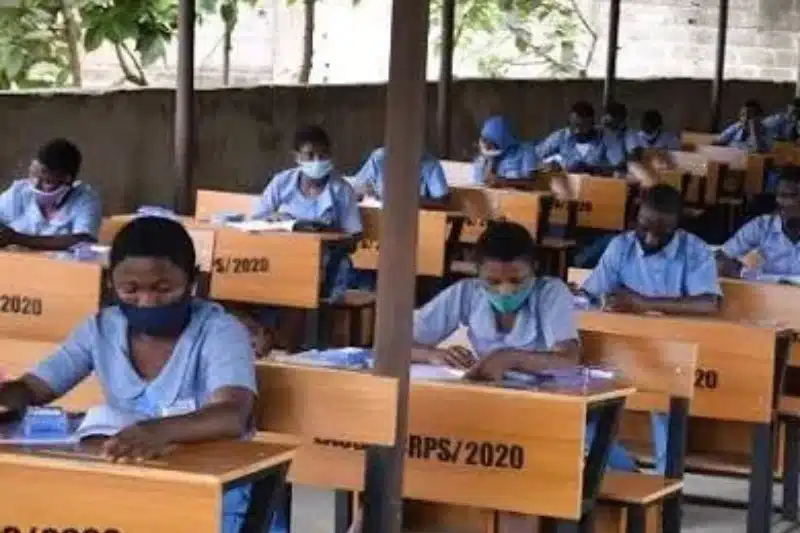

Nigeria’s Federal Ministry of Education has approved a uniform examination fee of N50,000 for candidates sitting the Senior Secondary Certificate Examination, in a WAEC NECO fee increase that has provoked backlash from parents, students and civil society groups.
A memo dated 18 June 2026, sighted by Vanguard and signed by the Director of Senior Secondary Education, Adeniji Ibrahim, on behalf of the Minister of Education, directed the Registrar of NECO to implement the new rate from 2027.
How The New Fees Compare
Before the WAEC NECO fee increase, internal candidates paid N27,000 for the West African Examinations Council and N30,000 for the National Examinations Council. Under the new arrangement, both bodies will charge N50,000 per candidate. That amounts to an 85 per cent rise for WAEC and a 67 per cent rise for NECO.
Candidates who intend to sit both examinations will now need N100,000 in total, excluding registration charges that individual schools often add on their own.
Government’s Justification For The Rise
The Ministry’s memo traces the decision to a meeting between the Minister of Education and examination bodies held on 31 March 2026, where officials discussed the rising cost of conducting public examinations. Following that meeting, the Minister directed WAEC and NECO to adopt a single, uniform fee structure rather than maintain separate figures.
The memo instructed NECO’s Registrar to bring the content of the letter to all stakeholders, effectively formalising the WAEC NECO fee increase as government policy ahead of the 2027 examination cycle.
Backlash From Parents And Stakeholders
The National Parent Teacher Association of Nigeria has been among the most vocal critics. Its Chairman, Board of Trustees, Deolu Ogunbanjo, told Vanguard that a fee review tied to the cost of living should have been progressive, at most 25 per cent, arguing that a rise of over 75 per cent is excessive given the other financial responsibilities parents already carry for their children.
Former Vice President Atiku Abubakar, through his Senior Special Assistant on Public Communication, Phrank Shaibu, described the WAEC NECO fee increase as cruel and economically insensitive, coming at a time when families are contending with inflation, high transport costs and stagnant incomes. The African Democratic Congress presidential candidate called on President Bola Tinubu to reverse the decision and convene a stakeholders’ dialogue on funding public education.
The National Association of Nigerian Students, led by President Akinteye Babatunde Afeez, rejected the WAEC NECO fee increase in a statement issued at the weekend, arguing that the ministry approved the policy without consulting student representatives.
A civil society group, the Campaign for Equal Rights and Opportunities for All Nigerians, also condemned the WAEC NECO fee increase. Its secretary, Francis Odiir, said parents already battling rising food prices and inflation should not be made to absorb a further financial burden, and urged the government to reverse course.
Fears Of Increased School Drop-outs
Beyond the immediate cost, stakeholders are concerned about what the WAEC NECO fee increase means for access to education. Several state governments currently cover examination fees for public school candidates, and education watchers warn the higher rate could deepen the debts some states already owe the examination bodies.
In Lagos State, for example, the government pays the WAEC fee for public school candidates, while parents typically cover the NECO fee themselves. With the WAEC NECO fee increase aligning both fees at N50,000, parents in states without government support face a considerably heavier bill.
The National President of the Nigeria Union of Teachers, Audu Titus Amba, took a more measured position, noting that the matter of registration fees ultimately rests with parents to accept or reject.
Civil society groups argue the stakes go beyond a single examination cycle. CERON warned that the fee rise could worsen Nigeria’s out-of-school children crisis by pushing families who cannot afford the cost to withdraw their children before they complete secondary school. Atiku made a similar point, arguing that for many children from low-income households, the path to university does not end at the admission stage but is cut off earlier by an inability to afford the qualifying examinations.
With the WAEC NECO fee increase set to take effect from the 2027 examination cycle, pressure is mounting on the Federal Ministry of Education to reconsider the policy or introduce measures to cushion its impact on households already stretched by Nigeria’s economic conditions.


