




Reports began to emerge early Sunday from isolated communities in northwest Nigeria. At first, the accounts were fragmented. Villagers spoke of gunmen arriving at night, homes set on fire, and families fleeing into nearby bush paths.
By Tuesday, a broader picture had started to form. What appeared to be separate incidents is now being described by residents and local sources as a series of coordinated Northwest Nigeria village attacks.
At least 60 people are reported to have been killed.
The violence unfolded between April 6 and April 8 across more than 10 rural communities in Kebbi State and Niger State, though access to some of the affected areas remains limited.
Death toll uncertain as accounts vary
The reported death toll from the Northwest Nigeria village attacks is drawn largely from local residents, clergy, and humanitarian contacts. In many of the affected communities, bodies are still being recovered.
In Erena village in Shiroro Local Government Area of Niger State, residents say around 20 people were killed when gunmen entered the community and opened fire.
In Kebbi State, at least 24 deaths have been confirmed. Local accounts from several villages indicate the number may be higher, though a full count is still unclear.
Officials have reported lower figures in some areas, reflecting the challenges of tracking casualties in remote communities where access is limited and information comes in slowly.
A pattern of attacks, but details still emerging
Across the areas affected by the Northwest Nigeria village attacks, witnesses describe a similar sequence. Armed men moved between villages over several days, attacking residents and setting fire to homes and supplies.
Many accounts point to indiscriminate killings. Victims included Christians, Muslims, and traditional worshippers. Livestock and food stores were destroyed, deepening the impact on already vulnerable communities.
Some survivors said attackers chased those who tried to escape into surrounding bush areas.
“They killed everybody in sight,” one local clergy member said, requesting anonymity. “They were not taking anything. They were there to kill and destroy.”
Even so, not all accounts are identical. While several witnesses reported no looting, others suggest that property was also taken or damaged, indicating that the pattern of the Northwest Nigeria village attacks may vary from one location to another.
Displacement grows as survivors flee
As the attacks spread, entire communities emptied.
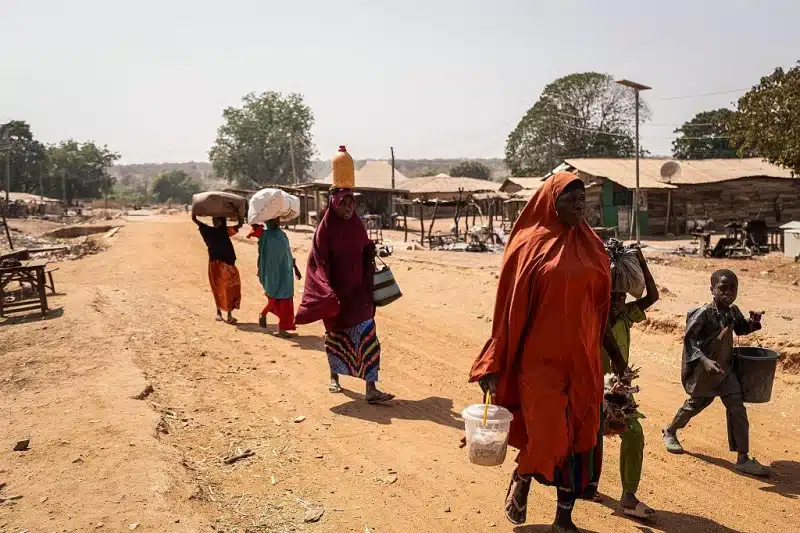
More than 500 people are now sheltering in churches and school buildings in Yauri town in Kebbi State. Many arrived with little warning and few belongings.
Some families say they have not been able to return to their villages. In some communities, families say they have not been able to return to bury those killed, fearing the attackers could come back.
The Northwest Nigeria village attacks have also drawn attention to how thin security presence remains in many rural areas, where help often arrives late or not at all.
Suspected links to armed groups
Authorities and residents have pointed to a group locally referred to as Mahmuda as being behind the Northwest Nigeria village attacks, although no group has formally claimed responsibility.
The group is believed to have links to Ansaru, a faction that split from Boko Haram.
Security analysts say the situation is becoming increasingly complex, with armed bandit groups and extremist factions operating in overlapping networks across northern Nigeria.
According to data from ACLED, such hybrid patterns of violence have become more frequent since 2025.
US advisory highlights broader risks
The latest violence comes at a time when security concerns in Nigeria are already under scrutiny internationally. The United States has advised its citizens to reconsider travel, and in some cases avoid it entirely.
Among the states listed are Niger, Borno, Plateau, Taraba, Yobe, Jigawa, Kogi, and Kwara. Niger State is one of the areas affected by the recent attacks.
Officials point to risks that range from kidnapping and armed attacks to gaps in healthcare access. The warning reflects a broader sense that insecurity is no longer confined to a few locations.
Limited official response
Police have confirmed the Shiroro incident and have linked violence in Kebbi State to the Mahmuda group.
Since then, authorities have said little about any arrests or follow-up operations linked to the Northwest Nigeria village attacks. This lack of information or inaction makes the situation even more depressing to the villagers.
A crisis still unfolding
What is emerging is not a single incident, but a series of attacks spread across hard-to-reach communities, where details are still coming in.
The Northwest Nigeria village attacks reflect how insecurity is pushing into areas that were once considered relatively stable. In many of these places, there is little immediate response when violence breaks out.
For those affected, the situation is still unfolding. Some have fled. Others are waiting for news from communities that are still out of reach.


