




Sudan’s Rapid Support Forces are fracturing from within as a succession of RSF defecting commanders has shaken the militia’s internal structure. Simultaneously, the United Nations Security Council has issued an urgent alarm over an RSF troop buildup around El Obeid, warning that a ground offensive on the city could trigger mass atrocities.
The two developments together paint a picture of a force haemorrhaging senior figures to its enemy while pressing ahead with an aggressive military expansion elsewhere.
Defections that shook the RSF
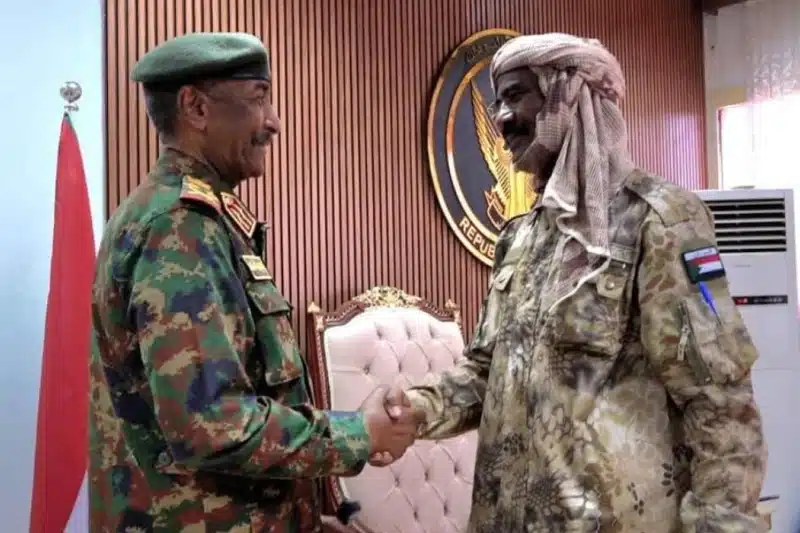
The most prominent figure among the RSF defecting commanders is Major General al-Nour Ahmed Adam, known as al-Qubba, who played a central role in the battles for El Fasher before joining the Sudanese Armed Forces in April 2026.
Military sources told Sudan Tribune that his decision followed internal disputes after he was passed over for the military governorship of North Darfur in favour of a rival, Ibn Shouk, following the fall of El Fasher in October 2025. Al-Qubba reportedly felt marginalised and complained of discriminatory treatment towards his troops.
His departure was anything but quiet. Supported by loyalist fighters and 46 combat vehicles, his convoy moved through the desert towards northern Sudan while the Sudanese army deployed combat drones to provide aerial cover and strike RSF ambushes positioned along the desert corridor.
RSF leader Mohamed Hamdan Dagalo, known as Hemedti, personally led efforts to dissuade al-Qubba from leaving. Sources inside the RSF said he had quietly departed his position in North Darfur about a week before his alignment with the army was confirmed.
Hemedti’s response was swift. He stripped al-Qubba of his rank and sentenced him to death in absentia. Observers say the harsh response reflects fears that additional RSF defecting commanders could follow al-Qubba’s example.
Army chief Abdel Fattah al-Burhan personally received al-Qubba in Dongola, presenting him with his own vehicle as a gesture of appreciation. Burhan declared that anyone who leaves the fighting and joins the state may have their case reviewed, an offer that amounts to a de facto amnesty.
Al-Qubba was not the only figure in the growing list of RSF defecting commanders. In May 2026, Commander Ali Rizq Allah, known as Al-Savannah, a key RSF figure who had operated across Kordofan and Darfur, also crossed over to the SAF.
On 17 May, he appeared at a press conference in a SAF uniform, denouncing the RSF and pledging to fight alongside the army. Both men are members of the Mahamid-Rizeigat clan, which forms part of the RSF’s core Arab constituency.
According to the Armed Conflict Location and Event Data Project, the defections expose fractures in the RSF’s core alliances, driven by resource scarcity and growing distrust among mid-level commanders. Growing number of RSF defecting commanders has become a major concern for the group’s leadership as battlefield setbacks continue to mount.
The pattern predates 2026. In October 2024, Abu Aqla Keikel, then a senior RSF-aligned commander in Gezira state, defected to the SAF. Army forces subsequently retook Gezira state in January 2025. The emergence of RSF defecting commanders has become one of the most significant trends shaping the battlefield since 2024.
Rights groups sound the alarm on accountability
The wave of RSF defecting commanders has drawn sharp scrutiny from human rights organisations. Human Rights Watch said on 10 June 2026 that the SAF must not allow defectors to escape accountability for crimes committed while in RSF service. The organisation stressed that investigations should apply equally to RSF defecting commanders and other combatants accused of serious violations.
Human Rights Watch documented widespread RSF attacks against civilians in El Fasher, including killings and rapes during the RSF’s takeover of the city in late October 2025. The organisation verified videos confirming the presence of both commanders during the RSF’s 18-month siege of El Fasher.
Mohamed Osman, Sudan researcher at Human Rights Watch, said those responsible for serious international crimes do not receive a free pass simply by switching sides, adding that Sudanese people deserve justice and an end to the vicious cycles of impunity that have long haunted the country.
El Obeid: a city under siege
While the trail of RSF defecting commanders signals internal breakdown, the militia has been tightening its grip around El Obeid, the capital of North Kordofan state.
The UN Security Council, in a statement on 20 June 2026, expressed alarm over reports of substantial military reinforcements by the RSF around El Obeid, warning of the risk of a potential ground offensive. Council members voiced concern over an imminent risk of mass atrocities and demanded that the RSF immediately halt its assault on the city.
UN Secretary-General António Guterres said he was particularly alarmed by the scale of RSF reinforcements around El Obeid, warning that an offensive would place yet another major population centre at grave risk of large-scale violence. He urged all those with influence over the warring parties to act to prevent further bloodshed.
The city has already been suffering. On 11 June 2026, at least 16 people were killed and dozens wounded when RSF drones struck several neighbourhoods in El Obeid, making it one of the deadliest bombardments to hit the city since the war began.
RSF drones then struck fuel stations in El Obeid for five consecutive days in mid-June, destroying or setting ablaze around five stations and threatening fuel supplies across North Kordofan.
UN High Commissioner for Human Rights Volker Türk drew a direct parallel with the fall of El Fasher, warning the same pattern was now unfolding in North Kordofan. “We cannot allow the repeat of the preventable atrocities we documented in El Fasher and Zamzam IDP camp in North Darfur last year,” he said.
The Global Centre for the Responsibility to Protect warned that the situation around El Obeid reflected patterns seen before El Fasher fell, where prolonged encirclement culminated in large-scale civilian attacks. It called on states with influence to use all available diplomatic channels to press for immediate de-escalation.
The UN human rights office reported that more than 1,000 civilians had been killed by drone strikes in Sudan in the first five months of 2026 alone.
Fracture lines and what follows
Analysts at ACLED warn that if the RSF’s internal breakdown deepens, local militia leaders may defect to the SAF or revert to operating as transnational mercenaries, potentially drawing volatile neighbouring countries including Chad, South Sudan and Ethiopia into the conflict.
They said further losses of more RSF defecting commanders could accelerate the fragmentation of the paramilitary movement across Darfur and Kordofan. The steady flow of RSF defecting commanders continues to hand the Sudanese army both a strategic and symbolic advantage in a war now entering its fourth year.
Whether those defections reflect a genuine collapse of the RSF’s command structure, or simply the grievances of sidelined individuals, remains a question that millions of displaced Sudanese cannot afford to wait long to see answered. For now, the continued emergence of RSF defecting commanders remains one of the clearest indicators of strain within the paramilitary force.


