



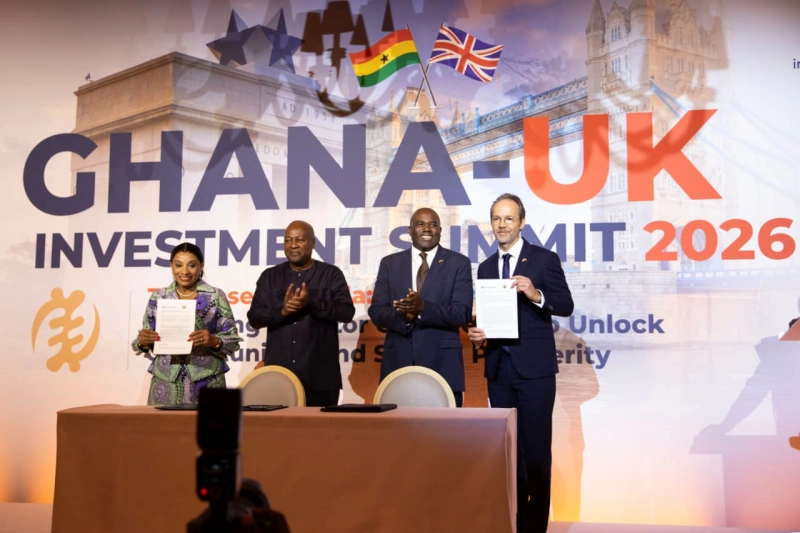

Ghana and the United Kingdom have signed the UK-Ghana Growth Partnership, a new framework designed to boost investment, infrastructure development and economic growth.
At the Ghana-UK Investment Summit in London on Monday, President John Dramani Mahama and Deputy Prime Minister David Lammy witnessed the signing of the UK-Ghana Growth Partnership, aimed at transforming the economy and creating thousands of opportunities for people.
The agreement sets out a coordinated roadmap for the 2026 to 2028 period, with investment deals valued at up to £215 million.
The signing was a moment Ghana’s government had been building towards. The summit was convened at the historic Raffles London under the theme “Restoring Investor Confidence to Unlock Opportunities and Shared Prosperity.”
A Deal Spanning Four Areas
The UK-Ghana Growth Partnership focuses on four priority areas: attracting private investment and finance, making it easier for Ghanaian businesses to trade, supporting infrastructure and industrial growth, and expanding skills and education partnerships.
Mahama told attendees that bilateral trade between the two countries already exceeds £1.5 billion annually, but said he believed that only scratched the surface of what was possible.
The president used the summit to make a direct pitch. “To the international investors gathered here today, let me say this clearly, Ghana is open for business,” Mahama said. “We’re open to partnerships that create jobs, transfer technology, develop skills, support industrialisation, expand exports, and deliver sustainable growth.”
A Port That Could Change the Region
The most substantial single item within the UK-Ghana Growth Partnership is a maritime project with regional implications.
A £101 million UK-backed investment will establish the Gulf of Guinea’s first commercial-scale ship repair and dry-docking facility at Takoradi, projected to create up to 430 direct jobs, with 30 per cent of positions reserved for women.
Mahama said the project had a wider significance beyond its job numbers. He particularly welcomed the Takoradi Floating Dock Project because, in his words, “it will pioneer the use of local pension funds for infrastructure. This is how Ghana becomes sustainable and self-reliant.”
British High Commissioner to Ghana, Christian Rogg, said the UK-Ghana Growth Partnership was designed to deliver practical economic benefits. “This Growth Partnership is about real change people can see and feel. It means more skilled jobs, stronger ports and transport links, better access to finance, and new opportunities for young people and women across Ghana,” he said.
Forests, Technology and Healthcare
Beyond the headline maritime deal, the UK-Ghana Growth Partnership spreads across several other sectors.
The partnership includes climate-related investments, among them an £85 million reforestation fund and a £9 million initiative focused on forest restoration in the Oti Region. That fund, developed in collaboration with Ghana’s Forestry Commission, will finance reforestation and carbon-credit projects, restore degraded land and create employment in rural communities.
In the technology sector, the agreement provides £6 million to support the implementation of Ghana’s Artificial Intelligence Strategy and strengthen science and technology collaboration across universities.
The deal also covers healthcare, with the partnership set to train Ghanaian clinical engineers with specialist skills, according to details outlined at the summit.
The Economy Ghana Is Pitching
The UK-Ghana Growth Partnership arrives at a moment when Accra is pointing to a significant economic turnaround.
Mahama told the summit that Ghana’s inflation had fallen sharply, from 23.8 per cent in December 2024 to 3.4 per cent as of April 2026. He said international reserves had risen from approximately $8.9 billion to nearly $13.8 billion, providing stronger external buffers and exchange rate stability.
He added that interest rates were easing, the cedi had stabilised and appreciated against major currencies, and Ghana’s sovereign credit outlook had improved following upgrades by international ratings agencies.
The partnership comes as Ghana seeks to accelerate its recovery, attract foreign investment and position itself as a regional hub for manufacturing, logistics and green growth, following years of fiscal strain and debt restructuring.
Benefits Flowing Both Ways
London framed the UK-Ghana Growth Partnership as an opportunity for British industry too.
The deals span sectors where British firms have competitive strength, including maritime engineering, infrastructure finance, education exports and specialist healthcare training.
A £5 million Green Project Preparation Facility, hosted by FSD Africa in partnership with the Ghana Infrastructure Investment Fund, is also designed to unlock further infrastructure deals over three years, with explicit support for UK companies.
The UK-Ghana Growth Partnership builds on commitments made during the Ghana Investment Summit and coincides with the fifth anniversary of the UK-Ghana Trade Partnership Agreement.


