



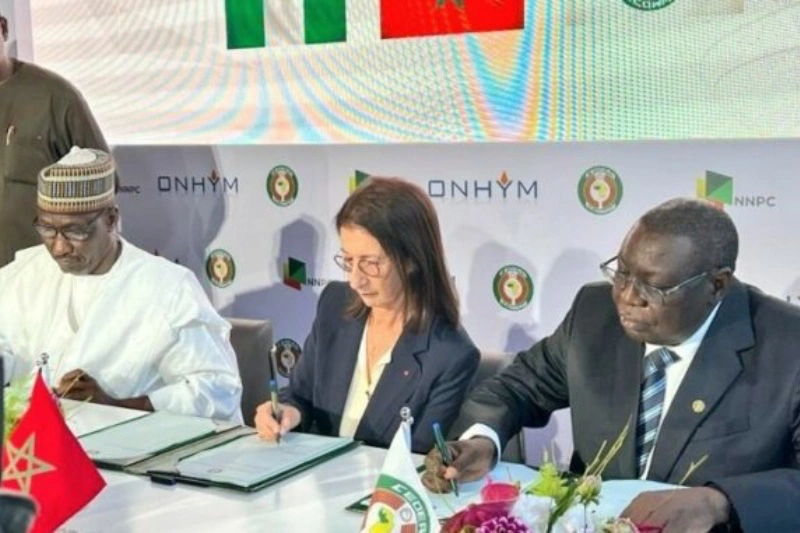

West African leaders have signed an intergovernmental agreement approving the long-delayed Nigeria-Morocco gas pipeline, marking one of the biggest energy commitments on the continent this year.
The agreement was signed on Sunday in Freetown, Sierra Leone, at a summit of the Economic Community of West African States. Heads of state from the bloc’s member countries put pen to paper on the Intergovernmental Agreement governing the pipeline’s development.
The agreement marks the most significant political breakthrough for the Nigeria-Morocco gas pipeline since the project was first announced in 2016.
Sierra Leone’s President Julius Maada Bio, who currently chairs ECOWAS, confirmed the signing to leaders gathered at the summit. He said the West Africa-Morocco gas pipeline had already been signed and told member states not to be surprised when the gas eventually reaches their shores.
The Nigeria-Morocco gas pipeline is designed to run for roughly 6,000 kilometres along Africa’s Atlantic coastline, according to figures reported by Vanguard and Arab News. Morocco’s state news agency MAP places the distance closer to 6,800 kilometres, so the exact figure may still be settled as engineering work continues.
Once complete, the Nigeria-Morocco gas pipeline will pass through 13 countries before linking into the Maghreb-Europe pipeline in northern Morocco. From there, Nigerian gas would reach European markets for the first time through an all-African overland route.
Morocco’s National Office of Hydrocarbons and Mines and Nigeria’s state oil firm NNPC Limited are jointly developing the project. In a joint statement, the two companies said the pipeline aims to link West Africa’s gas resources to major regional markets while strengthening the integration of African energy systems.
Cost estimates for the Nigeria-Morocco gas pipeline vary by source. Arab News and Newscentral put the figure at around 27 billion dollars, while Morocco World News reports an estimate closer to 25 billion dollars. Either way, it ranks among the costliest cross-border infrastructure projects on the continent.
The idea for the pipeline dates back to 2016, when Morocco’s King Mohammed VI visited Abuja and launched the project alongside the late Nigerian President Muhammadu Buhari. President Bola Ahmed Tinubu has continued to back the initiative since taking office.
Two countries along the route, Morocco and Mauritania, are not ECOWAS members. A separate signing ceremony involving both nations is expected to take place later, reportedly in Tinubu’s presence.
Following the Freetown signing, attention turns to setting up the structures needed to move the Nigeria-Morocco gas pipeline into its next phase. This includes forming a dedicated project company, expected to be headquartered in Casablanca, alongside a Pipeline Higher Authority that will be based in Abuja.
ONHYM and NNPC Limited say the main engineering, environmental and technical studies have already been completed. Investor mobilisation and a final investment decision are the next milestones before construction can begin in earnest.
For Nigeria, the pipeline offers a route to diversify gas exports beyond traditional LNG shipments. For the wider ECOWAS bloc, it represents a rare example of regional energy cooperation moving from paper to formal commitment, even as the timeline for gas actually flowing through the line remains some years away.


