



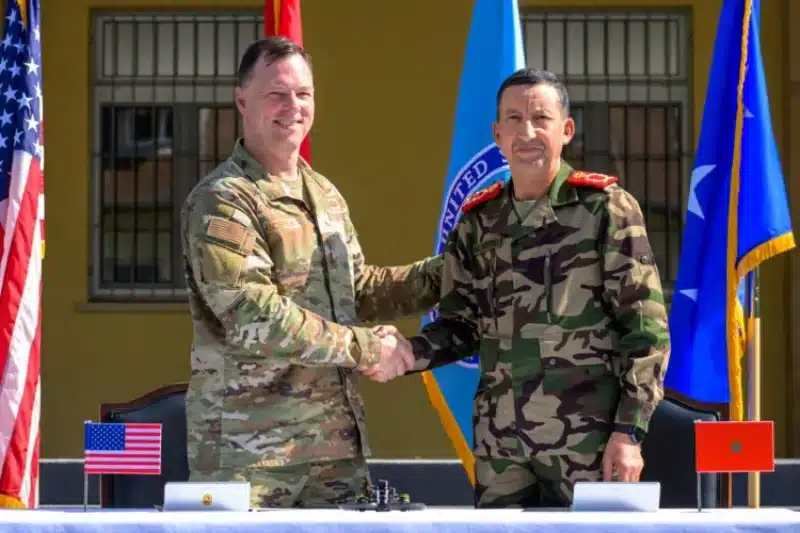

Morocco’s Royal Armed Forces and the United States Africa Command have signed a memorandum of understanding to establish the Africa Multidomain Training and Experimentation Centre, known officially as AMTEC. The agreement was signed on 13 July at AFRICOM headquarters in Stuttgart, Germany, according to a statement from the command.
The Morocco AFRICOM training centre is described by AFRICOM as a joint defence and innovation hub. It is set to be built in Tan-Tan, in southern Morocco, with a target completion date of 2030.
AFRICOM says the Morocco AFRICOM training centre will bring together three separate facilities under one main project. These are a Multidomain Training Area, a Drone Academy and an Innovation and Experimentation Centre, each with a distinct role.
The Multidomain Training Area is meant to give forces a single environment where they can train across land, air, sea, cyber and the electromagnetic spectrum. AFRICOM says the facility will replicate contested conditions similar to real combat environments, rather than relying on simulated exercises alone.
The Drone Academy, one arm of the Morocco AFRICOM training centre, will train operators, planners and instructors drawn from Morocco and other African partner nations. Its curriculum is built around integrating small unmanned aerial systems into military operations, with a stated focus on countering threats in West Africa.
Trainees will study airspace deconfliction, multidomain integration and strike capabilities, alongside intelligence, surveillance and reconnaissance synchronisation, AFRICOM says in its announcement of the programme.
The Innovation and Experimentation Center, the third component of the Morocco AFRICOM training centre, is expected to focus on testing emerging defence technologies. AFRICOM describes the aim as developing affordable and scalable tools for counterterrorism and wider regional security operations across the continent.
Universities and research institutions are also expected to join the initiative. AFRICOM says academic experts will work alongside military and industry teams in multidisciplinary design groups focused on next generation technologies.
General Mohammed Berrid, Inspector General of the Royal Moroccan Armed Forces and commander of its Southern Zone, said Morocco’s existing facilities and trained personnel would allow the project to move quickly from paperwork to operational reality. He added that the arrangement gives Moroccan and American industries what he called “a reliable and capable partner” for joint innovation and export opportunities.
General Dagvin Anderson, commander of US Africa Command, said the Morocco AFRICOM training centre would raise readiness levels and sharpen capabilities for both countries. He described the initiative as an opening for defence industries and academic institutions on both sides to experiment and build adaptable solutions around emerging technologies.
Beyond the military dimension, AFRICOM says the project carries an economic angle for Morocco. Officials expect it to expand network infrastructure in remote and underserved areas, while giving Moroccan and American developers a cost effective site to test advanced wireless and sensing technologies.
The first practical test of the Morocco AFRICOM training centre concept will come through African Lion 2027, Morocco’s annual joint military exercise with the United States. AFRICOM says the exercise will serve as a proof of concept, letting troops and industry partners trial artificial intelligence systems, autonomous platforms and advanced communication tools before any wider rollout.
Morocco already hosts the largest edition of African Lion on the continent, and has steadily deepened its defence relationship with Washington in recent years. AFRICOM oversees security cooperation across more than fifty African states, and the Morocco AFRICOM training centre ranks among its most substantial permanent infrastructure commitments on the continent to date.
The new centre adds a lasting research and training footprint to that relationship, anchored in the kingdom’s south near Tan-Tan, well ahead of the project’s planned 2030 completion.


