



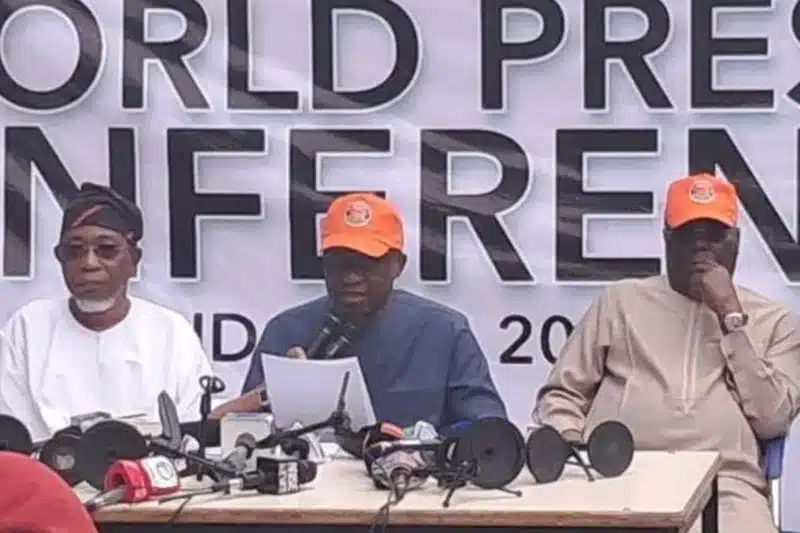

A three-member panel of the Court of Appeal in Abuja has upheld a Federal High Court judgment nullifying state congresses and a national convention conducted by the David Mark-led leadership of the African Democratic Congress. This is the latest turn in the ADC leadership crisis that has trailed the party since last year.
The ruling, delivered in a split decision of two to one on Monday, restrains the Independent National Electoral Commission from recognising the outcome of those congresses.
Justice Okon Abang read the lead judgment, with Justice Donatus Okorowo concurring. Justice Abba Mohammed, the presiding justice, dissented. He argued that the dispute was an internal party affair that fell outside the jurisdiction of the courts.
The appellate court dismissed the appeal marked CA/ABJ/CV/608/2026 and ordered the ADC to pay costs of ₦10 million to the affected state chairmen, a penalty that shows how costly the ADC leadership crisis has become for the party’s coffers. It affirmed the earlier ruling of Justice Joyce Abdulmalik of the Federal High Court, delivered on 29 April, which held that the four-year tenure of the party’s State Working Committees and State Executive Committees remained valid pending properly constituted congresses.
The underlying case, filed by aggrieved ADC members including Don Obinna and Johnny Derek on behalf of state chairpersons, was marked FHC/ABJ/CS/581/2026. Defendants named in the suit included the ADC, Mark, interim national secretary Rauf Aregbesola, and INEC.
Justice Abang held that the congresses and national convention conducted by the Mark-led leadership amounted to a nullity, since they were held in defiance of a subsisting court order issued on 14 April. The majority judgment found that responsibility for organising state congresses rests with elected state executive committees, not a caretaker national leadership.
This is not the first legal setback tied to the ADC leadership crisis. Mark’s leadership had earlier survived a related Supreme Court appeal in April, when a five-member panel led by Justice Lawal Garba set aside a Court of Appeal order that had prompted INEC to de-recognise his executive committee. That earlier victory, though, turned on a narrow procedural question over whether the appellate court had power to issue a preservative order, rather than on the legality of the congresses now voided.
ADC’s National Welfare Secretary, Nkem Ukandu, said the party would challenge Monday’s verdict at the Supreme Court. He maintained that the dispute remains an internal matter and voiced confidence that the apex court would side with the party.
The ADC leadership crisis now confronts a less favourable precedent, though. In a separate ruling weeks ago, the Supreme Court upheld, by a split decision of three to two, the nullification of a Peoples Democratic Party convention held in Ibadan. The apex court held that a party which proceeds in contempt of a subsisting court order cannot expect protection from the bench.
That reasoning mirrors the basis of Monday’s judgment against the ADC. Should the appeal reach the Supreme Court, the justices would need to distinguish the two cases on their facts, or depart from their own recent position on contempt, for the party’s chances of a reversal to improve. Neither path is guaranteed, and legal watchers say the odds now sit less comfortably with the party than they did in April.
The ruling arrives at a delicate moment for opposition politics. The ADC leadership crisis has persisted since July 2025, when a National Working Committee led by Mark emerged following the resignation of executives under Ralph Nwosu. Politicians including former Vice President Atiku Abubakar, former Kaduna State governor Nasir El-Rufai, and former minister Rotimi Amaechi adopted the party as a coalition platform to challenge President Bola Tinubu ahead of 2027.
Industry reporting has noted that the judgment could deepen internal disputes within the ADC leadership crisis and complicate the party’s preparation for the 2027 general election, given that valid state structures are central to candidate nomination and delegate processes. INEC’s timetable places the presidential poll in early 2027, leaving the coalition limited room to resolve internal disputes before primaries begin.
Beyond the courtroom, the practical implication for the ADC leadership crisis is time. INEC’s timetable places the 2027 presidential poll in mid-January, and state congresses are the foundation on which delegate lists and candidate primaries are built. Without settled state structures, the party cannot credibly conduct a national convention or select candidates that INEC and rival parties cannot later challenge in court.
A further appeal to the Supreme Court, even if filed promptly, is unlikely to be resolved quickly. The party’s own April experience shows that Supreme Court appeals in this dispute have taken weeks to determine, and a substantive ruling on the validity of congresses carries more legal weight than the procedural question the apex court settled in April. Each month spent in litigation is a month the ADC leadership crisis eats into its preparation window.
The ruling also strengthens the position of the state chairmen who brought the original suit, restoring their tenure and their authority to organise future congresses. Whether the Mark-led leadership can now work with them, rather than around them, may determine whether the ADC leadership crisis is resolved through negotiation or drags on through further rounds of litigation.
For now, the ADC’s stated position is one of unity. But every fresh ruling in the ADC leadership crisis narrows the window for the party to organise valid congresses, hold a properly constituted convention, and settle its candidate list before INEC’s deadlines close in on the 2027 race.


