



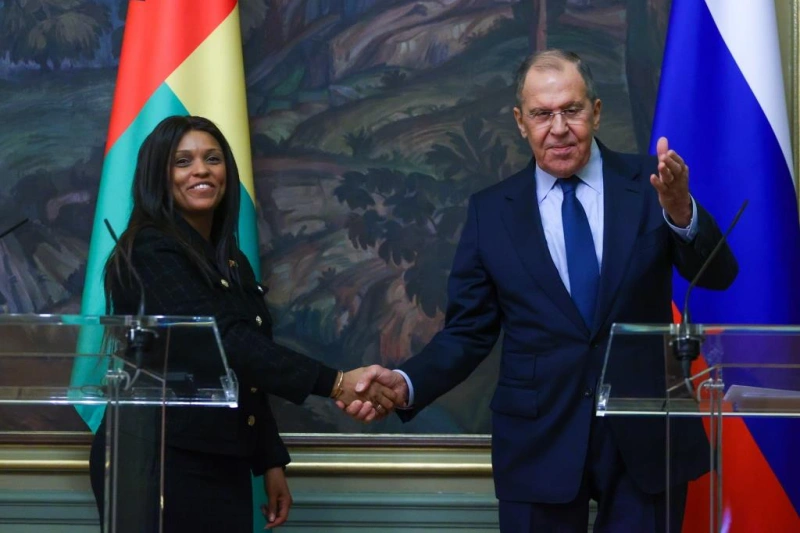

Russian Foreign Minister Sergey Lavrov received Guinea-Bissau’s Foreign Minister Fatumata Djau in Moscow on Thursday, in a visit that has renewed questions about Guinea-Bissau Russia ties less than eight months after a military takeover in Bissau.
Lavrov opened the talks by noting that the visit was not Djau’s first trip to Russia, and that both sides intended to build on what he called a solid foundation rooted in Guinea-Bissau’s independence struggle, according to Russia’s state news agency TASS. He said the goal was to keep strengthening Guinea-Bissau Russia ties within a new, multipolar world order.
The Moscow meeting comes as Guinea-Bissau’s transitional president, General Horta Inta-A Na Man, prepares to attend the third Russia-Africa Summit, scheduled for October in Moscow. Lavrov confirmed the attendance himself at a joint press conference with Djau, adding that Russia would welcome a full delegation from Bissau, TASS reported.
At that same briefing, Lavrov listed artificial intelligence, digital payment systems and alternative currencies to Western reserve currencies as priority items for the October summit, according to Sputnik. He also pointed to agriculture, fisheries, higher education and public health as areas where Guinea-Bissau Russia ties could expand further in the years ahead.
Trade between the two countries remains modest despite a recent uptick, Lavrov said, adding that current figures fall short of the two countries’ potential, per TASS.
The renewed engagement follows a turbulent stretch for Guinea-Bissau. The West African nation has been under military rule since 26 November 2025, when soldiers detained then president Umaro Sissoco Embalo and halted the release of results from a closely contested general election. General Horta Inta-A Na Man was sworn in as transitional president the next day, leading a junta that calls itself the High Military Command for the Restoration of National Security and Public Order.
ECOWAS suspended Guinea-Bissau from all decision-making bodies within 48 hours of the takeover, and the African Union followed with its own suspension. Both blocs have pressed the junta to release detained officials and restore constitutional order, with ECOWAS’s Mediation and Security Council warning that targeted sanctions remain on the table. It is against this backdrop of regional isolation that Guinea-Bissau Russia ties have gathered fresh attention.
That isolation from regional bodies is part of what makes the strengthening Guinea-Bissau Russia ties notable. A similar pattern played out in Mali, Burkina Faso and Niger, where military juntas that seized power turned towards Moscow after falling out with ECOWAS and former colonial power France. The three states eventually broke from ECOWAS altogether and formed the Alliance of Sahel States, deepening security and diplomatic cooperation with Russia in the process.
Guinea-Bissau has not taken that step. It remains, at least formally, an ECOWAS member state under suspension rather than a bloc that has withdrawn, and its junta has not announced any rupture with France or the wider West comparable to the Sahel states. Djau’s visit to Moscow also builds on an existing relationship rather than marking a first contact, since Lavrov himself noted it was not her first trip to Russia.
Even so, the timing invites comparison, and it is one reason observers are watching Guinea-Bissau Russia ties so closely. A junta under regional suspension sending its top diplomat to Moscow, securing a presidential invitation to a Russia-Africa summit and receiving pledges of cooperation across agriculture, education and health mirrors the early diplomatic moves the Sahel states made before their own pivot towards Moscow deepened.
Whether Guinea-Bissau Russia ties translate into the kind of security partnership seen in Mali and Burkina Faso, including the presence of Russian military instructors, is not yet clear from Thursday’s talks. Lavrov’s public remarks focused on trade, technology and the summit rather than military cooperation, and Guinea-Bissau’s foreign ministry has not issued its own detailed readout of the meeting.
The October summit in Moscow is likely to offer the clearest signal yet of how far Guinea-Bissau Russia ties will go, particularly if General Horta Inta-A Na Man attends in person alongside other African heads of state and government still navigating their own relationships with Western and regional partners.


