



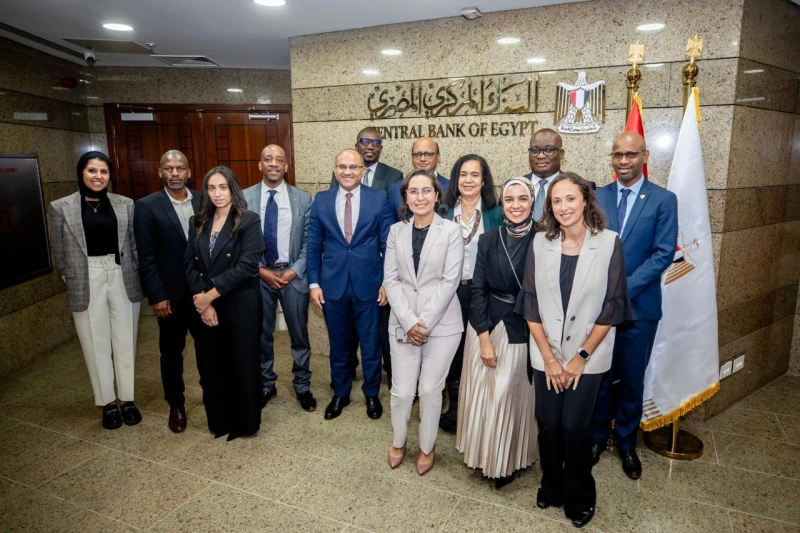

The Central Bank of Egypt has published the maiden African Financial Stability Report, giving the continent its first unified assessment of banking health and financial risk across 46 countries.
CBE Governor Hassan Abdalla chairs the working group behind the report. The document covers nations representing roughly 85 percent of Africa’s countries, 84 percent of its population and close to 90 percent of continental GDP.
The African Financial Stability Report was prepared under the African Financial Stability Committee, a body Abdalla proposed to the Association of African Central Banks in 2024. Cairo hosted the committee’s first meeting that December, formally launching the initiative.
Experts from seven central banks contributed to the work. They came from the Central Bank of West African States, the Bank of Central African States, the National Bank of Rwanda, the Bank of Mauritius, the South African Reserve Bank, the Bank of Mozambique and the Central Bank of Eswatini.
Their findings paint a picture of a continent building resilience despite external pressure.
According to the report, Africa’s Financial Stability Index stands at 0.55, a figure attributed to stronger banking sector performance across member states. Average economic growth held at 3.2 percent through 2024, even as economies contended with global headwinds and domestic shocks.
Total assets across Africa’s financial system reached about 126 percent of the continent’s GDP. Banks accounted for the larger share, with banking assets equal to 80 percent of GDP against 46 percent for non-bank institutions.
The African Financial Stability Report puts the banking sector at 63 percent of total financial system assets, with non-banking institutions making up the remaining 37 percent.
On capital strength, African banks reported an average capital adequacy ratio of 19.7 percent. That sits comfortably above the thresholds set by the Basel Committee. The report links this cushion to solid liquidity coverage ratios in both local and foreign currencies.
Regulatory alignment is also progressing. Central banks across the continent have implemented an average of 61 percent of international financial stability best practices, according to the findings.
Capital markets featured prominently too. Stock market capitalisation across Africa reached 56 percent of GDP, evidence of a deepening role for equity markets in channelling investment.
Mobile finance remains a standout strength. The report credits Africa with leading globally in mobile wallet adoption, alongside steady gains in financial digitalisation and regional payment infrastructure.
For investors and policymakers, the African Financial Stability Report is designed as a reference point. It offers a single, continent-wide gauge of risk at a time when global financial systems face mounting uncertainty.
Beyond monitoring, the report is meant to sharpen how African regulators use macroprudential tools, the policy levers that guard against system-wide shocks rather than risks at individual banks.
The AFSC operates through two working groups. One handles preparation of the annual report itself. The other focuses on developing and rolling out macroprudential policy across member states. A secretariat coordinates both.
Egypt’s leadership on the project reflects a broader push by the CBE to position Cairo as a hub for continental financial coordination, building on relationships established through the AACB since 2024.
Whether the index becomes an annual fixture will depend on continued participation from central banks across all five African regions, something the AFSC says remains a priority as the framework matures. The African Financial Stability Report is expected to serve as a benchmark for tracking financial resilience and systemic risks across the continent in the years ahead.


