



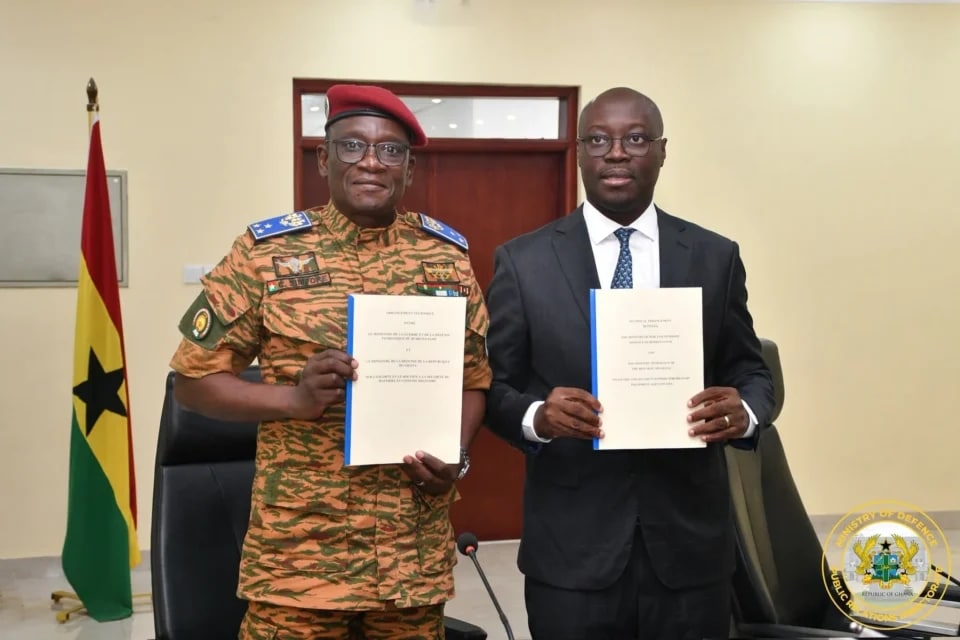

Ghana and Burkina Faso have signed a new defence pact designed to protect cross-border trade routes from insurgent attacks, formalising joint military escorts for cargo trucks moving between the two countries.
The Ghana Burkina Faso defence pact was signed on Tuesday in Accra by Ghana’s Acting Minister for Defence, Dr Cassiel Ato Forson, and Burkina Faso’s Minister of State and Minister of War and Patriotic Defence, Major General Célestin Simporé. Dr Forson later confirmed the agreement in a Facebook post, describing it as a move to deepen defence cooperation and protect the movement of goods and people between the two neighbouring countries.
Under the terms of the agreement, the two countries will establish a coordinated military framework that includes armed escorts for transit trucks and targeted security operations along key trade corridors. Joint military deployments and coordinated border patrols are expected to begin almost immediately.
The Ghana Burkina Faso defence pact centres on the Tema-Ouagadougou corridor, which has become increasingly important since landlocked Burkina Faso began shifting import and export traffic away from the Port of Abidjan amid political tensions with Côte d’Ivoire. That diversion has pushed a growing volume of Burkinabè cargo through Ghana’s Tema and Takoradi ports, turning the route into a vital economic artery and, at the same time, a more attractive target for armed groups operating across the Sahel and border regions.
Beyond truck escorts, the Ghana Burkina Faso defence pact provides for expanded intelligence sharing and tighter border controls aimed at combating terrorism and cross-border smuggling networks. The signing ceremony was attended by Ghana’s Deputy Defence Minister Ernest Brogya Genfi, Chief Director Emmanuel Kartey, Chief of the Defence Staff Lieutenant General William Agyapong, senior officers of the Ghana Armed Forces and members of the Burkinabè delegation.
This latest Ghana Burkina Faso defence pact builds on groundwork laid earlier in the year. In February, the two countries signed seven bilateral agreements in Ouagadougou following a deadly extremist ambush in the northern Burkinabè town of Titao that killed several Ghanaian nationals. Those agreements covered driver’s licence recognition, road transit, border governance and disaster management and emerged from the 13th session of the Permanent Joint Commission for Cooperation, a bilateral platform that had remained inactive for six years before its revival.
Foreign Affairs Minister Samuel Okudzeto Ablakwa, who led that February mission, said at the time that a further joint security framework was being negotiated to formalise intelligence sharing and coordinated counter-terrorism operations along the Sahelian border. Tuesday’s Ghana Burkina Faso defence pact appears to be the outcome of those discussions.
Security along West Africa’s coastal-Sahel trade corridors has become a growing concern for governments across the region as jihadist groups linked to al-Qaeda and Islamic State continue to push south from the Sahel’s interior. The Accra Initiative, a separate regional security framework involving Ghana and several coastal states, was established to prevent that spillover and strengthen cooperation against extremist threats.
For now, officials in Accra and Ouagadougou say the priority behind the Ghana Burkina Faso defence pact is straightforward: keeping goods moving safely along a corridor that Burkina Faso increasingly depends upon and protecting traders, transport operators and communities from attack.


