



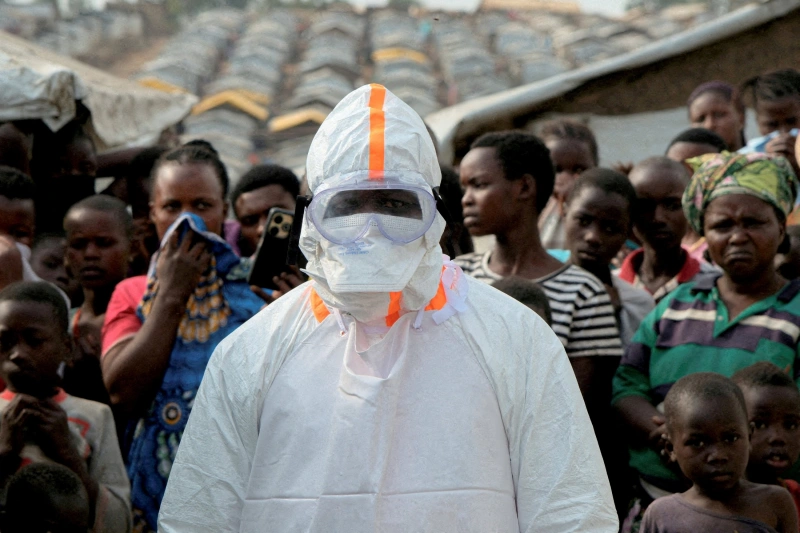

The death toll from the Congo Ebola outbreak has reached at least 930, the country’s Ministry of Health confirmed on Monday, after 37 people died in a single 24-hour period between Friday and Saturday, making it one of the highest daily totals recorded since the crisis began.
The deaths were drawn from 2,344 confirmed cases logged as of Saturday, the health ministry said.
The Congo Ebola outbreak was declared on 15 May in eastern Congo after, according to the World Health Organization, the disease had been transmitting undetected for weeks before that. The Africa Centres for Disease Control says it is the fastest-growing Ebola outbreak on the continent.
The outbreak is caused by the Bundibugyo virus, a less common strain of Ebola for which there is no approved vaccine or treatment. The absence of proven countermeasures has severely narrowed the options available to medical teams on the ground.
Five provinces, all in eastern Congo where rebel violence is widespread, have been affected. Ituri province is the worst-hit. According to data from the European Centre for Disease Prevention and Control, Ituri alone has recorded 1,904 cases and 692 deaths across 27 of its 36 health zones. North Kivu has reported 199 cases and 119 deaths.
The Congo Ebola outbreak has killed at least 36 health workers who were themselves infected with the virus, the health ministry confirmed. The World Health Organization has separately reported that more than 100 healthcare workers have been infected since the outbreak began.
Those figures have not stopped the strikes. Dozens of health workers at the Rwampara treatment centre in Ituri walked out over unpaid salaries and hazard bonuses in mid-July. Workers at Bunia General Hospital, the region’s largest medical facility, later followed, barricading the entrance and saying they had received no compensation despite working under dangerous conditions.
The striking workers said in a statement that just one day of action had already caused damage, with patients unable to access the centre. They held the government solely responsible for any loss of life if the site closed after their ultimatum.
Congo’s Health Ministry data show the Congo Ebola outbreak has been growing at an average of 272 new cases and 111 deaths per week. That pace has accelerated in July, when both case counts and fatalities rose more sharply than in earlier weeks.
The World Health Organization warned that 80 per cent of new infections were coming from unknown chains of transmission, a sign that the Congo Ebola outbreak is spreading faster than health officials can track.
Dr Chikwe Ihekweazu, the WHO health emergencies chief, said after returning from Bunia, the capital of Ituri province: “Perhaps the most alarming finding is that many of the newly reported deaths are people who died in their communities without ever reaching a health facility and without receiving care.
Health authorities have yet to identify the patient who first contracted the virus. Displacements caused by armed conflict, as well as mining-related movements, have made it difficult to trace thousands of people who may have been exposed.
At least 12 attacks on health facilities and medical teams have been recorded since the outbreak was declared in May, fuelled mostly by scepticism and misinformation about the disease.
The Congo Ebola outbreak has crossed international borders. Cases have been confirmed in neighbouring Uganda. As of 16 July, Uganda had reported 20 confirmed cases including two deaths. A US citizen working for a humanitarian organisation in Congo also tested positive and was medically evacuated to Germany on 13 July, the US Centers for Disease Control and Prevention reported.
The WHO declared the outbreak a Public Health Emergency of International Concern on 16 May, one day after it was officially confirmed by Congolese authorities.
Congo’s Ministry of Health said 724 patients are currently in isolation or receiving hospital care. Authorities say they are intensifying containment efforts across all affected health zones, with 22 new recoveries recorded in the latest 24-hour reporting period.
This is Congo’s 17th Ebola epidemic. The use of the Bundibugyo strain, with no licensed treatments and no approved vaccines, has made the Congo Ebola outbreak unlike any the country has confronted before.


