




For years, Nigerians have been told that elections are contests of ideas. There are manifestos, campaign promises, policy documents and grand visions for the future. There are debates about the economy, security, education, healthcare and infrastructure.
Then came 2026.
For some Nigerian pelicans, that was all a bit too much.
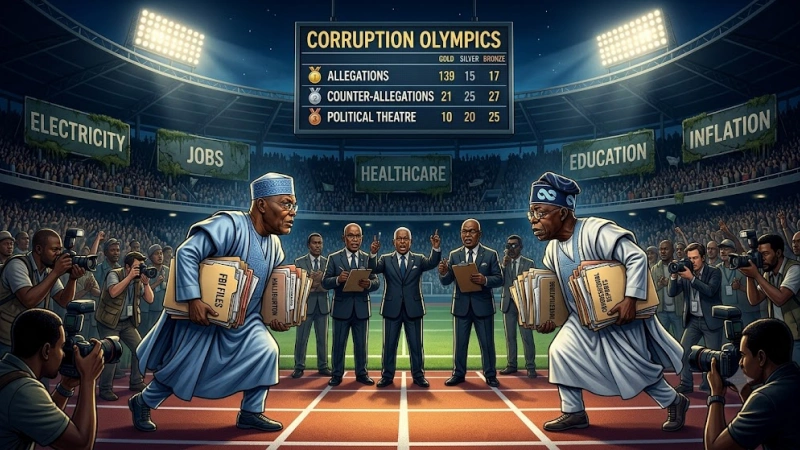
Welcome to the Corruption Olympics.
Here, election season increasingly resembles the opening ceremony of the Corruption Olympics, where the competitors do not arrive carrying policy proposals. They arrive carrying files.
In the red corner stands President Bola Ahmed Tinubu, armed with decades-old American court records, civil forfeiture proceedings, FBI documents, DEA records and enough archived paperwork to fill a small library.
In the blue corner stands former Vice President Atiku Abubakar, equipped with the William Jefferson investigation, Halliburton references, telecommunications allegations, congressional records and enough political baggage to require a cargo aircraft.
The starter’s pistol fires.
The games begin.
The first event is Historical Document Weightlifting.
Atiku’s supporters step forward and hoist the Tinubu files high above their heads. They point to the American investigations of the early 1990s. They cite forfeited funds. They reference FBI and DEA records. They remind voters that American agencies spent years examining transactions linked to Tinubu.
The crowd gasps.
Not to be outdone, Tinubu’s supporters respond by unveiling what they call the Atiku files. Out emerge the FBI affidavits from the William Jefferson investigation. There are allegations surrounding a proposed telecommunications venture. There are recorded conversations. There are claims involving requests for payments and business interests. There are enough references to Washington to convince an outsider that Nigeria’s elections are actually being conducted in the United States.
The judges award points for archival depth.
The crowd roars.
The second event is Selective Memory.
This is where the athletes truly excel.
Contestants demonstrate an extraordinary ability to remember every allegation against their opponents whilst simultaneously forgetting every allegation against themselves.
The performance is flawless.
Medical experts are baffled.
Political scientists are intrigued.
Nigerians are exhausted.
Then comes the most anticipated event of the tournament: the Halliburton Hurdles.
The mere mention of Halliburton sends commentators into a frenzy.
The scandal remains one of the largest corruption controversies ever associated with Nigeria’s oil and gas sector. Foreign companies paid hundreds of millions of dollars in penalties. Executives were prosecuted. Investigations stretched across continents.
Yet in Nigeria’s political arena, Halliburton has evolved beyond a scandal. It has become a ritual incantation.
Mention the word and somebody immediately points at Atiku.
Never mind that no court convicted him in relation to the affair.
Never mind that the legal history is more complicated than campaign slogans allow.
The objective is not legal precision.
The objective is political advantage, not legal clarity.
Across the arena, Tinubu’s opponents employ the same strategy.
They invoke FBI files with almost religious devotion. They speak of affidavits, investigations and records as though every document carries the force of a final judgement.
The distinction between allegations, investigations, civil proceedings and criminal convictions is treated as an unnecessary technicality.
Why waste time with nuance when outrage is available?
By now the Corruption Olympics is in full swing.
Tinubu’s camp insists the Atiku file should disqualify Atiku.
Atiku’s camp insists the Tinubu file should disqualify Tinubu.
Neither side appears interested in applying the same standard to itself.
This is where the competition becomes truly Nigerian.
The argument is no longer about who is innocent.
It is not even about who is guilty.
It is about who can make the other man look guiltier.
The gold medal goes not to the cleanest athlete but to the athlete who can produce the most damaging folder.
The Corruption Olympics grows fiercer with every election cycle.
One side releases documents from Chicago.
The other side releases documents from Washington.
One side cites court records.
The other side cites affidavits.
One side shouts FBI.
The other side shouts Halliburton.
The voters sit in the stands wondering when somebody will mention electricity.
Nobody does.
Inflation waits patiently outside the stadium.
Unemployment is denied entry.
Power supply is still searching for the venue.
Healthcare was never invited.
Education cannot afford a ticket.
As the closing ceremony approaches, both camps declare victory.
Tinubu’s supporters insist the Atiku file explains everything wrong with Nigeria.
Atiku’s supporters insist the Tinubu file explains everything wrong with Nigeria.
The economy remains unconvinced.
Inflation ignores the debate.
Power shortages continue uninterrupted.
Investors do not read affidavits before deciding where to put their money.
Unemployed graduates are strangely indifferent to political dossiers from Chicago and Washington.
Yet the files remain centre stage.
The judges deliberate.
The crowd argues.
The allegations survive.
And somewhere in the distance, a voter asks a dangerous question:
“If everyone is campaigning against corruption, why does corruption always seem to win the Olympics?”
No answer is provided.
The stadium lights go out.
The files are packed away.
The allegations survive to compete another day.
And Nigeria begins preparing for the next Corruption Olympics.


