



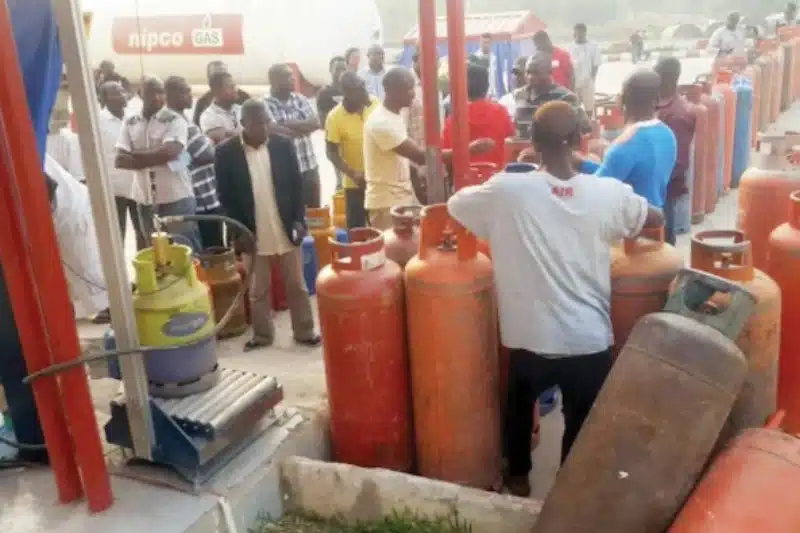

A cylinder that cost ₦13,000 to refill in August now takes closer to ₦16,000 in Lagos. The queue at the filling station down the road has not gotten any shorter either.
Cooking gas and petrol prices have both climbed sharply this month, and the numbers explain why so many households are feeling the pinch twice over, once at the stove and once at the pump.
According to Vanguard, liquefied petroleum gas, the cooking gas relied on in most Nigerian kitchens, rose by 8.3 per cent to about ₦1,300 per kilogramme in Lagos as of 16 September, up from ₦1,200 the previous month. Accredited outlets are selling at that rate, while smaller plants are charging ₦1,350 to ₦1,400 depending on location, and dealers say prices climb even higher outside Lagos.
The Nigerian Association of Liquefied Petroleum Gas Marketers, through its president Inyang Edu, pointed to global volatility, particularly the conflict involving the United States and Iran, as one driver behind the spike. He said bulk transactions of 20 metric tonnes in Lagos traded between ₦19.9 million and ₦22.7 million on 16 September alone, highlighting how unevenly the cooking gas price increase is affecting consumers even within the same city.
That external shock sits on top of a domestic supply problem that has been building for months. Nigeria’s downstream regulator had already recorded a year-to-date LPG supply deficit of close to 92,000 metric tonnes by June, which means the market was strained long before the Gulf tensions resurfaced. The pressure on supply is one of the reasons cooking gas and petrol prices have become a growing concern for consumers and businesses alike.
Cooking gas and petrol prices have moved in the same direction. The Nigeria Labour Congress said in a statement on Wednesday, titled “Save the Situation Now,” that pump prices had reached about ₦1,430 per litre in major cities, with costs noticeably higher in areas further from supply depots.
NLC president Joe Ajaero argued that a country which produces crude oil and refines it locally should not be this exposed to shocks originating thousands of kilometres away in the Gulf. He called on the federal government to introduce immediate wage awards for workers, sell sufficient crude oil to local refineries in naira, and expand the country’s fuel storage capacity.
There is a clear contrast at the heart of his argument. Nigeria produces crude oil domestically, yet workers continue to absorb the impact of international price swings at the pump. The gap between what the country produces and what many citizens can afford has shaped Nigeria’s energy debate for years.
The consequences rarely stay contained to fuel. Higher transport costs feed directly into food prices, school fees, rent and tariffs, the NLC noted, because almost everything sold in Nigeria travels by road before it reaches a buyer. As cooking gas and petrol prices increase, those additional costs are often passed directly to consumers.
For many households, cooking gas and petrol prices are now determining how much can be spent on food, transport and other essentials. A family cooking with gas and commuting by public transport is now paying more on both fronts at once, and neither the depot price sheets nor the labour ministry’s calendar suggest that relief is close.
The impact of cooking gas and petrol prices extends beyond individual households. Small businesses that rely on generators, transportation and regular energy supplies are also facing rising operating costs, increasing pressure on already thin margins.
Cooking gas and petrol prices are rising because several pressures are converging at the same time. Global conflict, domestic supply shortages and pressure on the naira are all pushing costs higher. Until those pressures ease, households are likely to continue feeling the squeeze both at the stove and at the pump.


