



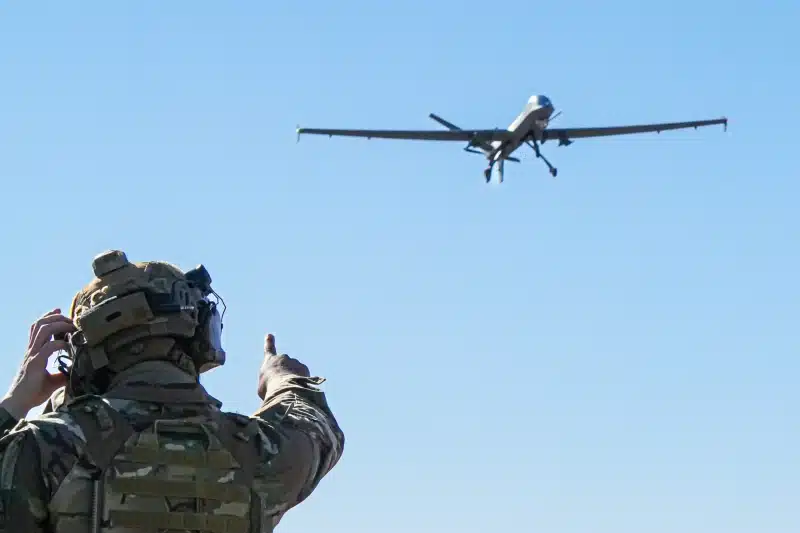

U.S. military trainers are now working with Nigerian forces in the northeast, deploying surveillance drones in what reflects expanding U.S. surveillance drones in northeast Nigeria operations, according to recent international reporting, as pressure builds in Borno and surrounding areas.
The support is understood to focus on intelligence rather than combat, even as fighting in parts of the region continues to test military positions.
Details of the deployment remain limited. However, reporting by Reuters indicates that U.S. personnel are assisting Nigerian troops with aerial surveillance, using drones to monitor movement across areas long affected by insurgency. The expanded use of U.S. surveillance drones in northeast Nigeria operations is aimed at improving visibility across hard-to-reach areas.
The northeast has seen a steady pattern of attacks in recent months. Some of these incidents have targeted military formations, while others have focused on isolated communities and transport routes. In many cases, the attackers do not hold ground for long. They strike, withdraw, and then reappear elsewhere.
That pattern has made it difficult to respond quickly.
The geography does not help. Large stretches of land remain sparsely populated, with limited infrastructure and long distances between settlements. In parts of Borno State, movement is already restricted, and visibility on the ground is often poor.
This is where aerial surveillance is expected to make a difference. Much of that expectation is tied to how U.S. surveillance drones in northeast Nigeria can maintain longer coverage than ground patrols.
Unlike patrol teams, drones can remain over an area for extended periods, watching for movement and building a clearer picture of activity over time. They are not limited by terrain in the same way ground units are. The expectation is that this will allow Nigerian forces to detect threats earlier and respond with better coordination.
At the same time, officials have been careful in how the U.S. role is described.
There is no indication of direct combat involvement. The focus remains on training, intelligence sharing and operational support. Nigeria and the United States have worked together in this space before, but this deployment places more weight on sustained surveillance.
Shifting Pattern on the Ground
The timing reflects changes in how insurgent groups operate.
Fighters linked to the Islamic State West Africa Province, or ISWAP, have changed how they operate over time. Large, fixed positions are less common now. Instead, they move in smaller groups, relying on speed and familiarity with the terrain, often along routes that are hard to monitor.
After attacks, some units are able to regroup quickly. That makes it easier to sustain pressure without staying exposed for long.
A security analyst familiar with the region said this has forced a shift in thinking.
“You cannot rely only on ground visibility in a place like this,” the analyst said. “If you do not see movement early, you are always reacting after the fact.”
That is part of the logic behind increased aerial surveillance. The role of U.S. surveillance drones in northeast Nigeria is becoming more central to that approach.
By tracking patterns rather than isolated incidents, military planners hope to disrupt movement before attacks are carried out. Whether that works consistently will depend on how the intelligence is used once it is gathered.
What Changes and What Does Not
There is cautious optimism around what the drones can achieve. Within military planning, U.S. surveillance drones in northeast Nigeria are increasingly seen as a force multiplier.
They could help identify supply routes and staging areas. They could also reduce the element of surprise, which has been a key advantage for insurgent groups. Faster information flow may improve coordination between units, especially in remote areas where communication is already a challenge.
At the same time, expectations are being kept in check.
Surveillance alone will not resolve the conflict. Troops still have to operate on the ground, and key problems remain, including limited local intelligence and fighters mixing with civilians.
It is not yet clear how fast this support will show results.
Past operations have shown mixed outcomes. Some areas hold for a time, then attacks resume elsewhere. New technology does not automatically change that cycle.
Pressure Points in the Northeast
Recent incidents in the northeast show the conflict is still active, despite years of military operations.
Some locations continue to come under repeated attack, especially those linked to supply routes or movement corridors. In such areas, the impact is not limited to military targets.
Communities now operate in an environment where threats can appear with little notice. Early warning can make the difference between evacuation and exposure.
This adds another layer to the importance of surveillance.
If movements can be tracked earlier, there is at least the possibility of reducing harm to civilians, although that outcome is not guaranteed.
Regional Dimension
The conflict is not limited to Nigeria.
The Lake Chad basin links Niger, Chad and Cameroon, and fighters move across these borders using familiar routes for entry, retreat and resupply. That makes coordination between countries necessary, but not always straightforward.
Improved surveillance on one side of the border may have effects across the wider region, particularly if intelligence is shared in real time. This is particularly relevant as U.S. surveillance drones in northeast Nigeria improve cross-border tracking potential.
At the same time, the presence of U.S. personnel, even in a limited role, adds another element to regional security dynamics.
External involvement in West Africa has shifted in recent years, with some countries reducing partnerships while others maintain or expand them. Nigeria’s approach appears to focus on targeted support rather than large foreign deployments.
A Measured Shift
For now, the U.S. surveillance drones in northeast Nigeria is being treated as part of ongoing cooperation rather than a major change in policy.
There have been no formal announcements suggesting a broader expansion of foreign military involvement. Even so, the use of sustained aerial surveillance points to a gradual adjustment in how operations are conducted.
More emphasis is now on visibility, timing and coordination.
Whether that leads to a lasting change on the ground will depend on a number of factors. These include how well intelligence is integrated into decision-making, how quickly units can respond, and whether pressure can be maintained over time.
On its own, the presence of surveillance drones will not determine the outcome of the conflict.
But in a region where much of the fighting has been shaped by who sees what, and when, the ability to observe movement over long periods could alter the balance in subtle ways, especially as U.S. surveillance drones in northeast Nigeria operations continue to expand.


