



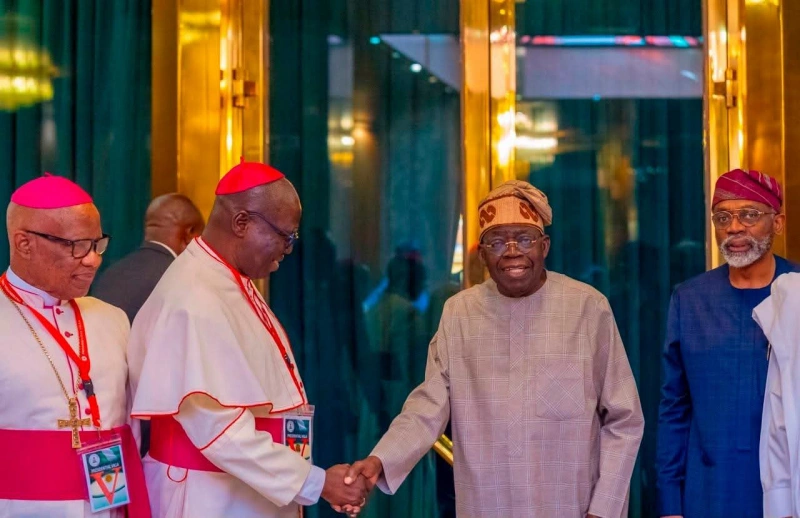

Nigeria’s presidency has spent days on an attack on Cardinal Onaiyekan rather than answering the concerns his fellow bishops raised with President Bola Tinubu. That choice is a mistake, and it is likely to backfire.
The row began after the Catholic Bishops’ Conference of Nigeria met Tinubu at the State House in Abuja on 28 July 2026. The bishops, led by Archbishop Matthew Ndagoso of Kaduna, told the president that insecurity, poverty and a struggling economy were pushing ordinary Nigerians into deeper hardship. Ndagoso told Tinubu plainly that the nation was bleeding and that citizens were suffering and crying.
Cardinal John Onaiyekan, the Archbishop Emeritus of Abuja, later described what happened inside that meeting during an interview on Arise News. He said Tinubu rejected the bishops’ assessment outright and told them the economy was doing fine. Neither the president nor his aides looked pleased with the presentation, he said. Onaiyekan added that the statement read to Tinubu was not put together casually. It reflected wide consultation across the Bishops’ Conference.
Rather than address what the bishops actually said, the presidency turned its focus to Onaiyekan personally. Presidential adviser Temitope Ajayi accused the cardinal of an abuse of clerical privilege for discussing a closed-door meeting in public. Special adviser Daniel Bwala went further, describing Onaiyekan as more political than spiritual and suggesting the Catholic Church favours Nigeria Democratic Congress candidate Peter Obi. Each is a version of the same attack on Cardinal Onaiyekan, questioning his standing rather than his facts.
This is the pattern worth examining. The attack on Cardinal Onaiyekan sidesteps the substance of his message and lands instead on his motives and standing.
The bishops did not invent the hardship they described. World Bank data published in April 2026 shows poverty in Nigeria climbed to 63 per cent last year, or roughly 140 million people, even as headline inflation eased. The same report found that household incomes have not grown fast enough to offset years of high prices, so poverty has yet to fall despite recent macroeconomic gains.
Figures from the National Bureau of Statistics support this picture. Headline inflation stood at 15.91 per cent in June 2026, still high by historical standards, while food inflation climbed to 17.52 per cent that same month. For a country where most households spend the bulk of their income on food, that gap between official cooling and daily reality is precisely what the bishops raised with the president.
The attack on Cardinal Onaiyekan, rather than a reply grounded in comparable figures, tells Nigerians that the presidency would rather manage the messenger than the message. Ajayi’s own defence, that Tinubu was simply presenting evidence during the meeting, actually confirms that a substantive disagreement took place. If the government has data that challenges the bishops’ assessment, presenting it would do more than questioning who Onaiyekan is politically.
The confidentiality argument behind the attack on Cardinal Onaiyekan also strains credulity. A courtesy visit between church leaders and a sitting president is not a classified state matter. Bishops routinely brief their congregations and the public on what they raise with government officials. Ndagoso’s own remarks during the visit, that the nation was bleeding and citizens were suffering, were made publicly the day of the meeting, not disclosed in secret by Onaiyekan afterwards.
The Peter Obi framing behind the attack on Cardinal Onaiyekan treats a disagreement over economic assessment as a partisan manoeuvre, which is also a stretch. Onaiyekan told Arise News that the bishops are not politicians and have no ambition beyond speaking for the people they serve. Reducing decades of a 91 year old cardinal’s pastoral work to an alleged political affiliation does not answer a single concern raised about insecurity, education or the cost of living.
The attack on Cardinal Onaiyekan carries a political cost too. African Democratic Congress candidate Atiku Abubakar has already demanded an apology, describing the presidency’s reaction as evidence of intolerance towards dissent. Whether or not that criticism is politically motivated, it lands more easily when the presidency’s own statements read as personal rather than substantive.
Nigerians watching this exchange are unlikely to be persuaded by arguments about clerical privilege while the underlying claims, elevated poverty, a fragile cost of living and daily insecurity, remain unanswered. A government confident in its record can simply show the improvements it claims. The attack on Cardinal Onaiyekan for saying what millions of Nigerians already feel achieves little beyond confirming the very grievance he raised.
If the presidency wants this story to end differently, dropping the attack on Cardinal Onaiyekan and responding to the bishops’ figures with figures of its own would serve it better than relitigating who had the right to speak.


