



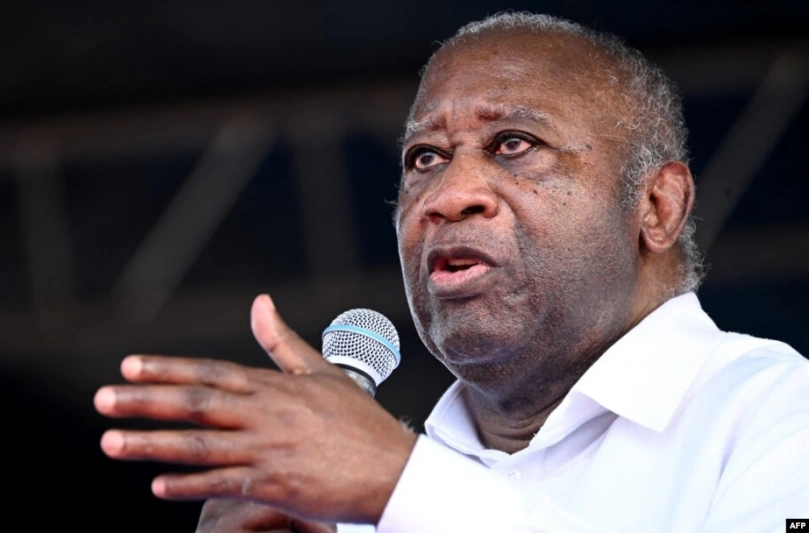

Fifteen years after Laurent Gbagbo was sent to The Hague, his supporters have returned to the International Criminal Court (ICC) with a PPA-CI motion demanding accountability for alleged crimes committed by pro-Ouattara forces during the 2010–11 post-election crisis, which killed an estimated 3,000 people.
On Friday, 27 November, European branches of his party, the PPA-CI, gathered outside the ICC in The Hague. They handed in a motion demanding prosecutions of pro-Ouattara forces over the 2010–11 post-election crisis, which killed an estimated 3,000 people.
The PPA-CI motion was addressed to the deputy prosecutors leading the court’s Office of the Prosecutor, Linfodrome reported. It asks one blunt question.
“When will you begin prosecutions against the camp of Mr Alassane Dramane Ouattara?” (The quotations here are translated from the French.)
The timing was no accident. Gbagbo left Abidjan on 29 November 2011 and entered the ICC detention centre the next day, as Ouestaf recalled. The Trop c’est trop Diaspora movement supported the rally and urged Ivorians and other Africans living in Europe to join.
The authors say the court has not fulfilled the expectation surrounding its investigation. When judges authorised the investigation in October 2011, they noted the prosecutor’s intention to investigate alleged crimes by both pro-Gbagbo and pro-Ouattara forces, according to the ICC. Yet the PPA-CI motion argues that prosecutions “have targeted only one camp”.
On the public record, that is difficult to dispute. Gbagbo and his former youth minister, Charles Blé Goudé, were acquitted in January 2019, and their acquittals were upheld on appeal in March 2021. Simone Gbagbo’s arrest warrant was also vacated in July 2021. No one from the Ouattara side has been publicly charged at the ICC, Ouestaf noted.
That is the contrast at the heart of the PPA-CI motion. One camp spent years in the dock. Gbagbo himself was held for more than seven years before his release. The other has not faced public prosecution at The Hague.
Duékoué is the case the PPA-CI motion leans on hardest. It says pro-Ouattara fighters killed more than 1,200 civilians it identifies as Gbagbo supporters there in a single day in March 2011.
That figure is the party’s own. The International Committee of the Red Cross put the toll at no fewer than 800 dead on 29 March 2011. Human Rights Watch later documented the killing of hundreds of Guéré civilians by a mix of forces supporting Ouattara in the town.
The rights group did not present the violence as one-sided. It also documented the killing of more than 100 people at Bloléquin by pro-Gbagbo forces the day before. But in 2012, it warned that impunity for the Duékoué killings showed that “justice is serving only the victors”.
Ouestaf’s account adds that the PPA-CI motion cites the so-called Invisible Commando in Abobo and the shooting of young people outside the presidential residence in 2011.
Whether the court can act is a separate question. The ICC’s Assembly of States Parties removed Karim Khan as prosecutor on 24 July 2026 following findings of serious misconduct and a serious breach of duty. His deputies, Nazhat Shameem Khan and Mame Mandiaye Niang, continued to lead the office, with Niang subsequently serving as Acting Prosecutor.
The PPA-CI motion therefore reaches a prosecutor’s office operating without an elected chief, amid continuing pressure from Washington over the ICC’s work. Linfodrome said the office had not reacted publicly to the submission.
A filing cannot force the prosecutor to bring charges. Only the prosecutor can seek arrest warrants from judges. Human Rights Watch recorded that Ouattara said in 2015 he would not transfer future suspects to The Hague, preferring national courts. Prosecutions of people associated with his side in Côte d’Ivoire have remained exceptional, although some domestic proceedings have taken place.
The ICC has also not formally closed its investigation. In its 2025 annual report, the Office of the Prosecutor said investigative activities in Côte d’Ivoire were continuing despite the closure of its Abidjan office in June 2025. The distinction matters: the absence of public charges against the Ouattara camp does not mean the investigation has formally ended.
Abidjan tells a different story, and the PPA-CI motion will not change it overnight. Ouestaf’s press review noted that Ouattara, receiving the UN deputy secretary-general this week, described Côte d’Ivoire as a good model of exit from crisis.
There is politics here too. The party says more than 1,600 of its members and officials were arrested during protests against Ouattara’s fourth term. The same press review said it had taken that fight to the French Senate. The PPA-CI motion is another attempt to take its grievances beyond Côte d’Ivoire.
Fifteen years on, one camp has had its day in court. The other has yet to face public charges at The Hague.


