




Russian fighters left Kidal in April under a safe-passage deal with the rebels who had just taken the town.
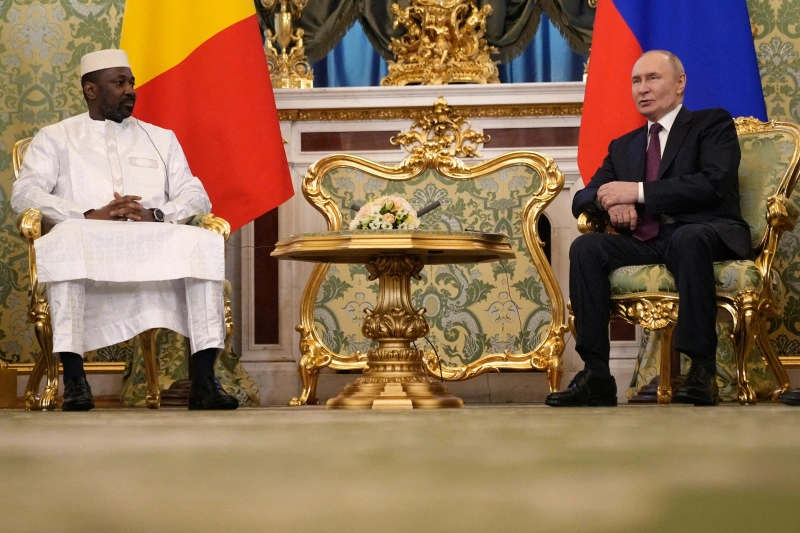
Six months later, Mali’s leader was in Moscow, meeting Vladimir Putin.
That gap is the story. Russia’s Sahel partnership was sold to Mali and Burkina Faso as a clean break from France. So what have they actually received?
The pitch was simple. France had failed to beat the jihadists, so Russia would try. Mali’s military leadership pushed French troops out in 2022. Burkina Faso demanded the same in January 2023.
Russian paramilitaries filled the space, first as Wagner and later as the Africa Corps, which answers to Moscow’s defence ministry.
Under Russia’s Sahel partnership, as many as 2,500 Russian personnel were reportedly in Mali by early 2026, says the US Congressional Research Service.
Security is where Russia’s Sahel partnership is most visible, and most contested. Wagner and Malian troops took Kidal in November 2023. On 25 April this year, Tuareg separatists and al-Qaeda-linked JNIM fighters struck across Mali at once. Kidal fell. Days later, JNIM announced a blockade of Bamako.
Mali’s armed forces entered Kidal on 6 October with support from Russia’s Africa Corps, following an air and ground campaign. The Azawad Liberation Front (FLA), which had seized the city in April alongside al-Qaeda-linked JNIM fighters, announced a controlled withdrawal, citing the intensity of the Russian-backed air operations. The Malian government described the operation as a recapture, although the FLA said its forces withdrew without a direct battle for the city.
Civilians paid for it. Human Rights Watch says Africa Corps fighters killed nine people, including four children, in the village of Bombori on 10 July. The Armed Conflict Location and Event Data project counts 49 air strikes by Malian forces and the Africa Corps between April and August. They killed 89 civilians.
Food is the second pillar of Russia’s Sahel partnership. Putin promised free grain at the 2023 summit in St Petersburg. Russia’s Agriculture Ministry says Mali and Burkina Faso each received 25,000 tonnes before the programme ended in February 2024.
That was real help. It was also aid, not trade.
Energy comes next. Burkina Faso signed a memorandum of understanding with Russia’s Rosatom in October 2023 to develop cooperation towards a nuclear power plant. Fewer than a quarter of its people have access to electricity. In June 2025, the two governments went further, signing an intergovernmental agreement for the installation of a civilian nuclear power plant.
The agreement marked an important administrative step towards construction, but it did not mean work on the plant had begun. Burkina Faso’s energy ministry said Russia was expected to submit a technical and financial proposal for examination, after which discussions would move to the technical requirements and resources needed for construction. The project remains dependent on those arrangements.
Gold is where Russia’s Sahel partnership has its strongest case. Mali produces about 50 tonnes a year and has long sent its gold abroad for refining. A refinery near Bamako, built with Russia’s Yadran Group, is meant to end that. Mali’s state holds 62 per cent, according to finance minister Alousseni Sanou. The plant is planned to handle 200 tonnes a year, almost four times Mali’s output.
Mali’s leader, Assimi Goita, calls it economic sovereignty. Supporters of the government see a country finally keeping the value of its own gold. They have a point. Mali’s revised mining code already requires gold to be refined at home.
The money is the open question. Andrei Maslov leads the Centre for African Studies at Moscow’s Higher School of Economics. In September 2025, he said financing for the refinery was not yet secured.
Trade is thinner still. Russia’s trade with Africa reached $27.1bn in 2025, well short of the $40bn Putin promised in 2019, according to Russian statistics cited by Al Jazeera. In the first eight months of 2026, Russia sold about $14bn of goods to the continent and bought just $3.2bn.
Dakar-based analyst Beverly Ochieng told Al Jazeera that “the economic incentives to go for the Russia summit are much more limited” than at US or Chinese events.
Information is part of Russia’s Sahel partnership too. In July, Russian state broadcaster RT signed a content-sharing deal with Tafouk TV, the channel run by the military governments of Mali, Burkina Faso and Niger.
African Union chair Evariste Ndayishimiye told the Moscow summit: “Africa has not come to ask for aid.”
Yet grain and soldiers remain the best-documented deliveries under Russia’s Sahel partnership.
In February, Burkina Faso’s foreign minister, Karamoko Traoré, was in Moscow finalising a package of agreements with Sergey Lavrov. At the summit itself, not every Sahel country was represented at presidential level. Goïta attended for Mali, while Burkina Faso’s Captain Ibrahim Traoré sent his prime minister, Rimtalba Jean Emmanuel Ouédraogo.
So who gains most from Russia’s Sahel partnership? For the government, protection has come first. It has given them troops and a seat at Putin’s table. For ordinary people, the gains are slower and less certain.
None of this proves the choice was wrong. Many in the Sahel judged France’s operations a failure after 2013, and that frustration is real. But a partner is judged by what it leaves behind.
Gold may yet change the balance. A working refinery would be a clear win. Until then, Russia’s Sahel partnership protects rulers more reliably than it feeds, powers or secures their people.
So far, Russia’s Sahel partnership has shown that Moscow can arrive. The Sahel is still waiting to see it deliver.


