



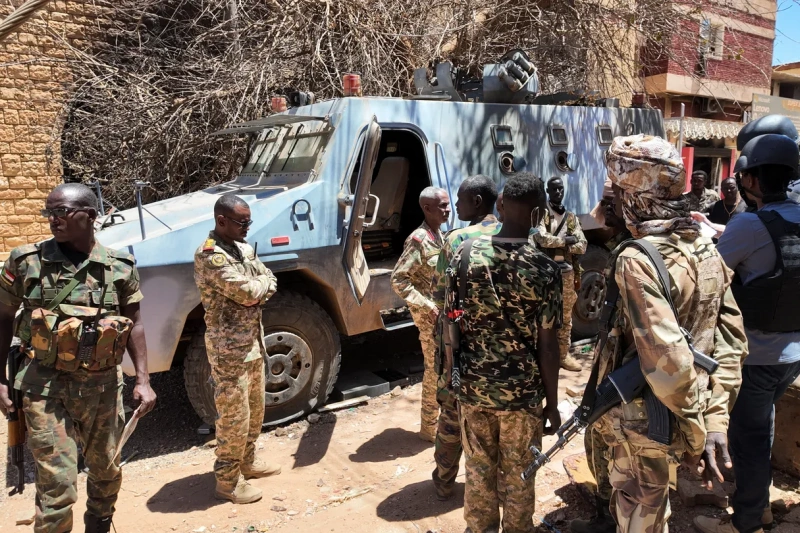

Sudan’s army can take a road. It cannot yet keep the lights on.
That is the contradiction at the heart of the South Kordofan advance. As troops push deeper into contested territory, a widening drone campaign is knocking out electricity infrastructure across Sudan, exposing the gap between battlefield gains and the army’s ability to protect essential services.
Take Kadugli, the clearest test of the South Kordofan advance. The army broke the siege of the state capital on 3 February, after more than two years. Army chief Abdel Fattah al-Burhan said in a statement cited by the state news agency SUNA that troops had “reopened the road to Kadugli”.
Almost nine months later, the city’s power station is gone.Local sources told Darfur24 that drones believed to belong to the Rapid Support Forces (RSF) destroyed the power station and a fuel depot in the city centre on Wednesday, 28 October. Darfur24 reported no casualties at the two facilities, although Sudan Tribune separately reported that eight women and children were injured in strikes on the city that day
Kadugli was not alone. Sudan Tribune reported that drones hit power stations at Al-Junaid, Singa, Al-Hawata, Al-Faw and Mashkour on Monday 26 October. The Sudan Electricity Holding Company said the strikes blacked out the south-eastern network and threatened the stability of the national grid.
The attacks kept coming. Sudan Tribune counted Tuesday’s strike on the Al-Markhiyat substation, north-west of Omdurman, as the seventh on Sudan’s power facilities in under a week. It cut electricity in Khartoum.
On Thursday, the Um Dabaker thermal power station in Rabak was hit, cutting supply to White Nile and North Kordofan. On Saturday, Sudan Tribune reported another strike on the Haya transformer and an oil pumping station in the east, the second attack on energy sites at Haya in three days.
By the same count, more than 13 distribution stations across seven states, South Kordofan among them, have been severely damaged. The electricity company blames the RSF.
Port Sudan goes further. Foreign Ministry Undersecretary Muawiya Osman told diplomats on Saturday that the drones were launched from Ethiopia’s Assosa air base. He called it “brutal aggression”. The claim has not been independently verified.
On the ground, the territorial gains made by the army in South Kordofan are real, but remain limited. In September, the army and its allies said they had taken Al-Farshaya and Al-Mamsouka, two points on the road between El Obeid and Dilling.
That road matters to the South Kordofan advance. Holding it links army positions across Kordofan and makes it harder for the RSF and its ally, the SPLM-N, to cut off Dilling and Kadugli again.
But the South Kordofan advance is far from decisive. The SPLM-N, led by Abdelaziz al-Hilu, still holds large areas of the Nuba Mountains and fights alongside the RSF.
Burhan shows no appetite for compromise. In early October he rejected negotiations and promised to take back “every inch” of RSF-held territory.
Yet the South Kordofan advance is only half the war now. A September 2026 UK government assessment estimated that fighting, sabotage, fuel shortages and decaying infrastructure had cut Sudan’s electricity generation capacity by about 40 per cent.
The damage reaches the tap. UNICEF’s mid-year humanitarian report, covering January to June, said attacks on power and water infrastructure, repeated outages and rising fuel costs were straining water supplies across Sudan. Residents in Khartoum told Sudan Tribune they feared long blackouts would disrupt the water treatment stations along the Nile.
A road can be reopened by soldiers. Light has to be defended every night. So far, the South Kordofan advance has not shown the army can do both.


