




A man who had been ill for about a month landed at Nairobi’s main airport on Saturday afternoon. He passed health screening, cleared immigration and went straight to a hospital.
By Monday night, he was dead.
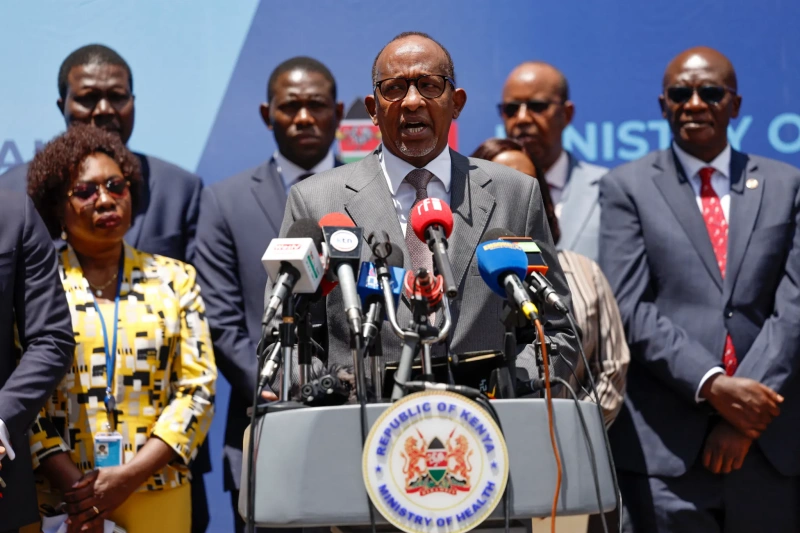
On Tuesday, Health Cabinet Secretary Aden Duale confirmed the first Ebola case in Kenya. The patient was a Kenyan who had lived and worked in Congo for seven years.
The ministry’s timeline of the Ebola case in Kenya starts in Congo. Duale told a press conference that the man fell ill about a month before he flew. He was treated at several hospitals in Congo, then travelled by road to Kampala.
From there he boarded Jambojet flight 8523 to Nairobi, with 23 other passengers and four crew. He landed at Jomo Kenyatta International Airport (JKIA) at around 1pm on Saturday 3 October.
He went through “a normal public health screening at JKIA,” Duale said, and then passed the immigration desk. A relative and a friend drove him to Nairobi Hospital.
Staff isolated him in a separate room in the emergency area, then moved him to an isolation unit in the hospital’s East Wing. He had fever, chills, extreme tiredness, muscle pain, painful swallowing and bleeding under the skin.
Doctors first suspected a viral fever, given his symptoms and travel history, and took samples. The National Virology Reference Laboratory and the Kenya Medical Research Institute both confirmed Ebola.
He died at 11:30pm on Monday 5 October while on supportive treatment. The ministry said his burial would follow Ebola safety protocols on Tuesday.
The airport is the part of the Ebola case in Kenya that travellers will ask about first. The ministry says the man had been unwell for about a month before he landed. He still got through screening and immigration and left the airport.
The accounts released so far do not say what the screening checked, or whether he reported any symptoms.
Many Ebola patients do not appear critically ill during the early stages of infection. Airport screening systems are generally designed to identify visible symptoms such as fever or obvious signs of illness, but they cannot reliably detect every infected traveller. Health officials have not said whether the patient showed symptoms during screening or whether any warning signs were recorded.
This anticipates the reader’s biggest question.
It was the hospital, not the airport, that flagged the Ebola case in Kenya. Duale said the patient was quickly isolated, and the tests followed.
The minister insists the country is ready. “All systems are in place to mitigate the spread of the disease,” he said. He added that health workers at national and county level had been trained in Ebola prevention and management.
Kenya has argued about Ebola before. In May, the doctors’ union KMPDU opposed a 50-bed US quarantine unit for exposed Americans, warning it could bring the virus into the country. Its secretary-general, Davji Atellah, told CNN: “If it is too dangerous for America, it is too dangerous for Kenya.”
None of the official accounts links this patient to that facility. The man at the centre of the Ebola case in Kenya was a citizen coming home on a commercial flight. That was the route that mattered.
The next job is finding everyone he met.
The ministry has identified 28 contacts linked to the Ebola case in Kenya, including relatives and the health workers who treated him. It is also looking for the 23 other passengers and four crew from flight 8523.
According to the Associated Press, ministry director general Patrick Amoth said contacts would be isolated for 21 days and released only after testing negative.
The ministry says it has tested 276 samples across five laboratories, including mobile labs at the Busia border and in Bungoma County. It has also notified the World Health Organization.
Those contact numbers are a first count, and tracing is still under way. Tracing is what will decide whether the Ebola case in Kenya stays a single case.
Whether Kenya records more infections will depend on what contact tracers uncover in the coming days. To understand the risk, it helps to look at the scale of the outbreak in Congo where the infection originated.
The Ebola case in Kenya was caused by Bundibugyo virus, one of the species that cause Ebola disease. Congo declared its outbreak in mid-May, and the World Health Organization named it a public health emergency of international concern within days.
According to the US Centers for Disease Control and Prevention, Congo had recorded 8,442 confirmed cases and 4,080 deaths by 2 October. The WHO says it is the largest Ebola outbreak ever recorded in the country.
There is no licensed vaccine or treatment made for Bundibugyo, and the WHO called the situation “extraordinary” for that reason. The vaccine used against the better-known Zaire species was not designed for it. That makes containment, isolation and contact tracing the primary tools available to health authorities.
Past Bundibugyo outbreaks killed roughly 30 to 50 per cent of patients. People are usually infectious only once symptoms begin, and the incubation period runs from two to 21 days.
Médecins Sans Frontières said on 2 October that North Kivu now accounts for nearly 40 per cent of new confirmed cases. Treatment capacity, it added, is not enough.
According to the Associated Press, the Ebola case in Kenya makes the country the fourth to record an infection in this outbreak. Until Tuesday, there had been no active cases outside Congo since Uganda declared its own outbreak over in late August.
Kenya says it has trained 4,971 health workers on Ebola. The first case still came through its main airport.
The incubation period runs up to 21 days. Until those days have passed, nobody can say the Ebola case in Kenya is closed.


