



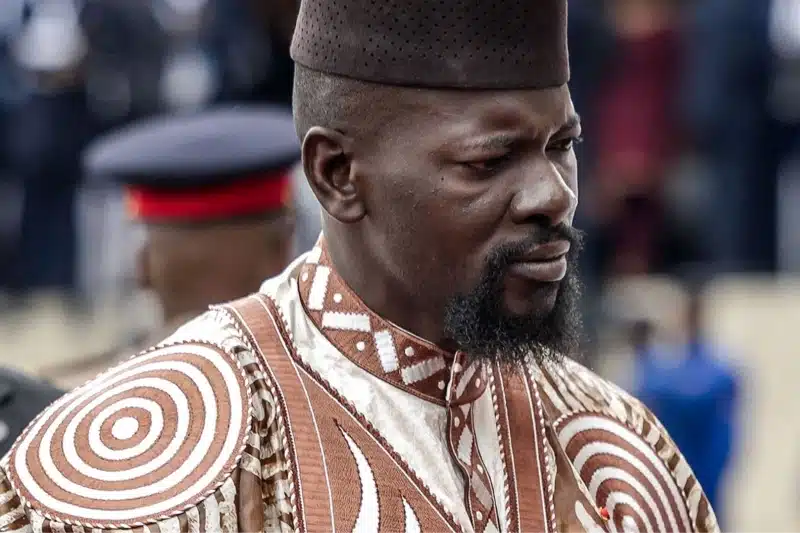

Two men convicted of looting Guinea’s public purse did not walk out of prison through the front gate. They were flown out of the country on presidential orders, to hospitals in Paris and the United States. Days later, President Mamadi Doumbouya went on Facebook to explain himself directly to the nation.
The story behind Doumbouya’s evacuation decision did not begin this month. It began in April 2022, seven months after Doumbouya’s coup toppled Conde, when Camara and Fofana were arrested and placed in pretrial detention.
Camara stood trial over a diverted US$40 million Chinese government grant meant to build a new parliament headquarters. The Court for the Repression of Economic and Financial Offences, known locally as CRIEF, convicted him in December 2024 and sentenced him to four years in prison. An appeal court reduced that to three years and six months in May 2025 while ordering him to pay one billion Guinean francs in damages.
Fofana’s case followed a similar path. CRIEF convicted him in February 2025 of illicit enrichment, money laundering and offences linked to funds intended for the COVID-19 response and social programmes. He received a five-year sentence.
On appeal in July 2026, judges overturned the embezzlement conviction but upheld the enrichment and money laundering findings, reducing his sentence to three years and nine months. By then, he had already spent more than three years receiving treatment at a private clinic in Conakry at state expense while court proceedings continued.
By September 2026, the two men at the centre of Doumbouya’s evacuation decision were preparing to leave Guinea altogether. Camara departed for the United States on 16 September. Fofana followed two days later, travelling to Paris aboard a medical flight that his lawyer, Dinah Sampil, said had been chartered by the presidency.
That sequence of events triggered immediate debate across Guinea and prompted Doumbouya to address the issue publicly. In his message to the nation, he argued that the transfers were motivated solely by medical necessity.
“A strong state is not a state without a heart,” he said.
Doumbouya insisted the evacuations were neither pardons nor amnesties. The convictions, he said, remain valid and enforceable. Nothing had been cancelled, rewritten or negotiated. According to the president, Doumbouya’s evacuation decision was based on the inability of Guinea’s health system to provide the specialised care required by the two men.
The explanation has not ended the controversy.
Since taking power in 2021, Doumbouya has repeatedly presented CRIEF’s work as evidence that senior officials can be held accountable for corruption. The prosecutions of former ministers, lawmakers and public officials became one of the central pillars of his administration’s anti-corruption campaign.
Now, two of the most prominent figures convicted under that campaign are recovering in foreign hospitals rather than serving their sentences inside Guinea.
The contrast is especially striking given the state of the country’s prison system. Conakry Central Prison was built to accommodate around 300 inmates but held more than 1,700 prisoners as of 2024, according to a United States State Department human rights report. Camara and Fofana spent only limited periods of their sentences there before being transferred to medical facilities and eventually leaving the country under Doumbouya’s evacuation decision.
Supporters of the move have framed it as a demonstration of humanity rather than leniency. Ansoumane Fofana, a member of parliament and political party leader, defended Doumbouya’s evacuation decision, arguing that respect for human dignity should not disappear once a person is convicted.
Others remain unconvinced. Critics have questioned why individuals found guilty of corruption are receiving access to overseas treatment that is unavailable to ordinary prisoners and beyond the reach of most Guinean citizens. For them, the issue is not only healthcare but also whether justice is being applied equally.
Doumbouya has sought to place the episode within a broader national reconciliation effort. He argues that accountability, truth and reconciliation can coexist, and that compassion does not invalidate judicial decisions.
Whether Guineans view Doumbouya’s evacuation decision as an act of humanity or a concession to powerful former officials remains an open question. The answer may depend on whether they see the medical transfers as a necessary response to serious health concerns or as an exception granted to people with influence.
For now, Camara and Fofana remain abroad receiving treatment. Their convictions still stand. What Doumbouya’s evacuation decision has unquestionably changed is who gets to serve a sentence, and where.


