




A soldier walked into Cameroon’s presidential compound in broad daylight on Wednesday. He was carrying cannabis and a lighter. When challenged, he said he had come to take power.
That is the account now circulating in Yaoundé security circles, and it captures everything strange about the moment Cameroon finds itself in. Officials have yet to explain, in any detail, how this Yaoundé palace breach was allowed to happen at all.
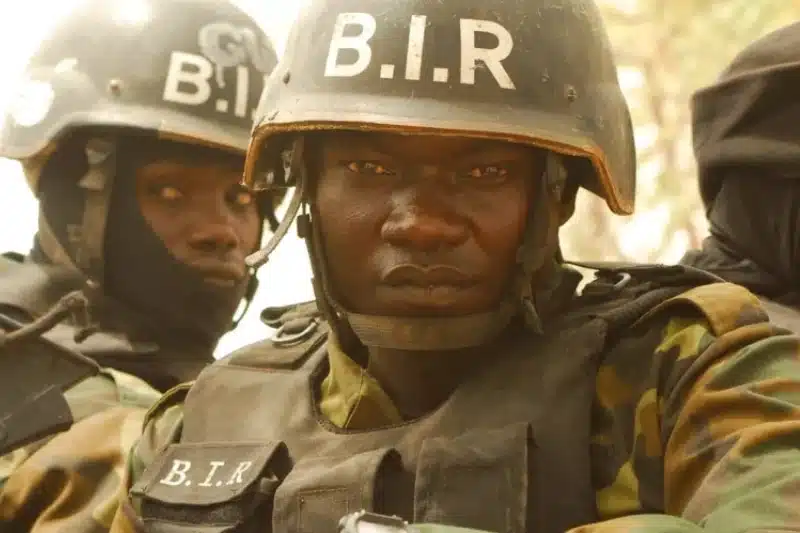
The Yaoundé palace breach happened at around 2.30pm on 16 September inside the grounds of the Palais de l’Unité, the seat of President Paul Biya’s power since 1982. The man detained was named as Ntsama Biting Benoît, 29, a soldier attached to the CAT unit of the Bataillon d’Intervention Rapide (BIR), Cameroon’s most feared and best-equipped force.
According to a radio dispatch from the Brigade d’Etoudi cited by Camer.be, Ntsama was stopped by Master Chief Petty Officer Ntye Samuel, a naval officer serving with the Presidential Guard. He was found with a small amount of cannabis and a lighter and reportedly told his captors he had come to “take power”.
Security officers reportedly detained him without resistance before moving him for questioning.
He was later handed to the Military Intelligence service, known by its French acronym SEMIL. Investigators are trying to determine whether he acted alone, under the influence of drugs, or whether this Yaoundé palace breach points to something more coordinated inside the ranks.
On paper, this reads like a small story. A junior soldier, some cannabis, a strange claim and an arrest. Nothing was fired. Nobody was hurt.
But the setting of this Yaoundé palace breach is what makes it worth taking seriously.
The Palais de l’Unité is not an ordinary government building. It sits behind layered checkpoints run by three separate security bodies: the Presidential Guard, the BIR and the gendarmerie.
Getting past all of them, even briefly, even by one man with no weapon, is not supposed to be possible. That single fact is why a Yaoundé palace breach of this kind matters more than the modest details of one soldier’s arrest.
What might otherwise have been dismissed as an isolated disciplinary incident arrives at a moment when every sign of instability inside the presidency attracts scrutiny.
Biya, now 93, is the world’s oldest serving head of state. He disappeared from public view for two months this year, boarding a flight to Geneva that fed weeks of speculation before returning to a country no clearer on who is actually governing it.
In April, the National Assembly created a vice presidency for the first time since 1972, a move Biya proposed himself and which was widely interpreted as the opening move in a succession contest.
Set against that backdrop, a Yaoundé palace breach involving a soldier from one of the country’s elite security formations was always going to be read as more than a policing matter.
That contest has hardened into open rivalry.
On one side sits Franck Biya, the president’s son, whose influence has grown visibly since the vice presidency was created.
On the other stands Ferdinand Ngoh Ngoh, secretary general at the presidency since 2011, a man who signs on the president’s behalf and who, according to analysis by the Carnegie Endowment for International Peace, derives much of his authority from controlling the machinery of government inside the presidency.
Justice Minister Laurent Esso and Territorial Administration Minister Paul Atanga Nji are also watched closely, less as direct contenders than as figures who could influence the eventual outcome.
None of them has commented publicly on the Yaoundé palace breach, and there is no evidence linking any political faction to the incident.
Cameroon’s military has its own history of settling such questions by force rather than by committee.
In April 1984, elements of the Republican Guard, then largely drawn from the mainly Muslim north, attempted to seize the same palace and were only defeated after fighting that left hundreds dead.
Biya survived that coup attempt and spent the decades that followed ensuring the security services never concentrated too much power in one place.
Authority was divided among the BIR, the Presidential Guard and the gendarmerie so that no single force could move against him alone.
That is precisely the arrangement now being tested.
A junior BIR soldier inside the palace, detained by a Presidential Guard officer and questioned by SEMIL, offers a small snapshot of a system built on overlapping loyalties and mutual suspicion.
Viewed through that lens, this Yaoundé palace breach appears less like an isolated aberration and more like a symptom of deeper uncertainty.
It is worth being careful here.
Nothing so far confirms that Ntsama had any backing, political or otherwise, and Cameroonian authorities have issued no detailed public explanation beyond the initial security dispatch.
No charges have yet been announced, and a narrative built entirely around one radio message deserves caution until investigators release further findings.
Even so, the questions raised by this Yaoundé palace breach are unlikely to disappear.
How did a member of an elite security unit reach the country’s most heavily protected compound?
Why did it take a naval officer, rather than the multiple security layers designed to prevent exactly such a scenario, to stop him?
Those questions touch on the resilience of the security system itself rather than the actions of a single soldier.
What is already clear is less about the man who entered the compound and more about the institution he entered.
Whether the incident proves to be an act of confusion, indiscipline or something more serious, the questions it has raised will linger.
In a system built on layers of security and carefully balanced loyalties, the fact that one soldier reached the heart of power has become a story far larger than the man himself. For a presidency navigating an uncertain succession and an ageing leader’s final years in office, that reality may prove more troubling than the breach itself.


