




Equatorial Guinea’s government has never explained why Facebook and TikTok went dark inside its borders. Two weeks on, it still hasn’t.
Within days she was under arrest. Two of the country’s most used apps had become unreachable without a VPN, and the Equatorial Guinea social media block was underway.
That is the shape of the Equatorial Guinea social media block now unsettling one of Africa’s most closed states. An AFP correspondent inside the country confirmed this week that Facebook and TikTok remained inaccessible, while internet speeds had been throttled since 2 September.
WhatsApp and Instagram, both owned by Meta, kept working, though with limitations.
Nobody in government has said why. Equatorial Guinea’s information ministry did not respond when AFP sought comment on the social media block. More than two weeks in, officials have offered no public justification at all.
That silence is itself revealing about how the Equatorial Guinea social media block is being handled. Governments that shut down platforms for genuine security reasons usually say so, even if the explanation is thin.
Gabon did exactly that in February. Its media regulator suspended Meta’s platforms, YouTube and TikTok, citing defamatory content it said threatened national stability.
Whatever one makes of that reasoning, Libreville put a name and a justification on record. Malabo has offered neither, and the gap between the two responses says something about how each government weighs its own exposure.
The Equatorial Guinea social media block also raises a narrower puzzle. Facebook is where the video first appeared. TikTok is where it spread fastest.
WhatsApp, owned by the same company as Facebook, remains open. The same clip could move through it in seconds. Blocking two platforms while leaving a third untouched looks less like a security operation and more like an attempt to slow one specific story down without shutting the country off entirely.
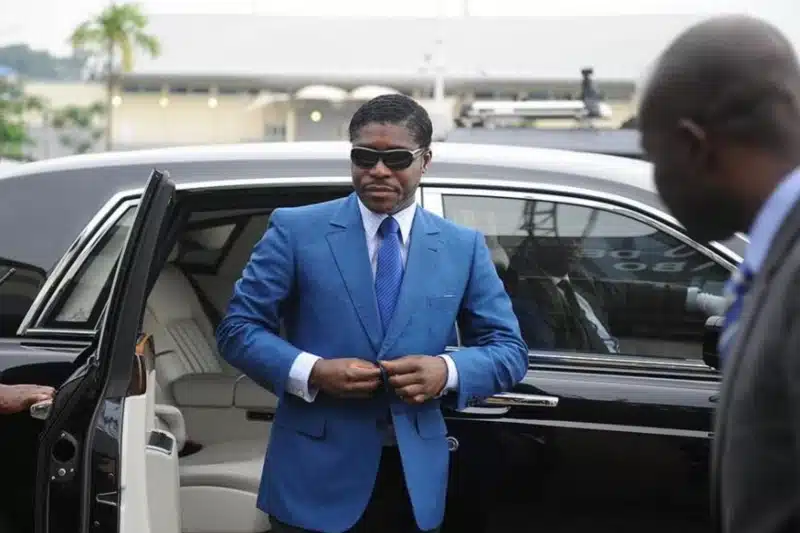
Understanding why the Equatorial Guinea social media block has focused on this particular video means going back nearly a decade. Teodorin, as the vice president is widely known, was convicted in absentia by a Paris court in October 2017 for laundering embezzled state funds through luxury purchases in France.
Among them was a mansion on Avenue Foch fitted with a hammam and a private disco, bought at more than a thousand times his official salary. Judges also seized vintage wine, artworks and a fleet that included a Bugatti Veyron and a Rolls-Royce.
Human Rights Watch, which followed the case from the outset, said the ruling exposed how deeply government corruption in Equatorial Guinea had drained the country’s oil wealth. French courts ultimately confiscated assets worth close to €150 million.
Britain separately froze holdings tied to him after its own corruption inquiries. In 2021, France’s Court of Cassation rejected his final appeal, making the conviction definitive and clearing the way for the seized funds to eventually be returned to Equatorial Guinea.
Set that history against daily life in the country and the contrast sharpens. Equatorial Guinea’s oil reserves give it one of the highest per-capita incomes on paper in Africa.
Yet Transparency International France has pointed out that most of the roughly 1.4 million people who live there survive on less than a dollar a day. A vice president fined €30 million for wine, art and supercars sits uneasily beside that figure, and it is precisely that gap the leaked video was accusing him of widening further.
President Teodoro Obiang Nguema Mbasogo has ruled since 1979, making him the world’s longest-serving head of state. Reporters Without Borders describes Equatorial Guinea’s media laws as among the harshest on the continent.
Defamation cases are used routinely there to enforce self-censorship, and journalists report surveillance, tapped phones and arbitrary detention for straying too far from approved lines.
Against that backdrop, a video accusing the president’s own son of graft was never going to be waved through as ordinary online chatter, which helps explain why the Equatorial Guinea social media block followed so quickly.
The Equatorial Guinea social media block sits, then, at the meeting point of two long-running stories. One is a family fortune built on state resources and defended in courtrooms from Paris to London. The other is a domestic media apparatus built precisely to keep such stories from spreading at home.
For now, the second story appears to be winning. The Equatorial Guinea social media block has kept two platforms down, internet speeds throttled, and one woman under arrest for saying out loud what French judges already ruled on years ago.
Blocks like this rarely hold forever, though. VPN use tends to climb faster than regulators can chase it down, and Gabon’s own “temporary” suspension shows how a measure like the Equatorial Guinea social media block can drag on for months with no fixed end date.
Equatorial Guinea’s authorities may have muted two apps for now. What they have not muted is the question their own citizens are asking more openly than before: if there is nothing to hide, why has an entire government gone quiet.


