




A naming ceremony meant to celebrate new life in southern Nigeria has instead turned into one of the deadliest drink poisonings the country has recorded in years.
The Ondo methanol poisoning has now claimed at least 48 lives, with 182 people affected and about 100 still receiving hospital treatment.
Dr Banji Ajaka, Ondo State’s Commissioner for Health, confirmed the figures on Thursday, telling reporters that cases had spread across the Odigbo and Irele local government areas.
He said the toxic drink works fast. Once consumed, depending on the quantity, the kidneys fail, the eyes go and the brain suffers lasting damage.
The scale of the Ondo methanol poisoning unfolded rapidly, spreading from one community to another within days as health officials raced to identify the source.
What began as a handful of unexplained deaths soon developed into a public health emergency stretching across multiple communities.
The first reports reached the Ministry of Health on 3 September when sudden deaths began appearing in New Town, a community in Odigbo. Within days, more cases surfaced in Odole, Okele and Orita Odigbo before spreading to Araromi-Obu.
By 9 September, more than 24 people, mostly young adults, had died. As new victims continued arriving at hospitals, the Ondo methanol poisoning became one of the state’s most serious health crises in recent years.
A week later, the death toll had climbed beyond 29 and then past 38.
By Wednesday night, some local estimates placed the figure close to 49, although Thursday’s official briefing settled on 48 confirmed deaths. The difference between official and unofficial figures reflects the speed at which the Ondo methanol poisoning has been developing, with authorities still verifying fresh cases.
What sets this outbreak apart is how it began.
Investigators traced the earliest cluster of the Ondo methanol poisoning to two naming ceremonies where a locally brewed mixture known as Monkey Tail was served to guests.
Ajaka said an outsider brought the drink to one of the events and shared it among attendees who had no reason to suspect it was contaminated.
A celebration for a newborn child became, within days, a funeral procession for dozens of adults.
Health officials believe those gatherings played a critical role in the early spread of the outbreak.
By 16 September, the crisis had crossed into Irele Local Government Area, where eight people died within a 24-hour period. Idogun and Gbogunron, two communities in Irele, emerged as the newest flashpoints, according to the News Agency of Nigeria.
Ajaka described Irele as carrying the heaviest burden of the Ondo methanol poisoning, with hospitals there struggling to manage the growing number of patients.
Urine samples taken from victims point towards methanol exposure, Ajaka said, although full laboratory confirmation remains pending.
Police investigators have also recovered substances from affected communities and sent them for forensic examination to determine their exact composition and trace their origin.
Authorities hope the tests will help establish how the Ondo methanol poisoning reached so many people in such a short period.
The police response has expanded almost as quickly as the outbreak itself.
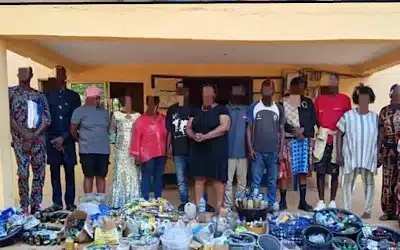
Fifteen people have been arrested in connection with the Ondo methanol poisoning, including a man known locally as Meko, identified by police as Oloruntoba Babatunde. Investigators allege he produced the suspected methanol-laced substance linked to the deaths.
DSP Abayomi Jimoh, the Ondo Police spokesperson, said several of those arrested were involved in the sale or consumption of herbal products in violation of an existing ban on unverified alcoholic drinks.
He said investigators are continuing to track additional suspects as the manhunt widens across the affected areas.
Six government and security agencies are now involved in the investigation.
The Ministry of Health is working alongside the Nigeria Police Force, the Department of State Services, the National Agency for Food and Drug Administration and Control, the National Drug Law Enforcement Agency, the Nigeria Security and Civil Defence Corps and the World Health Organisation.
Despite the extensive response, officials say it remains unclear whether the Ondo methanol poisoning originated from a single contaminated batch or multiple sources.
This is not the first time southern Nigeria has faced such a tragedy.
In May 2015, a methanol poisoning incident in Rivers State affected 84 people across five local government areas and prompted an emergency response that public health researchers later studied closely.
More than a decade later, the Ondo methanol poisoning suggests that significant gaps still exist in the regulation of informal alcohol production.
Locally distilled drinks such as ogogoro and herbal mixtures sold as Monkey Tail are often produced outside the inspection systems that govern licensed manufacturers.
They can be distributed at naming ceremonies, funerals and roadside bars without any formal safety testing.
Public health experts say that lack of oversight, more than any single contaminated batch, is what transformed a family celebration into a mass casualty event.
Ajaka has urged residents to avoid unregulated drinks and warned that products marketed as herbal medicine can be just as dangerous when their contents are unknown.
For families burying loved ones in Odigbo and Irele this week, the Ondo methanol poisoning has already delivered its verdict long before the toxicology reports do.


