



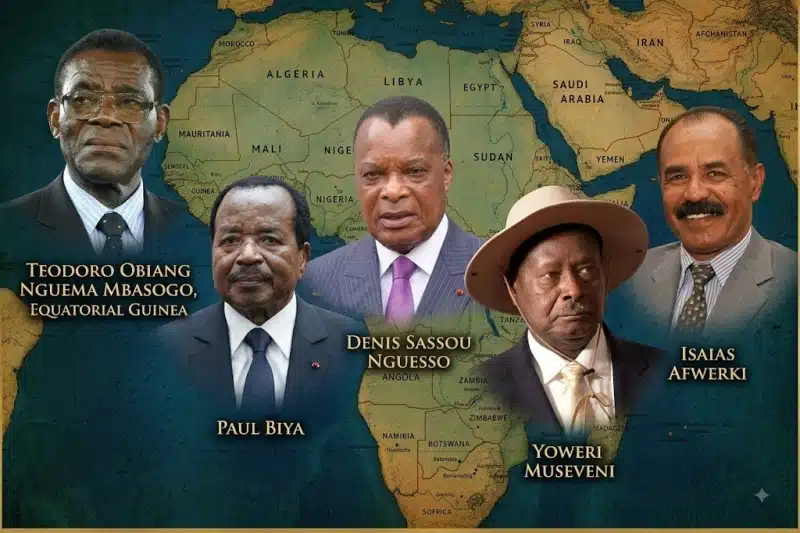

Cameroon’s Paul Biya has spent nearly two months outside his own country, and he has used the time to reorganise his army from a hotel in Geneva. The move has revived a familiar question across the continent: how long can ageing African leaders keep running their nations from a distance while their aides quietly hold the reins at home.
Biya, 93, left Cameroon on 7 June for what his office called a brief private stay in Europe, according to TheCable. Nearly two months on, he has not made a single public appearance, a silence that has become familiar among ageing African leaders who spend long stretches away from home. Government spokesman Rene Emmanuel Sadi insists the president is alive and will return soon, TheCable reported, yet no date has been given.
On Monday, Biya signed a series of decrees from Geneva that reshaped the command of Cameroon’s armed forces. Gazette Africa reported that five colonels were promoted to brigadier general, among them Raymond Jean Charles Beko’o Abondo, who was confirmed as head of the elite Presidential Guard, a post he has held since 2013.
Commanders in four of Cameroon’s five joint military regions were replaced, and a new leader was named for the Rapid Intervention Brigade, according to a report by Oman Ghana News. Several motorised infantry brigades also saw leadership changes, in what the outlet described as one of the most extensive military reorganisations in Cameroon in recent years.
Cameroon Concord News reported that during his time abroad Biya has signed other decrees too, including approvals for loan agreements with international lenders. Officials say he continues to work through paperwork sent to him by aides, wherever he happens to be, a working style that has become the trademark of ageing African leaders governing at a distance.
Not everyone is convinced. Mamadou Mota, vice-president of the opposition Cameroon Renaissance Movement, said Biya’s absence had created what he called a glaring institutional vacuum, according to a report carried by PM News Nigeria. He was blunter still in remarks cited by Cameroon Concord News, saying executive power should be exercised at the heart of the nation and not through smoke signals from hotel suites abroad.
The opposition Social Democratic Front went further, describing the country as being on autopilot, PM News Nigeria reported. Higher education minister Jacques Fame Ndongo rejected the criticism, insisting the head of state was meticulously following files submitted by his aides no matter where he was staying.
Part of what has sharpened the debate is the absence of a clear successor. Cameroon created the post of vice-president through a constitutional amendment in April, yet no one has been appointed to fill it. In June, forged documents resembling a presidential decree were sent to a state radio station claiming a vice-president had been named. Staff there identified the papers as fake and did not air them.
Discussion of the president’s own health remains a delicate subject in Cameroon, and officials have repeatedly denied reports that he was hospitalised in Geneva. What is not in dispute is his age. At 93, Biya is the world’s oldest serving head of state and has led Cameroon since 1982, making him one of the continent’s most enduring ageing African leaders.
He is far from alone. Equatorial Guinea’s Teodoro Obiang Nguema Mbasogo has ruled since 1979, longer than any other sitting leader on earth, and has installed his own son as vice-president.
Like several other ageing African leaders, he has kept power within a tight family and party circle rather than opening a path to succession. Uganda’s Yoweri Museveni, in power since 1986, secured another term in January after courts scrapped an age limit that would once have barred him from standing again.
Denis Sassou Nguesso has led the Republic of Congo for a combined 39 years across two spells in office, The Guardian Nigeria reported, while critics say elections there are held with little transparency and scant room for international observers.
Ivory Coast’s Alassane Ouattara, a former International Monetary Fund executive, secured a fourth term last year at 83, joining the list of ageing African leaders whose long tenures have outlasted several generations of would be successors.
Nigeria provides a different version of the same generational question. President Bola Ahmed Tinubu, 73, is considerably younger than Biya, Obiang and Sassou Nguesso, but his presidency has also drawn attention to his age, visible frailty and periods of absence linked to reported medical treatment abroad.
Repeated hospital visits and concerns over his health have fuelled wider questions about how much day-to-day authority an ageing president can continue to exercise personally, and who would wield influence should his capacity to govern become more limited.
Analysts argue that these ageing African leaders share a common playbook. Loyal officers are promoted into sensitive posts, cabinets are reshuffled to reward allies, and succession is treated as a subject too dangerous to raise even among close aides.
Anthony Antem of the Nkafu Policy Institute in Yaounde told Reuters that Cameroon’s decrees reflect a strategy of building a fortress of loyal generals around the president to suppress any challenge to his rule, a tactic other ageing African leaders on the continent have leaned on too.
For ordinary citizens across these countries, the pattern looks similar regardless of the capital. A small circle of advisers, generals and family members manages daily affairs while ageing African leaders themselves grow less visible in public life. Elections are delayed, cabinets go unformed for months, and any talk of succession is treated as taboo.
Cameroon’s next scheduled polls have already been pushed back several times, extending the terms of sitting officials indefinitely, according to Macau Business. Whether Biya returns to Yaounde in the coming days or extends his stay further, his absence has again shown how, for many ageing African leaders, governing a country and simply managing its paperwork from abroad have become almost the same thing.


