



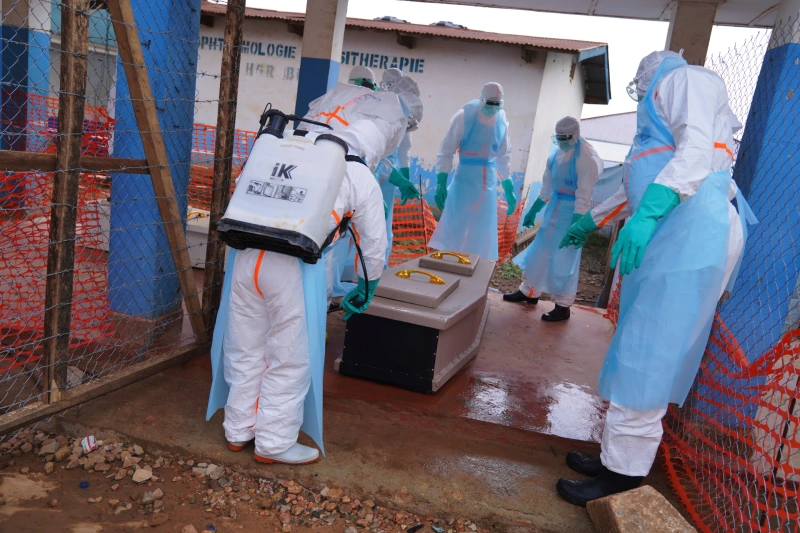

The DR Congo Ebola outbreak has overtaken the country’s 2018 to 2020 epidemic to become the second-largest ever recorded globally. Data released on Friday by the Congolese Ministry of Communication and Media, and confirmed by the World Health Organisation, put confirmed cases at 3,532 and deaths at 1,556.
Only the West African epidemic of 2014 to 2016 was larger, with the World Health Organisation recording 28,616 cases and 11,310 deaths across Guinea, Liberia and Sierra Leone. The DR Congo Ebola outbreak has now surpassed the 3,481 cases logged during the country’s previous largest epidemic, which ran for nearly two years between August 2018 and June 2020.
What sets this crisis apart is its speed. The outbreak was first identified in mid-May in Ituri province, meaning it has climbed past the 2018 to 2020 total in little over two months. By contrast, the earlier epidemic took nearly two years to reach a similar case count. WHO Director-General Dr Tedros Adhanom Ghebreyesus said this month that the response was still being outpaced by transmission, adding that intense spread in Ituri remained the organisation’s biggest concern.
Officials have described the DR Congo Ebola outbreak as the fastest-growing in recorded history. The Centers for Disease Control and Prevention noted that the first 1,000 cases were reported within 40 days of the response being activated, compared with roughly 235 days during the 2018 to 2020 epidemic. That pace has left responders repeatedly playing catch-up as the DR Congo Ebola outbreak continues to widen its footprint.
The virus, identified as the rare Bundibugyo strain, has now spread beyond Ituri into four other provinces. Cases have been confirmed in Haut-Uele, North Kivu, South Kivu and Tshopo, with dozens of the country’s health zones now reporting infections. Kisangani, the capital of Tshopo and more than 500 kilometres from the original epicentre in Bunia, has also recorded cases, according to figures cited by health officials.
A critical gap is complicating the DR Congo Ebola outbreak response. Unlike the Zaire strain behind the 2018 to 2020 epidemic, the Bundibugyo strain has no approved vaccine or licensed treatment.
The Zaire outbreak was brought under control partly through Ervebo, the world’s only approved Ebola vaccine, alongside monoclonal antibody therapies shown to reduce deaths among hospitalised patients. The World Health Organisation has said existing evidence does not support using Ervebo against this genetically distinct species.
Contact tracing, ordinarily the frontline defence against Ebola, is also struggling to keep pace. WHO officials say more than 80 per cent of new infections are being detected outside known contact lists, a sign that transmission chains are being missed faster than they can be traced.
Roughly two-thirds of deaths are occurring among people who never reached a health facility, a pattern that increases the risk of unsafe handling of bodies and further community spread. Health workers say this gap is one of the clearest reasons the DR Congo Ebola outbreak has resisted the containment tools that worked in earlier epidemics.
The Council on Foreign Relations has linked the difficulty of the response to the wider instability gripping eastern DR Congo, where nearly seven million people are internally displaced, most of them in North Kivu, South Kivu and Ituri. Armed group activity, cross-border smuggling and population movement have made it harder for responders to track and isolate cases.
Health facilities have also come under attack, with at least a dozen incidents reported since the outbreak began, prompting the United Nations to deploy a mobile peacekeeping base near Nyakunde to protect treatment operations.
Some progress has been reported. A vaccine candidate targeting the Bundibugyo strain, developed by the University of Oxford with the Serum Institute of India, has reached clinical trial stage, with the first doses administered in recent weeks. Officials have also pointed to hundreds of recoveries as evidence that early diagnosis and safe care can still save lives, even without a licensed vaccine against the strain driving the DR Congo Ebola outbreak.
For now, the DR Congo Ebola outbreak shows no clear sign of peaking. With transmission continuing to outrun containment efforts and the virus already present in five provinces, health authorities face a race against time to prevent further spread across one of Africa’s most conflict-affected regions.


