



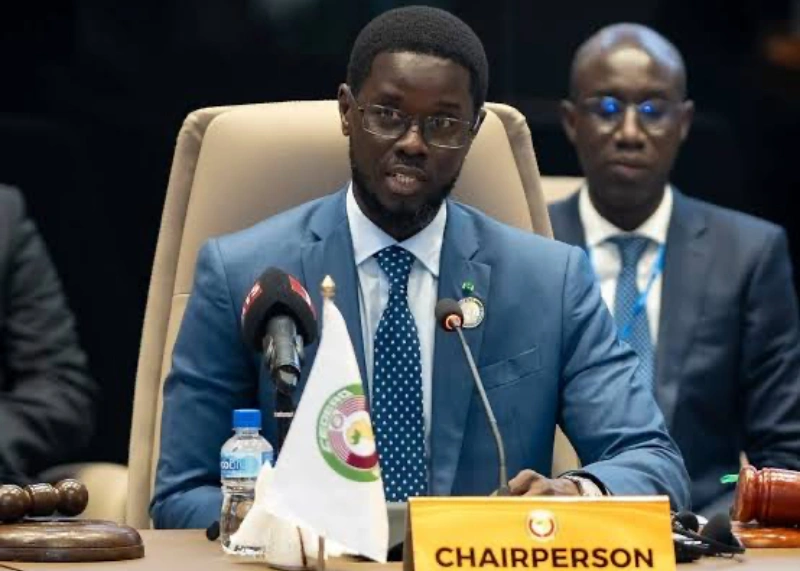

Senegalese President Bassirou Diomaye Faye has taken over as ECOWAS chairman, and he has made ECOWAS Sahel reconciliation the defining goal of his one-year term.
He was elected during the 69th Ordinary Session of the Authority of Heads of State and Government, held in Lungi, Sierra Leone, on 19 July 2026, succeeding Sierra Leonean President Julius Maada Bio.
Faye’s rise to the chairmanship was confirmed by outgoing chairman Bio, who, as reported by Nairametrics, told fellow leaders he was passing the mantle to his “younger brother.” The handover places a 46-year-old former tax inspector, who became Senegal’s president in April 2024, at the helm of a bloc still reeling from the departure of three of its founding members, and one that will now watch closely to see how far he can carry ECOWAS Sahel reconciliation.
At the same summit, General Birame Diop of Senegal, according to Pointblank News, was confirmed as the next President of the ECOWAS Commission. He takes office on 1 September 2026, replacing Gambian diplomat Omar Alieu Touray, whose four-year tenure has come to an end. Diop’s appointment marks the first time a Senegalese national has led the Commission since ECOWAS was formed in 1975, and it gives Faye a close ally at the Commission as he steers ECOWAS Sahel reconciliation through its next phase.
Faye’s ECOWAS Sahel reconciliation drive did not begin with his chairmanship. He was appointed as ECOWAS mediator to Mali, Burkina Faso and Niger back in July 2024, working alongside Togolese President Faure Gnassingbé, after the three countries signed a confederation treaty establishing the Alliance of Sahel States. Faye, in comments from that period carried by a Foreign Policy report, expressed hope that ongoing conversations would help reconcile views and strengthen the organisation before the exit notice period lapsed.
That reconciliation effort has yet to bear fruit. Mali, Burkina Faso and Niger formally completed their withdrawal from ECOWAS in January 2025, cementing the Alliance of Sahel States as a standalone confederation under President Assimi Goïta of Mali, President Ibrahim Traoré of Burkina Faso and President Abdourahmane Tiani of Niger. The three governments have repeatedly described their exit as irreversible, citing sovereignty concerns and dissatisfaction with how ECOWAS handled sanctions imposed after their respective changes of government.
Accepting the chairmanship in Lungi, Faye struck a conciliatory tone. He thanked fellow heads of state for their trust and, in remarks that Sahara Reporters carried on the day, closed with the pledge to work towards a “reconciled and united West Africa.” According to the Senegalese presidency, his tenure will prioritise collective security, economic sovereignty and a renewed commitment to the founding ideals of the regional bloc, alongside continued outreach to the breakaway states.
Analysts tracking the transition say Faye is well placed to advance ECOWAS Sahel reconciliation given his existing rapport with the Sahel leadership and his own reformist credentials at home. He is, as West Africa Weekly reports, expected to intensify efforts to rebuild trust and keep communication channels open with Mali, Burkina Faso and Niger, building on the mediator role he has held since 2024.
The challenge remains steep. ECOWAS, as Africanews notes, continues to grapple with rising insecurity linked to extremist violence across the Sahel, alongside democratic setbacks in several member states and the practical difficulties of reintegrating three landlocked economies that have deepened defence and trade ties with one another outside the bloc’s structures. The International Monetary Fund’s Africa department has previously noted that the departing states face steep transaction costs from trading outside ECOWAS’s $702 billion market, a pressure point that could yet influence how far ECOWAS Sahel reconciliation can go.
Beyond the Sahel question, Faye’s chairmanship, as highlighted by Blueprint Newspapers, is expected to focus on institutional reform, governance and youth participation in regional decision-making. Nigeria’s Vice President Kashim Shettima, who represented President Bola Tinubu at the Lungi summit, reaffirmed Abuja’s commitment to regional integration and called for stronger security cooperation across the bloc.
Whether Faye can succeed where his predecessors could not remains uncertain, and much of that judgement will rest on how much progress ECOWAS Sahel reconciliation makes in the coming months. Mali, Burkina Faso and Niger have consistently maintained that their withdrawal is final, even as they continue engaging informally with ECOWAS envoys. For now, Faye’s early messaging signals that ECOWAS Sahel reconciliation will remain a standing item on the bloc’s agenda throughout his tenure, even if formal reintegration stays out of reach in the short term.


