



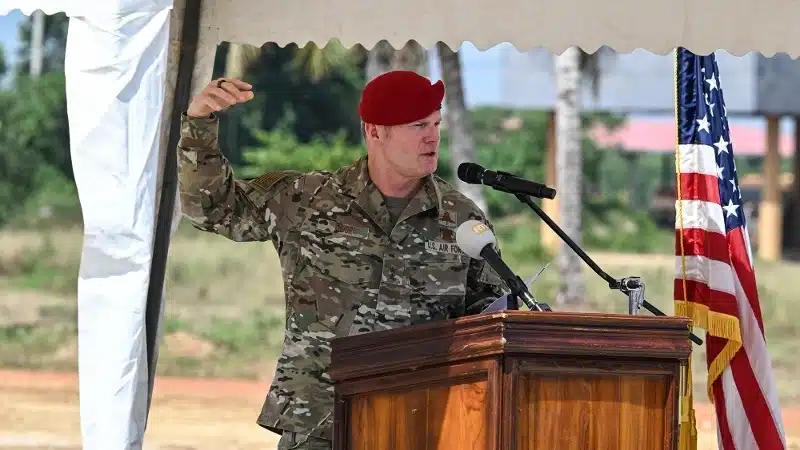

US-Cameroon military cooperation is entering a new phase, with American forces preparing to return to a base in Cameroon’s Far North region after a seven year absence, as cross-border attacks by Islamic State West Africa Province and Boko Haram factions continue to batter communities along the Nigeria-Cameroon frontier.
The United States military is finalising plans to redeploy troops to Maroua, the regional capital, according to reporting by Military Africa on June 20 2026 also confirmed by the Cameroon News Agency.
The Salak base, home to Cameroon’s elite Bataillon d’Intervention Rapide, has been refurbished and is ready to receive American personnel, with Colonel Albert Bias holding local command and General François Pelene coordinating on the Cameroonian side. Security officials believe US-Cameroon military cooperation could improve the speed of intelligence sharing across the Lake Chad Basin.
This latest step in US-Cameroon military cooperation is driven largely by intelligence, surveillance and reconnaissance support. American teams would feed real time aerial and electronic intelligence directly to Cameroonian units tracking ISWAP fighters and the Jama’atu Ahlis Sunna Lidda’awati wal-Jihad faction, according to details reported by Cameroon Concord News.
The aim, as outlined in coverage from Military Africa, is to close the gap between detection and action that has historically let insurgents melt away before conventional forces respond.
Officially, though, Washington is treading carefully. A spokesperson for AFRICOM told DefenceWeb that current activities reflect ongoing, invitation based cooperation rather than a new basing initiative, stressing that any US teams operate at the explicit invitation of the Cameroonian government. The command described a small force that had just concluded a training event, alongside a small assessment team evaluating future training opportunities, rather than confirming a formal redeployment.
The push for renewed US-Cameroon military cooperation follows the closure of the 110 million dollar Agadez base in Niger in August 2024, after Niger’s military government expelled American personnel following the 2023 coup. That closure, reported by Military Africa, stripped AFRICOM of its primary surveillance node for the western Sahel and left a gap that armed groups have since exploited across Mali, Burkina Faso and the Lake Chad Basin.
Washington has responded by building a wider ISR network across the region. Around 200 US personnel are already operating MQ-9 Reaper drones from Bauchi Airfield in northeastern Nigeria since March 2026, a platform with roughly four times the payload of the older Predator, according to Cameroon Concord News. Coverage from Salak and Bauchi would overlap across the Lake Chad Basin, treating the theatre as a single operational picture.
The urgency behind this US-Cameroon military cooperation is visible on the ground. Troops of Operation Hadin Kai thwarted an attempted ISWAP and Boko Haram infiltration along the Kirawa axis of the Nigeria-Cameroon border in the early hours of 22 May 2026, according to a military statement carried by Vanguard, with attackers forced to withdraw towards the Cameroonian side after sustaining heavy casualties. Daily Post reported that twelve militants were neutralised in the same clash, with weapons including AK-47 rifles and a PKT machine gun recovered afterwards.
Analysts at the Institute for Security Studies have separately noted large scale ISWAP attacks on military posts across Cameroon, Chad and Niger, aimed partly at restocking weapons and exploiting the cross-border trade that has revived since border posts reopened.
Cameroon’s Far North remains home to more than 476,000 people displaced by the violence, according to figures cited by Africa Defence Forum. US-Cameroon military cooperation may have increasingly become important as insurgent groups expand cross-border operations.
Bilateral momentum extends beyond Washington and Yaoundé. On 16 June 2026, Nigeria and Cameroon signed a defence agreement in Yaoundé expanding intelligence sharing and coordination along shared land and maritime borders, a pact confirmed by Nigeria’s Ministry of Defence as a response to jihadists exploiting the porous frontier.
For now, US-Cameroon military cooperation remains framed by both sides as capacity building rather than a return to permanent basing. AFRICOM’s 2026 counterterrorism posture, according to its own public materials, favours partner force development and host nation command authority over large independent footprints. Whether that framing holds as ISWAP’s cross-border campaign intensifies will shape how deep Washington’s footprint in the Far North ultimately becomes.


