



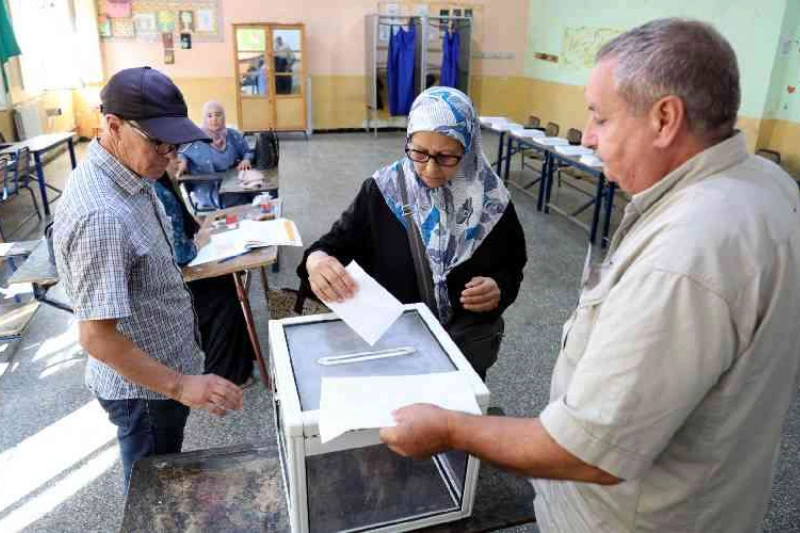

Algeria’s election turnout has sunk to its lowest level on record, deepening questions over public trust in the country’s political system even as the ruling National Liberation Front claims victory in parliamentary polls.
The National Independent Elections Authority announced on Monday that the FLN secured 90 of the 407 seats contested in the 2 July vote, according to France 24. The result confirms the party’s continued dominance of the National People’s Assembly, though it falls well short of an outright majority.
What has drawn far more attention than the result itself is how few Algerians bothered to take part. Only 21 percent of the country’s roughly 25 million registered voters cast ballots, Africanews reported, citing the electoral authority’s figures. That figure marks a fresh low in Algeria’s election turnout, sliding beneath the previous record of 23 percent set during the 2021 legislative vote.
Karim Khelfane, interim head of the elections authority known as ANIE, defended the process as transparent and argued that the weak Algeria’s election turnout figures were not unique to the country, France 24 reported.
The backdrop to this year’s vote makes the numbers harder to dismiss. Algeria’s 2021 parliamentary election, held two years after the Hirak pro-democracy protests forced the resignation of long serving president Abdelaziz Bouteflika, had already produced what was then a historic low turnout of 23 percent, Al Jazeera reported. President Abdelmadjid Tebboune, first elected in December 2019, went on to win a second term in 2024.
This year’s campaign unfolded under fresh controversy. Electoral authorities barred 269 prospective candidates from standing for the 407 seat lower house, France 24 reported, while other analysis put the scale of disqualifications even higher. GZERO Media reported that more than 3,700 candidates were struck off on grounds of what officials described as suspicious political activity, a move that included several figures linked to the Hirak movement. The Italian think tank ISPI put the figure at 61 rejected lists out of 793 submitted, covering 2,250 individual candidacies.
Analysts say the disqualifications, layered on top of years of restrictions on dissent, have compounded the disillusionment behind the weak Algeria’s election turnout. Abdelmoumene Khelil, former secretary general of the Algerian League for the Defence of Human Rights, told Al Jazeera that low participation predates the Hirak but has worsened sharply since. The organisation, active during the 2019 protests, says it was effectively forced to shut down in 2023 along with several other civil society groups.
Louisa Dris-Aït Hamadouche, a professor at the University of Algiers, told ISPI that participation tends to rise only when voters see a credible chance of political change, and that an increasingly closed system made a repeat of the 2026 pattern unsurprising.
The government had tried to head off another slump before the vote. Officials declared election day a national holiday to encourage participation, GZERO Media reported, and introduced youth quotas and public funding schemes aimed at citizens under 40, who make up more than half the electorate, according to ISPI.
The measures ultimately failed to prevent Algeria’s election turnout from falling to a new record low. A law passed in March 2026 also allows courts to dissolve political parties that boycott two consecutive elections, a measure widely seen as pressuring opposition groups back into the process.
That pressure appears to have worked on paper. The Socialist Forces Front, which boycotted the 2021 election entirely, returned this year with 30 candidate lists, Al Jazeera reported, while the Rally for Culture and Democracy also rejoined after its own boycott. Yet their participation did little to shift the overall Algeria’s election turnout figures, suggesting the return of these parties reflected legal compulsion rather than renewed public enthusiasm.
Nouri Dris, a sociology professor at the University of Sétif, told Al Jazeera he expected the ruling establishment to retain the bulk of parliamentary seats regardless of turnout, while noting that smaller parties historically dominant in the years immediately after 2019 appeared to be losing ground.
For ordinary Algerians, the vote competed with other priorities. GZERO Media noted that attention on polling day was drawn as much to the national football team’s World Cup fixture against Switzerland as to the ballot box, with some observers framing low participation less as apathy than as a quiet form of protest against a system many no longer see as responsive to them.
With provisional results already published and final certified figures expected in the coming days, the debate over Algeria’s election turnout looks set to continue well beyond this vote. The latest Algeria’s election turnout figures will also feed into wider questions about the legitimacy of a parliament that critics have long dismissed as having little real influence over the country’s direction.


