



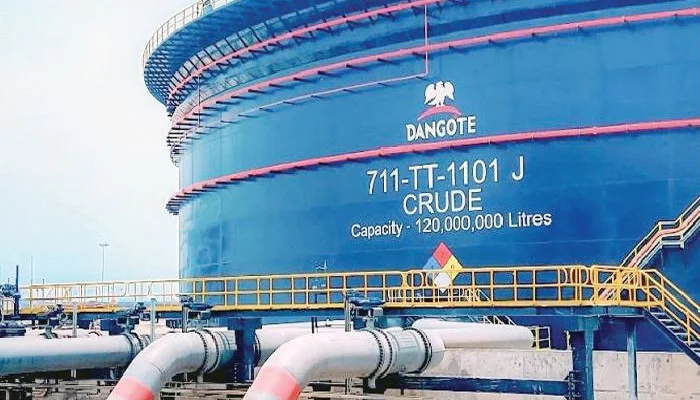

Nigeria’s jet fuel exports to Europe climbed to a record high in June, with the Dangote Petroleum Refinery overtaking the United States as the continent’s leading external supplier of aviation fuel.
Figures from S&P Global Commodity Insights show that Nigeria’s jet fuel exports to Europe nearly doubled month on month, rising from 232,000 metric tonnes in May to 466,000 metric tonnes in June. That is the highest volume Nigeria has sent to Europe since it became a net exporter of aviation fuel in 2024, when the Dangote refinery began producing jet fuel.
The June cargo is equivalent to roughly 582.5 million litres. At an average domestic price of ₦1,300 per litre, the shipment carries an estimated value of ₦757 billion, or about $553 million.
America’s numbers moved in the opposite direction. US jet fuel exports to Europe fell from a record 818,000 metric tonnes in April to 560,000 metric tonnes in May, then to 399,000 metric tonnes in June. That decline is what allowed Nigeria to overtake the US as Europe’s top external supplier for the month.
The surge in Nigeria’s jet fuel exports to Europe has landed at an odd moment for the market. Prices have been falling steadily even as shipments climb.
Platts, part of S&P Global Commodity Insights, assessed the Northwest Europe jet fuel cargo benchmark at $981.75 per metric tonne on 30 June. That is down sharply from a peak of $1,694.25 per metric tonne on 30 March, when prices spiked during the Israel-Iran conflict. Despite the increase in jet fuel exports to Europe, weaker benchmark prices suggest supply is currently outpacing demand across major trading hubs.
Forward contracts show the same pattern. The August contract fell to $968.25 per metric tonne from $1,507.50 over the same period, according to Platts pricing data.
A trader speaking to Platts explained the glut in fairly simple terms. High refinery output encouraged operators to delay maintenance while prices were still elevated, both the US and Dangote pushed out large cargoes, and some flows have also resumed through the Suez Canal from the UAE.
Other suppliers shifted their output too. Saudi Arabia’s shipments to Europe jumped to about 106,000 metric tonnes in June, up from just 7,000 metric tonnes in May, while India sent 197,000 metric tonnes, up from 129,000 tonnes the month before.
Shipments from the United Arab Emirates and Kuwait, both significant earlier in the year, were absent from June’s tally altogether. Competition in jet fuel exports to Europe has intensified as suppliers from Africa, the Middle East and Asia all seek to capture a larger share of the market.
Whether Nigeria’s jet fuel exports to Europe keep climbing from here depends on events well beyond Lagos. Platts reports that traders see the durability of the current oversupply as tied to developments in the Strait of Hormuz and how quickly Middle Eastern refiners recover from recent disruption. A renewed flare-up in the region, or a slower restart of damaged refining capacity, could tighten supply again and reverse the price slide.
Stronger summer travel demand could also help rebalance the market, along with refiners’ growing preference for diesel production over jet fuel, Platts data suggests.
Dangote’s rising share of Europe’s aviation fuel market sits inside a wider pattern in Nigeria’s refined products trade. Figures from the Nigerian Midstream and Downstream Petroleum Regulatory Authority show the refinery exported about 1.66 billion litres of refined petroleum products in April, made up of roughly 513 million litres of petrol, 534 million litres of diesel and 615 million litres of aviation fuel.
That output has already reshaped Nigeria’s position in global fuel markets. The country became a net petrol exporter for the first time in decades in March, when it shipped about 434 million litres after domestic production overtook local demand.
If current production trends continue, jet fuel exports to Europe could remain one of the strongest contributors to Nigeria’s refined petroleum export earnings in the months ahead.
The Dangote refinery remains Nigeria’s only major facility producing enough refined fuel to cover both domestic consumption and export volumes. Its growing output is steadily moving the country away from its long-standing position as one of the world’s largest importers of refined petroleum products, and towards becoming an export hub for Africa and beyond.


