



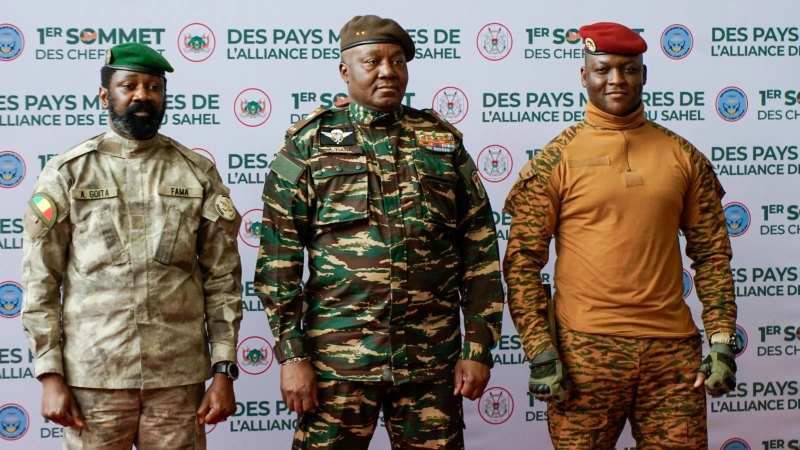

Human rights organisations have responded sharply after Niger, Mali and Burkina Faso completed the formal step needed to trigger their withdrawal from the ICC, turning what had been a political declaration into a legal process now running against the clock.
Human Rights Watch issued a fresh statement on Wednesday, arguing that the three governments’ withdrawal from the ICC betrays the victims who relied on the court as a last line of recourse. The rights group said the move strips away access to justice at a moment when accountability for atrocity crimes in the Sahel is already fragile.
Niger deposited its written notification with the UN secretary-general on 18 June. Burkina Faso and Mali followed on 24 June, according to Parliamentarians for Global Action, an international network that tracks Rome Statute compliance. Under Article 127 of the treaty, a withdrawal from the ICC only takes legal effect one year after that notification is received, meaning the three countries remain bound by their obligations until June 2027.
Amnesty International‘s regional director for West and Central Africa, Marceau Sivieude, said the decision would significantly harm the chances of victims and survivors of future war crimes and crimes against humanity ever reaching the court. He urged the three states to raise their concerns through dialogue within the Assembly of States Parties rather than pressing ahead with a withdrawal from the ICC that closes off that route entirely.
The ICC’s Assembly of States Parties, the body representing the court’s 125 member states, said this week that the departures risk weakening the collective pursuit of justice, Africanews reported. The Assembly said it regretted the decision and has invited the three governments to a further exchange, framing the withdrawal from the ICC as reversible if political will shifts.
Niger, Mali and Burkina Faso have defended their position on grounds that carry real weight across the continent. Niger’s notification accused the court of being misused, while Burkina Faso called it a selective and politicised institution, according to Human Rights Watch. Those complaints echo a longer history. Between 2009 and 2015, the African Union itself pushed back against the ICC over a docket that, for years, contained almost exclusively African cases.
That history matters for how this story should be read. The concern that the ICC has focused disproportionately on Africa is not a fringe position invented by military governments seeking cover. It has been raised by African Union member states, by legal scholars and even by Amnesty International, which warned in 2022 that perceived double standards threatened the court’s credibility.
None of that, however, makes a full withdrawal from the ICC the right answer for victims on the ground. Selectivity is a fair criticism to raise inside the system, through the Assembly of States Parties, where African states have real voting weight. Walking away removes that leverage entirely and leaves survivors of war crimes with fewer options rather than better ones.
The stakes are concrete in Mali, where the ICC still runs an active investigation referred by the Malian government itself back in 2012. A reparations process tied to the destruction of religious and historic sites in Timbuktu is in its final phase, and a further reparations decision in a related Timbuktu case is expected soon. Cooperation with that investigation remains a legal obligation for Bamako until the exit takes effect.
To fill the gap left by the withdrawal from the ICC, the Alliance of Sahel States, the political bloc formed by the three military governments, has announced plans for a Sahel Criminal and Human Rights Court, intended to handle justice and accountability domestically. Human rights groups have voiced doubt that a body created by the same governments accused of failing to investigate abuses by their own forces can deliver independent oversight.
A withdrawal from the ICC can still be reversed before it takes legal effect. Gambia and, more recently, Hungary both filed similar notifications and later withdrew them. Niger, Mali and Burkina Faso have given no public sign that they intend to follow that path, but the door remains open for the next twelve months.
For victims across the Sahel, what happens next will depend less on the diplomatic argument over ICC selectivity and more on whether any credible alternative for justice actually takes shape before June 2027 arrives.


