



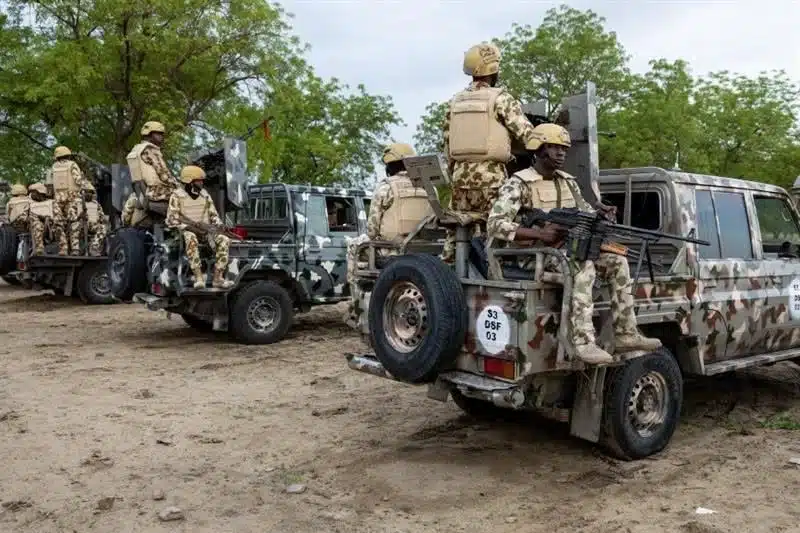

The United States says the recent US-Nigeria counterterrorism operation has produced the largest seizure of terrorist equipment on Nigerian soil since the September 11 attacks, as joint forces continue to dismantle the infrastructure of Islamic State West Africa Province (ISWAP) and Boko Haram across north-eastern Nigeria.
The Nigerian Defence Headquarters confirmed that operations conducted with the US military’s Africa Command (AFRICOM) destroyed checkpoints, weapons caches, logistics hubs, military equipment and financing networks used by ISIS and ISWAP.
The Nigerian Defence Headquarters said that as of 19 May 2026, assessments indicated that 175 ISIS fighters had been removed from the battlefield.
The results mark the most consequential US-Nigeria counterterrorism operation in terms of terrorist infrastructure destroyed since the global war on terror began after September 2001.
Senior ISIS Commander Killed
The operation began at approximately 12:01 a.m. as two dozen operators arrived by helicopter, including SEAL Team Six, and fought with militants on two small islands in the Lake Chad Basin with the intent to capture Abu-Bilal al-Minuki. After a three-hour firefight, a surrender seemed unlikely. Rather than risking a potential escape, an airstrike was launched on his compound, killing al-Minuki.
Al-Minuki provided strategic guidance to the ISIS global network on media and financial operations, as well as the development and manufacturing of weapons, explosives, and drones. AFRICOM described him as the most active terrorist in the world, with a significant history of involvement in planning attacks and directing hostage-taking.
Officials described the US-Nigeria counterterrorism operation as one of the most sophisticated joint missions conducted in the Lake Chad Basin.
US Secretary of War Pete Hegseth said al-Minuki was the senior ISIS General Directorate of Provinces Emir, describing him as the number two for ISIS globally, responsible for overseeing the planning of attacks, directing hostage-taking and managing financial operations.
Nigerian President Bola Tinubu confirmed the operation and said al-Minuki was killed alongside several of his lieutenants during a strike on his compound in the Lake Chad Basin.
The US-Nigeria counterterrorism operation also resulted in the deaths of three other senior figures. Abd-al Wahhab had been the group’s chief attack coordinator and propaganda chief. Abu Musa al-Mangawi was a senior ISWAP operative. Abu al-Muthanna al-Muhajir ran the group’s media production arm.
A Series of Coordinated Strikes
The US-Nigeria counterterrorism operation unfolded across several days. AFRICOM conducted the initial operation on 16 May 2026, followed by additional kinetic strikes on 17 May and 18 May 2026, with intelligence confirming the targets were ISIS militants and no US or Nigerian forces harmed in any of the strikes.
On 30 May 2026, a further US-Nigeria intelligence-led strike killed 21 ISWAP fighters in Arege, Borno State. Security sources disclosed that three of those killed were mid-level commanders believed to have coordinated several attacks and raids in Monguno, Damasak and surrounding communities in northern Borno State.
Retired Colonel Timothy Antigha, a member of the Minister of Defence Media Team, described Arege as a major transit point for the movement of fuel, food supplies, weapons and ammunition destined for terrorist cells operating within the Sambisa Forest and Mandara Mountain corridors, as well as a command-and-control location used by ISWAP to coordinate operations across the Lake Chad region.
Partnership That Preceded the Strikes
The US-Nigeria counterterrorism operation did not emerge overnight. On 3 February 2026, an advance team of US soldiers was sent to train and advise the Nigerian military. By 16 February, the United States had sent an additional 100 troops, bringing the total deployment to 200 military personnel.
US Secretary of State Marco Rubio, speaking on US foreign policy and international security cooperation, reaffirmed the US-Nigeria counterterrorism operation, citing joint operations that dealt a major blow to the Islamic State network and confirming that American and Nigerian security agencies collaborated to eliminate a senior global ISIS leader operating from within Nigeria.
The Nigerian military said the operation was a result of recently formed US-Nigeria partnership and intelligence-sharing efforts. Military spokesperson Samaila Uba said in a statement that the operation had disrupted a violent terrorist network that endangered Nigeria and the broader West African region.
Military analysts say the US-Nigeria counterterrorism operation demonstrates a new level of intelligence sharing between both countries.
ISIS Pivots to Africa
Analysts say the scale of what the US-Nigeria counterterrorism operation has uncovered reflects a fundamental shift in the global jihadist threat. Since suffering major setbacks in the Middle East, ISIS has pivoted towards Africa, which accounted for 86 per cent of the group’s global activity in the first three months of 2026, according to crisis monitoring group Armed Conflict Location and Event Data.
Malik Samuel, a senior researcher at Good Governance Africa who specialises in insurgent groups in Nigeria, said the killing of al-Minuki was the first time a security agency had killed someone so highly ranked within ISWAP, adding that the potential to cause chaos within the group was real because the operation had been carried out in the heart of ISWAP’s fortified base, which is very difficult to access.
The Centre for Strategic and International Studies noted that West Africa’s terrorist groups are currently the world’s most active and increasingly threaten regional governments, with ISSP conducting a record number of large-scale attacks across the Sahel in 2025 and drawing closer to Niamey, Niger’s capital.
Nigeria has been battling armed groups across multiple theatres for over a decade. Between 4 and 6 March 2026, suspected Islamic militants attacked the town of Ngoshe in north-eastern Borno State, reportedly abducting more than 300 civilians, including women and children, and killing many others.
The US-Nigeria counterterrorism operation represents the deepest US military involvement in Nigeria in the post-9/11 era, and Abuja and Washington have signalled that the partnership will intensify.


