



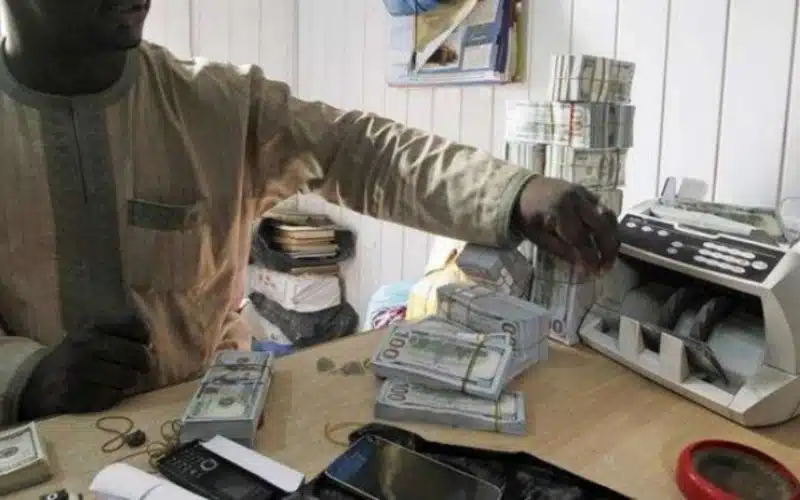

The United States government has placed a Lagos-based bureau de change operator and three of his firms on its terrorism blacklist, accusing them of moving money for the Islamic State in West Africa.
The Nigerian ISIS financing sanctions were announced on 22 June 2026 by the US Department of the Treasury’s Office of Foreign Assets Control, known as OFAC. They form part of a sweeping action targeting nine parties across France, Syria, Türkiye and Nigeria. The Nigerian ISIS financing sanctions represent one of the most significant US actions this year aimed at disrupting extremist financing networks linked to West Africa.
The man named is Mukhtar Adamu Muhammad, 35, also known as Mukhtar Adamu and Muhammad Mukhtar. OFAC listed his address as No. 45, Abimbola Street, Agege, Lagos State.
According to OFAC, Muhammad conducted money transfers on behalf of ISIS’s West Africa affiliate, the group widely known as ISWAP. The three bureaux de change OFAC says he owns or controls are Nine to Nine Exchange Bureau De Change Limited, located at the FAAN Complex on Airport Road in Ikeja, Lagos; Manhattan Bureau De Change Limited on Murtala Mohammed Way in Kano; and Generation Currency Bureau De Change Limited in Lagos.
OFAC designated all three firms under Executive Order 13224, citing them for acting directly or indirectly on Muhammad’s behalf in support of ISIS-West Africa’s financial operations.
Secretary of the Treasury Scott Bessent said ISIS continues to look for new ways to fund its attacks. “The United States will leverage every tool at its disposal to crush ISIS’s remaining capabilities and protect American lives,” he said in the Treasury’s official statement.
A Network Across Four Countries
The Nigerian ISIS financing sanctions are one part of a wider action. OFAC also designated France-based Miloud Abderrahmane, accusing him of carrying out transactions with ISIS affiliates and passing on information about building explosives to ISIS supporters.
Two TRON cryptocurrency wallet addresses linked to Abderrahmane were published on OFAC’s Specially Designated Nationals list, marking one of the few instances where the agency has named specific blockchain wallet identifiers.
Syria-based Abdelhakim Boukich, also known as Abu Sulayman, was sanctioned for running Bitcoin Xchange, a money services business that OFAC says transferred funds on behalf of ISIS associates in Norway, Belgium, the Netherlands, South Africa and the United States. Mohamad Alhmidan, who was first sanctioned by OFAC in March 2016, was designated again.
US authorities say he owns two Türkiye-based firms, Spider Gayrimenkul Ve Genel Ticaret Limited Sirketi and Alkaram Danismanlik Gayrimenkul Ic Ve Dis Genel Ticaret Limited Sirketi, which originated as a hawala network moving funds out of ISIS-controlled territory in Syria.
Nigeria-US Security Cooperation
The US State Department spokesman Thomas Pigott, announcing the Nigerian ISIS financing sanctions alongside parallel designations, said Washington and Abuja have been working closely on counter-terrorism. He pointed to the 16 May 2026 joint operation that killed Abu-Bilal al-Minuki, described by US authorities as ISIS’s second-in-command and head of its General Directorate of Provinces.
“These actions reflect the United States’ unrelenting pressure on ISIS, which continues to decentralise its operations and rely on financial intermediaries to connect its global network,” Pigott said.
The Nigerian ISIS financing sanctions bring the total number of Nigerians targeted by Washington over terrorism financing to ten since 2022, when the US State Department began its most prominent sanctions campaign against Nigerian nationals. OFAC expanded that list in February 2026 to include eight Nigerians over alleged links to Boko Haram, ISIS and cybercrime.
Under the latest measures, all property and interests belonging to the designated individuals and entities that fall within US jurisdiction are frozen. American citizens and businesses are barred from transacting with them. OFAC further warned that foreign financial institutions found to be facilitating significant transactions on behalf of sanctioned persons could themselves face secondary sanctions.
Security analysts say the Nigerian ISIS financing sanctions highlight growing concerns about the use of informal financial networks by extremist groups operating across West Africa.
The Treasury’s 2026 National Terrorist Financing Risk Assessment, cited in the sanctions notice, noted that sustained counter-terrorism pressure has pushed ISIS towards more decentralised cells and a greater reliance on regional financial facilitators.
The latest Nigerian ISIS financing sanctions underscore Washington’s broader strategy of targeting the financial infrastructure that enables terrorist organisations to operate across multiple regions.


