



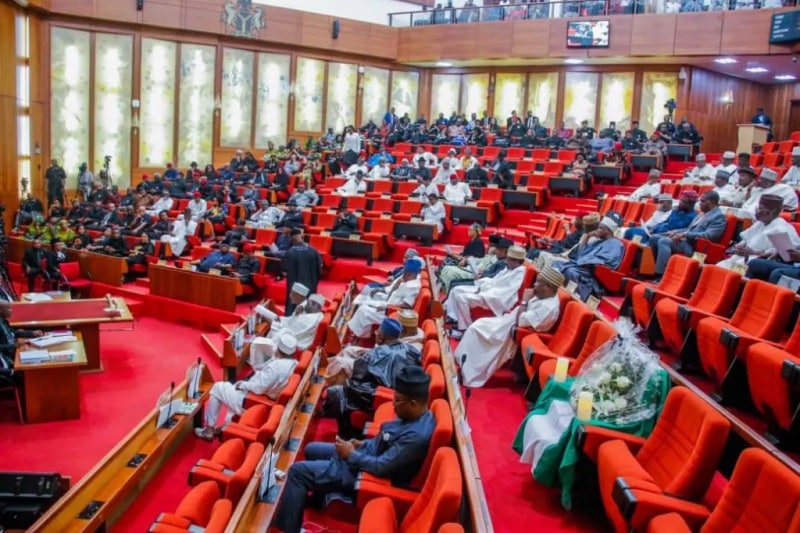

Nigeria’s Senate will sit in emergency session on Tuesday, 23 June 2026, to take a final vote on the Nigeria state police bill, cutting short a recess that was not due to end until 7 July.
The session, scheduled for 11:00 a.m. at the Red Chamber in Abuja, was convened at the instance of Senate President Godswill Akpabio.
The Clerk of the Senate, Emmanuel Odo, formally notified lawmakers of the sitting through a memo issued on 15 June, indicating that the session would focus on matters of urgent national importance, particularly national security.
A quorum problem that forced a recall
The Senate did not vote on the Nigeria state police bill before going on recess because it could not assemble enough members.
A principal officer of the Senate, who spoke to ThisDay on condition of anonymity, confirmed that the bill could not advance because the chamber failed to muster the constitutionally required two-thirds majority of the 109 senators needed to pass a constitutional amendment.
Both chambers had only recently adjourned for a legislative break scheduled to run until 7 July 2026, to allow lawmakers participate in Democracy Day activities. The emergency recall cut that break short.
According to the source, the Senate leadership has since intensified consultations, reaching out to lawmakers across party lines to ensure full attendance at Tuesday’s sitting. “We will surely reconvene on Tuesday to pass the bill on State Police,” the source told ThisDay.
How the bill got here
On 11 June, the House of Representatives passed the bill in a plenary session presided over by the Speaker, Tajudeen Abbas, with a majority voting in support of legislation formally titled “A Bill for an Act to Alter the Constitution of the Federal Republic of Nigeria, 1999, to Provide for the Establishment of State Police and for Related Matters (Sixth Alteration) Bill, 2026.
The Senate advanced the Nigeria state police bill through second reading the same day, with Senate Leader Opeyemi Bamidele leading the debate and underlining the urgency of reform given what he described as Nigeria’s escalating security challenges, including terrorism, banditry, mass abductions, farmer-herder clashes, and cyber-enabled crimes.
Senate President Akpabio referred the bill to the Senate Ad Hoc Committee on the Review of the 1999 Constitution, chaired by Deputy Senate President Barau Jibrin, for further legislative scrutiny before returning it to the full chamber for a final vote.
What the Nigeria state police bill would change
Nigeria currently operates a single, centralised police force controlled from Abuja, with every state relying on the same command structure. The Nigeria state police bill proposes to replace that with a dual system, creating a Federal Police that continues to operate at the national level alongside State Police forces that individual state governments can establish and control.
The bill also seeks to transfer policing from the Exclusive Legislative List to the Concurrent List, a move its sponsors say would promote cooperative federalism and enable each level of government to discharge its constitutional responsibilities more effectively.
Bamidele argued during the second reading debate that state police would improve intelligence gathering, saying local officers are better placed to obtain actionable information from communities because they understand local languages, customs, and social structures.
On the concern that governors could weaponise state police against political opponents, Bamidele said the bill establishes State Police Service Commissions to handle recruitment, training, and coordination, serving as an institutional check against political interference.
The bill also makes clear that the Federal Police cannot interfere with state police operations or the internal security affairs of a state except in situations involving a complete breakdown of law and order that the state police cannot handle, or where a governor formally requests federal intervention. Any such intervention would require approval from two-thirds of the Senate.
Supporters of the Nigeria state police bill argue that decentralising policing would allow faster responses to local security threats and improve accountability at the state level.
Near-universal political backing
Senate Leader Bamidele, in a statement issued by his media office, confirmed that President Bola Tinubu and all 36 state governors are in support of the Nigeria state police bill, adding that all strata of the federation had made clear there could be no better time to establish state police than now.
That alignment across the presidency, all state governorships, and the Nigeria Police Force itself is considered rare in Nigerian politics.
What comes after the Senate
Senate passage alone would not make the Nigeria state police bill law.
For the legislation to take effect, at least 24 of Nigeria’s 36 state Houses of Assembly must approve it, and President Tinubu must sign it into law. Given the political consensus currently behind the bill, those stages are expected to move quickly.
The bill has been described by analysts as the most significant restructuring of Nigeria’s security architecture since independence. Should state legislatures ratify it and President Tinubu sign it, the Nigeria state police bill would reshape how policing is organised and funded across all 36 states.


