



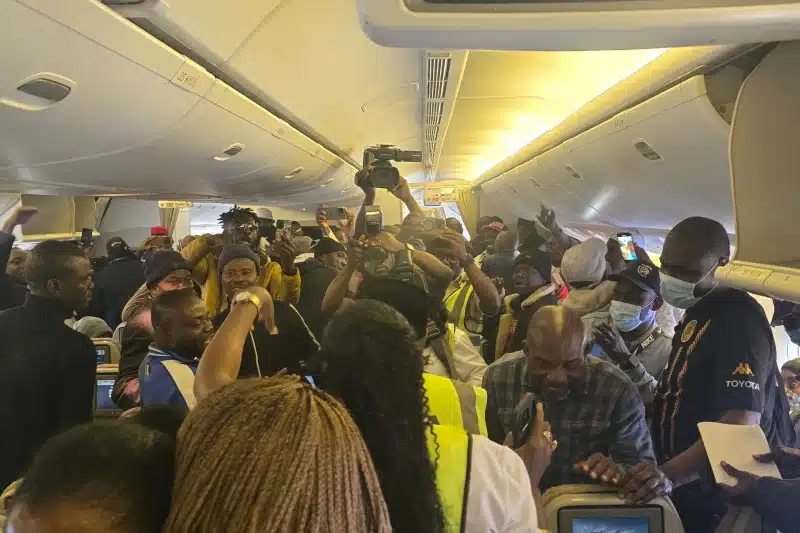

Nigeria has set a firm June 30 deadline to complete the Nigerian evacuation from South Africa, as the government warns it may move against major South African corporate interests operating on Nigerian soil if attacks on its citizens persist.
Foreign Affairs Minister Bianca Odumegwu-Ojukwu announced the deadline through a statement released by her Special Assistant on Communication and New Media, Magnus Eze, assuring that no willing returnee would be left behind. Officials say Nigerian evacuation from South Africa is being accelerated due to worsening security concerns.
The Nigerian evacuation from South Africa follows months of worsening violence by anti-migrant vigilante groups across several South African cities.
Violence behind Nigerian Evacuation from South Africa
In April and May 2026, a citizen-led movement known as March and March, which advocates more stringent immigration enforcement, organised demonstrations against undocumented migrants in major cities including Pretoria, Johannesburg and Durban, with violent and sometimes fatal results.
Vigilante groups reportedly targeted migrants across multiple cities, looting shops, breaking into homes and subjecting foreign nationals to intimidation and humiliation. The Nigerian evacuation from South Africa has become a central response to the escalating wave of anti-migrant violence.
The situation turned deadly for Nigerians specifically. The Nigerian Consul-General in Johannesburg, Ninikanwa Okey-Uche, confirmed that Amaramiro Emmanuel died from injuries allegedly sustained after being beaten by personnel of the South African National Defence Force on 20 April 2026. A second Nigerian, Ekpenyong Andrew, was arrested in Pretoria and later found dead at the Pretoria Central Mortuary.
An earlier advisory from Nigeria’s Consulate in Johannesburg, dated 22 April 2026, had already flagged unrest in East London, Cape Town, Durban and KwaZulu-Natal, including looting, property damage and injuries.
Evacuation already under way
The Nigerian evacuation from South Africa formally commenced when the first batch of 258 Nigerians was airlifted and received at the Murtala Muhammed International Airport, Lagos, on 11 June by the Minister of State for Foreign Affairs, Ambassador Sola Enikanolaiye.
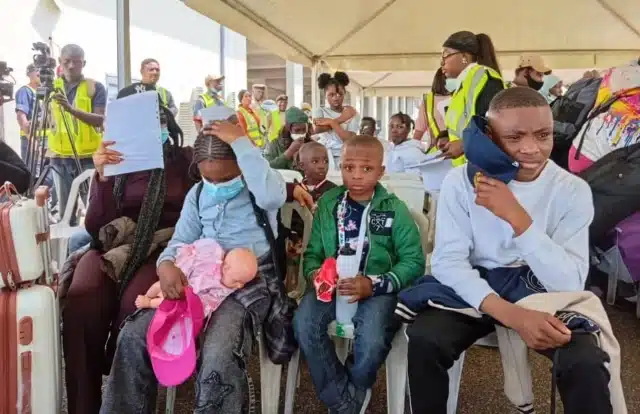
Around 1,000 Nigerians had registered for evacuation, with arrangements being finalised to airlift the remaining registrants before the June 30 deadline.
Nigeria is not alone in pulling its citizens out. Countries including Ghana, Malawi, Zimbabwe and Mozambique had also begun evacuating their nationals from South Africa over rising security concerns.
South Africa hosts more than three million foreign nationals, accounting for just over five per cent of its population, according to the country’s statistics agency. Unemployment exceeds 30 per cent, a figure that has long fuelled anger directed at migrant workers.
The MOU that was never activated
At the centre of Nigeria’s anger is a bilateral agreement that Abuja says Pretoria has effectively abandoned. South African authorities declined to activate a Memorandum of Understanding signed with Nigeria in October 2025 on an early warning mechanism intended to protect the lives and property of citizens of both countries during periods of tension.
South Africa later argued that those who signed the agreement on its behalf lacked the authority to make it binding and that additional procedures were required before it could take effect.
Odumegwu-Ojukwu said Nigeria would continue engaging South African authorities through diplomatic channels while the National Assembly would play a constitutional role in determining further steps should diplomacy fail.
South African firms placed on notice
The Nigerian evacuation from South Africa is now carrying an economic warning alongside it. The minister noted that more than 120 South African-owned businesses operate in Nigeria, including MTN, MultiChoice, Stanbic IBTC and Protea Hotels, without facing the kind of hostility that Nigerians reportedly encounter in South Africa.
Odumegwu-Ojukwu said South African businesses continue to operate freely in Nigeria while Nigerians in South Africa face increasing scrutiny and harassment, adding: “There are over 120 South African companies in Nigeria. Nobody is asking them to provide proof of identity before they can operate. Yet Nigerians in South Africa are being subjected to this treatment.”
The minister stated that any action taken by Nigeria would be guided by constitutional provisions and due legislative processes, and that the National Assembly would play a critical role in determining further steps should diplomatic efforts fail.
Senator Adams Oshiomhole had in May called for the revocation of licences of South African companies operating in Nigeria, including MTN and MultiChoice. That call has since gathered fresh momentum as the crisis deepened.
A legacy under strain
Odumegwu-Ojukwu did not hold back in assessing the broader damage to South Africa’s reputation. She invoked the legacy of Nelson Mandela, saying anti-migrant vigilante groups had “destroyed what this man sacrificed 28 years in prison for.
She also noted that the crisis was rippling through South Africa’s own social and economic life, pointing out that concerts were being cancelled and conferences called off.
The Nigerian evacuation from South Africa is set to be completed before the month ends. Whether it marks the close of a crisis or the opening of a longer diplomatic rupture between Africa’s two largest economies will depend on what happens in Pretoria in the days that remain.


