



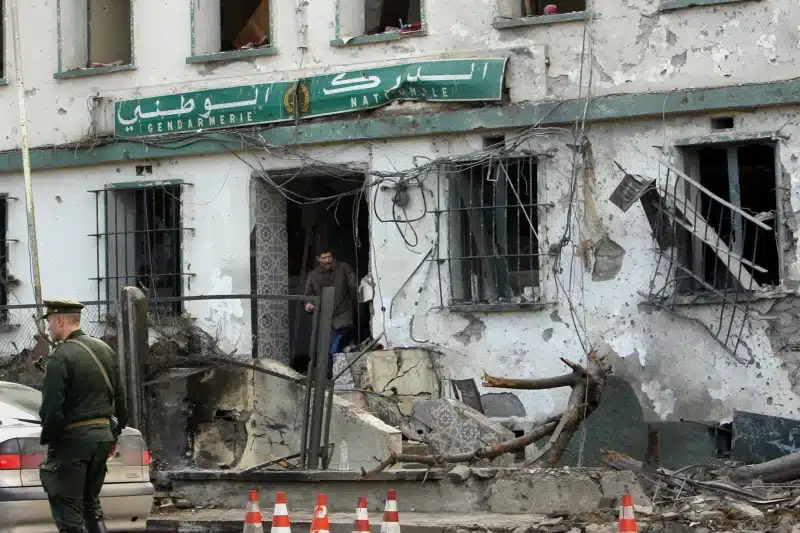

Two bombs. A papal visit. And a wall of official silence that stretched from Algiers to the African Union headquarters in Addis Ababa.
AfricanQuarters.co | Investigative Desk
BLIDA, Algeria – On the morning of 13 April 2026, two men strapped with explosive vests walked into the centre of Blida, a city of roughly 300,000 people situated about 45 kilometres southwest of Algiers, and detonated their devices within minutes and 250 metres of each other.
Both men died. Several civilians nearby were wounded.
And then, for the better part of two days, almost nothing was said.
No press statement from the Interior Ministry. No acknowledgement from the presidency. No official confirmation from police. The Algeria information blackout that followed the twin attacks in Blida was, by any measure, as deliberate as it was complete.
A City Centre, a Police Headquarters, and Two Vests
The first explosion occurred near a Puma retail store at the intersection of Boulevard Boudiaf and Rue Palestine, one of Blida’s central commercial corridors.
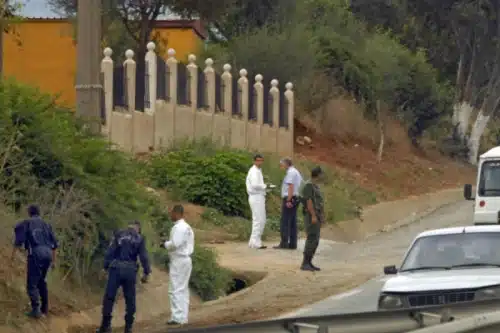
The second detonated roughly 250 metres away, at the perimeter wall of the Blida wilaya, the provincial police headquarters, near Rue Belkacem El-Ouzri.
Security analysts who reviewed available evidence noted that both devices went off prematurely. Neither attack succeeded in causing mass casualties. The failure pointed not to a sophisticated cell, but to poorly trained individuals operating without the backing of an organised network.
No militant group claimed responsibility. Investigators found no confirmed links to a wider organisation. Those familiar with the post-ISIS landscape in North Africa described the attackers as decentralised actors, the kind of lone-wolf profile that has become increasingly common across the Sahel and Maghreb since the territorial collapse of the Islamic State.
The operational damage, in other words, was minimal.
What followed, however, was anything but.
The Pope Lands. The Bombs Go Unacknowledged.
The date was not incidental.
13 April 2026 was the same day Pope Leo XIV touched down in Algiers for what was formally the first papal visit in Algeria’s history. The visit had been months in the preparation, a carefully managed event freighted with symbolism: a majority-Muslim nation welcoming the leader of the Roman Catholic Church, interfaith dialogue made visible on the world stage.
Algerian state media covered the arrival with extensive, celebratory reporting. Images of the Pope’s reception filled television screens and government-aligned newspaper front pages.
Meanwhile, footage of smoke rising from central Blida was beginning to circulate on social media, shared by residents who had witnessed the blasts firsthand.
The contrast was immediate and jarring.
Foreign journalists travelling with the papal delegation were, according to multiple accounts reviewed by this publication, entirely unaware of the explosions. When questions were raised, the Vatican declined to comment and referred all enquiries to Algerian authorities. Those authorities said nothing.
The Algeria information blackout was, at that point, fully in place.
Social Media Fills the Void
In the hours after the attacks, pro-government voices on Algerian social media moved quickly to shape the narrative.
Circulating video footage, some of which showed the immediate aftermath of the blasts, was dismissed as fabricated. Commentators loyal to the government characterised the clips variously as old recordings repurposed for political purposes, footage of unrelated gas explosions, or outright disinformation designed to embarrass Algeria during a moment of international prestige.
The tactic was effective domestically.
With no independent journalists on the ground to verify what had occurred, and with domestic media firmly aligned with official positions, the counter-narrative took hold within Algeria’s information ecosystem.
It was left to international news agencies to break through. The French news agency AFP, drawing on its own verification processes, independently confirmed the attacks approximately 24 hours after they occurred. The confirmation came not from official Algerian sources, but from the agency’s own reporting.
Beyond the 48-hour mark, Algerian authorities had still issued no formal statement.
The African Union Speaks. Then Deletes.
Perhaps the most telling episode in the entire affair played out not in Blida, but in Addis Ababa.
On 14 April 2026, the African Union issued a statement explicitly condemning what it described as “the double attack that occurred on April 13, 2026, in Blida.” The statement offered condolences to the injured and acknowledged the seriousness of the incident.
Within hours, the statement was gone.
The African Union subsequently offered an explanation: it had withdrawn the condemnation because there had been no official confirmation from Algerian authorities.
Political analysts who monitor continental affairs pointed to a less procedural explanation. Algeria is one of the African Union’s most significant financial contributors and has long exercised considerable influence within the organisation’s peace and security architecture. The deletion of the statement, those analysts argued, reflected the practical weight of that influence rather than a principled commitment to verification standards.
The episode illustrated, with unusual clarity, how this Algeria information blackout was capable of extending well beyond national borders.
Algeria’s Difficult History With Security Transparency
To understand Algeria Information Blackout, it helps to understand the context.
Algeria’s relationship with public disclosure around internal security has been shaped profoundly by the 1990s civil conflict, a decade-long war between the government and Islamist insurgents that killed an estimated 150,000 to 200,000 people, with some counts running considerably higher.
The state emerged from that period with a deeply embedded instinct for narrative control. Security incidents, in the official framing, are matters for security services, not public discussion.
That instinct has hardened further in recent years. Journalism researchers and press freedom organisations have documented a narrowing of space for independent reporting in Algeria since the early 2020s, with domestic outlets increasingly aligned with government positions on matters of security and political sensitivity.
The result is a media environment in which stories of the kind that unfolded in Blida are unlikely to be broken by Algerian journalists working inside the country.
The Algeria information blackout, in other words, is not an aberration. It reflects a structural condition.
Security Visible. Information Invisible.
There is a particular irony embedded in the timeline of events.
The papal visit was, by all accounts, one of the most heavily secured occasions in Algeria’s recent history. Intelligence services were on elevated alert. Movement routes for the delegation were tightly controlled. Security personnel were deployed extensively across Algiers and along the routes associated with the visit.
Yet two individuals were able to reach a central urban location in a major Algerian city and detonate explosive devices.
That operational failure might, in another political environment, have triggered immediate public accountability. In Algeria, it triggered silence.
The gap between the visible security presence and the complete absence of official information has, security observers note, done more damage to confidence in official narratives than the attacks themselves might have done, had they been acknowledged and addressed promptly.
A Pattern Across the Region
Algeria is not alone in this tendency, though it has pursued it with particular consistency.
Across North Africa and parts of the Sahel, governments have developed sophisticated mechanisms for managing the public presentation of security incidents, particularly those that occur during diplomatically sensitive periods. Selective disclosure, timed statements, and the exploitation of information vacuums are tools that multiple states in the region have reached for.
What distinguishes the Blida case is the scale of the attempt and the degree to which it was ultimately unsuccessful. Social media, international wire services, and the African Union’s own brief acknowledgement combined to ensure that the Algeria information blackout could not be sustained indefinitely.
The attacks were confirmed. The silence was noted. The deletion by the African Union became, itself, a news event.
What Blida Actually Tells Us
Stripped back to its operational reality, the Blida incident was a failed attack by undertrained actors with no confirmed organisational backing.
It did not mark the return of organised jihadist insurgency in Algeria. Security analysts are cautious about drawing that conclusion, and the evidence does not support it.
What it did reveal is a residual radicalisation threat. Small numbers of individuals, motivated by ideology and operating outside any formal structure, remain capable of attempting violence in Algeria’s urban centres. That threat is harder to detect than the networks Algeria spent years dismantling. It requires different tools, different intelligence, and a different kind of public communication to address.
On that last point, Algeria’s authorities chose a different path entirely.
The Algeria information blackout that surrounded the Blida bombings confirmed what many observers of the country’s governance have argued for years: that the state continues to treat security transparency as a risk to be managed rather than a public interest to be served.
The Digital Age Does Not Accommodate Silence
There is a closing irony worth stating plainly.
The Algerian government’s management of information around the Blida attacks was, by the standards of the 1990s, a reasonable strategy. In a pre-internet environment, controlled state media, a compliant domestic press, and international disinterest might have buried the story entirely.
In April 2026, it could not.
Residents filmed the aftermath on mobile phones. Those clips were uploaded, shared, and preserved before any official had the opportunity to intervene. AFP verified the attacks independently. The African Union’s own statement, before it was deleted, was captured and archived by observers tracking the situation in real time.
The Blida bombings were limited in their operational effect.
But the Algeria information blackout that surrounded them exposed something the bombs themselves could not: the widening gap between what governments in the region claim and what the world can now see for itself.
That gap is not closing. It is growing.
This report is based on verified open-source reporting, wire agency confirmation from AFP, documentation of the African Union’s statement and its subsequent deletion, and analysis of the incident’s security and media dimensions.


